
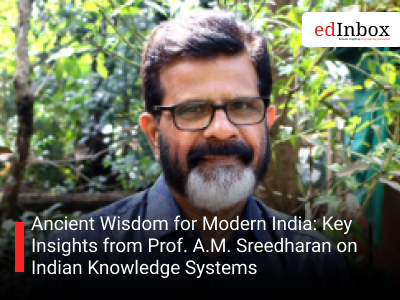
At a time when global challenges demand new thinking, Indian Knowledge Systems (IKS) offer time-tested solutions rooted in India's rich heritage. Prof. (Dr.) A.M. Sreedharan, Director of the Centre of Excellence in Indian Knowledge Systems (CoE IKS) at Alliance University, Bengaluru, and former Professor and Head of the Department of Malayalam at Kannur University, shares insights on blending ancient wisdom with modern needs. In this exclusive interview by Kanishka from Edinbox, he explains why IKS matters for students, professionals, and India's future under NEP 2020.
Q1: How do you define Indian Knowledge Systems in today’s academic context, and why is it important for modern India to revisit these knowledge traditions?
Prof. Sreedharan says: "Indian Knowledge Systems... refer to the vast and interconnected intellectual traditions that evolved in India over thousands of years, covering fields such as philosophy, arts, sciences, ecology, linguistics, governance, architecture, and medicine." He adds, "rather than viewing them as relics of the past, IKS today is understood as a living framework that offers alternative ways of thinking which are holistic, sustainable, ethical, and contextually rooted." On importance: "Revisiting these traditions... helps India articulate its own intellectual narrative while enriching global scholarship with diverse epistemologies."
Q2: Many students assume IKS is purely historical. Could you explain how IKS contributes to contemporary fields like technology, management, ecology, psychology, or architecture?
“Many students consider IKS entirely historical, but the reality is that its principles are deeply relevant to contemporary disciplines. In technology, concepts from Panini’s Ashtadhyayi influence modern computational linguistics and machine learning. Indian logic systems like Nyaya contribute to reasoning models and pattern structuring used in AI. In management, texts such as the Arthashastra provide frameworks for leadership, ethics, diplomacy, and economic governance. Ecological sciences draw from traditional water harvesting, biodiversity management, and sustainable agriculture practices. Indian psychology, shaped by the Gita, Yoga Sutras, and the Natyashastra, informs emotional regulation, motivation theory, and stress management. Architecture and design adopt vastu principles and indigenous materials for climate-friendly structures.”
Q3: What are some lesser-known but powerful examples from ancient Indian texts or practices that young learners should explore for practical insights?
Prof. Sreedharan recommends: "The Śulba Sūtras... present sophisticated geometric principles that predate many modern formulations." On farming: "Texts like Krishi-Parashara and Vrikshayurveda offer insights into sustainable farming, soil care, seed preservation, and climate adaptability." For health: "Ayurveda’s Dinacharya and Ritucharya highlight preventive health strategies that align with modern lifestyle management."
Q4: How can today’s students and working professionals integrate IKS methodologies, such as holistic thinking... into their academic or corporate projects?
“Students and professionals can integrate IKS by adopting holistic thinking, valuing context, and approaching problems through interconnected lenses. Indigenous research methodologies encourage fieldwork, oral histories, community engagement, and experiential learning via methods particularly effective in social sciences, anthropology, and ecology.” He further added,
“Frameworks such as the Panchakosha model provide holistic perspectives for health, wellbeing, and organisational behaviour. The Triguna concept offers a psychological lens to assess human tendencies and decision-making. Indian logic systems help structure arguments and refine critical thinking. Architecture students can refer to vastu-based spatial harmony; designers can draw from traditional aesthetic theories; managers can integrate Gita-based leadership values; and corporate sectors can embed yoga and mindfulness into wellness programs.” Prof. Sreedharan also emphasized, “the essence lies in using IKS not as a decorative add-on but as a functional tool in real-world problem-solving.”
Q5: IKS often requires interdisciplinary understanding. Which subjects or skill sets should students prioritise to build a strong foundation in this domain?
“A strong foundation in IKS requires an interdisciplinary mindset, as the domain bridges humanities, sciences, and creative disciplines. Students benefit from introductory exposure to Indian philosophical systems, especially darshanas like Nyaya, Samkhya, and Vedanta, as these form the conceptual backbone of Indian epistemology. Basic familiarity with Sanskrit or classical regional languages helps engage with primary texts and commentaries.” He explained further, “research skills like qualitative techniques, field immersion, documentation, and comparative analysis are essential. Equally important are creativity, cultural literacy, ethical awareness, and the ability to synthesise ideas across domains. A grounding in subjects like history of science, aesthetics, ecology, psychology, linguistics, and heritage studies helps students place IKS within the larger global intellectual context.”
Q6: How are universities in India currently using IKS-based approaches, and what future opportunities do you foresee?
"Under NEP 2020, higher education institutions are introducing courses on Indian philosophy, traditional sciences, arts, and society," he observes. "The future demands professionals who can merge traditional wisdom with cutting-edge technologies and global standards."
Q7: Many learners worry about career clarity. What career pathways can emerge from studying Indian Knowledge Systems?
"IKS opens multiple career possibilities within and beyond academia," highlights Prof. Sreedharan. "In academic settings, one may become a researcher, educator, manuscript specialist, conservator, linguist, or cultural historian. Interdisciplinary roles include psychologists drawing from yoga and Indian mental models, architects using Vastu, environmental scientists specialising in traditional ecological knowledge, and performing arts scholars exploring classical frameworks." He adds: "Outside academia, IKS supports careers in heritage tourism, museum curation, traditional arts entrepreneurship, wellness industries, yoga therapy, nutrition, corporate leadership training, policy consulting, and sustainable rural development. With digital humanities expanding rapidly, new roles emerge in data-driven cultural studies, digital archiving, and AI-assisted knowledge mapping. Thus, IKS is not a narrow field but a platform for diverse and meaningful career outcomes."
Q8: With the rise of AI and digital humanities, how can technology support the preservation of India’s traditional knowledge?
"AI and digital humanities are transforming how IKS is preserved and disseminated. Modern OCR engines are now capable of reading Sanskrit and regional scripts," explains Prof. Sreedharan. "Technology thus becomes a bridge reviving ancient wisdom while enabling its reinterpretation for modern research, policy, and innovation," he added.
The insight by Prof. Sreedharan has shown how IKS under NEP-2020 is the intersecting point, marrying ancient smarts with AI, green technologies, and jobs for millions. Students blending holistic thinking with modern skills lead sustained growth, cultural pride, and global innovation. Thus, students, researchers and professionals can find some great research topics and solutions to modern challenges by integrating the Indian Knowledge System in their brainstorming sessions.
Ancient Wisdom for Modern India: Key Insights from Prof. A.M. Sreedharan on Indian Knowledge Systems
Typography
- Smaller Small Medium Big Bigger
- Default Helvetica Segoe Georgia Times
- Reading Mode