
In an exclusive conversation with Edinbox Editorial Head Nibedita on the relevance and revival of the Indian Knowledge System (IKS), West Bengal Education Minister Bratya Basu reflected on how India’s ancient intellectual traditions can meaningfully shape modern education.
According to him, the real challenge today is not a lack of knowledge, but a lack of structured integration. “We definitely need to understand modern science in global frameworks,” he said. “What we need is a balanced fusion where students can learn Newton and Aryabhata, molecular biology and Sushruta, governance and Kautilya, not as competing ideas but as complementary streams.” With a touch of humour, the minister added, “Had we paid attention in our classes, we would remember these names. We wouldn’t need a separate subject just to remind us.”The minister also admitted that IKS has become a politically charged subject in recent years. However, he insisted that knowledge must rise above ideological divides. “A civilisation that produced breakthroughs centuries before the West deserves academic recognition,” he said. “But revival must be rigorous, research-driven, and historically accurate. Romanticism has no place in serious education reforms.” Basu advocated for peer-reviewed scholarship, multilingual translations of classical texts, and training teachers to avoid superficial or tokenistic implementation.
“Universities must not treat IKS as a decorative elective. It should contribute to inquiry, innovation, and identity,” he noted, adding that Bengal with its legacy of reformers, scientists, and Renaissance thinkers has a natural advantage in leading this movement.
Basu also stressed that students respond positively when IKS is taught as applied knowledge. Examples like ancient water management models, musical mathematics, traditional architecture, early ecological wisdom, and logic systems enrich their understanding. “Education must give students confidence that India has been a contributor to global knowledge—not just a consumer.”When asked about global perception, Basu believed that India has an opportunity to position itself as a knowledge leader again. “Countries are looking for diverse epistemologies. Yoga, Ayurveda, classical literature, they have already found global homes. Now it’s time for our scientific and philosophical heritage to receive international academic legitimacy.”
Closing the conversation, he underscored that the goal is not to look backward but to move forward with cultural self-assurance. “IKS is a reminder that our past is not a burden; it is an asset. If we integrate it wisely, we can build an education system that is modern, rooted, and globally respected.”
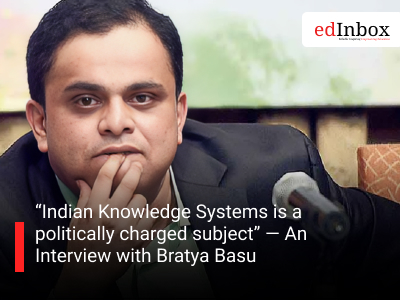
“Indian Knowledge Systems is a politically charged subject” — An Interview with Bratya Basu
Typography
- Smaller Small Medium Big Bigger
- Default Helvetica Segoe Georgia Times
- Reading Mode