
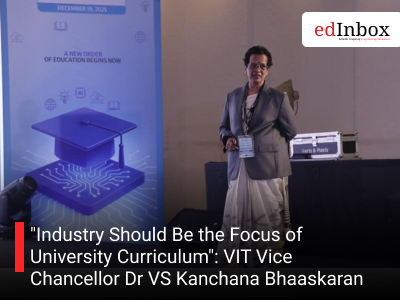
Addressing the HT Future Ed Conclave, Dr VS Kanchana Bhaaskaran, Vice Chancellor of Vellore Institute of Technology, made a strong case for the urgent need to reimagine university education, as the new technology-led future requires industry needs to drive curriculum design. An interaction with her underlined rapid technological disruptions, an increasing skill gap, and changing needs of industry push universities to rethink their role in the innovation ecosystem of India.
Dr Bhaaskaran said universities can no longer afford to function in isolation from industry. “We are witnessing rapid technological disruptions and severe skill gaps. Universities must be spurring nodes in the national innovation and industrial ecosystem,” she said, adding that higher education must move away from rigid structures towards flexible, learner-centric models.
In Dr Bhaaskaran's view, the future university would have to provide multidisciplinary pathways, permit students to tailor learning journeys, and go for competency-based assessments. "Institutions must turn flexible and student-centric-learners may want to choose pathways across disciplines and be evaluated on skills, and not just examinations," she explained.
The VIT Vice Chancellor also spoke about the need for industry-designed education, and co-creation of dynamic curricula involving the industry. “Curricula should be revisited every year and reworked according to industry demand. Autonomous institutes should be able to do this; industry professionals should be part of the advisory boards.” She also said students should work on real-world technology problems for 50–60% of their academic time to bridge the gap between what they learn in class and what the industry is looking for.
Dr Bhaaskaran said VIT had already moving ahead by adopting innovative curriculum frameworks, comprising core subjects, professional core courses, electives, soft skills, and multidisciplinary options. “For countries like India, both quality and quantity consciousness is critical at scale. We need models that can deliver excellence while educating large numbers,” she said.
She presented a phased implementation roadmap supported by policy enablers. “The first phase comprises the upgrade of IT infrastructure, followed by comprehensive faculty training. The next phase introduces flexible curricula with active industry participation—from laboratories to classroom teaching,” she said, underscoring the importance of institutional readiness.
Q: How much does research and AI contribute to the reform of higher education?
Dr Bhaaskaran adds that research and innovation have broadened national impact, especially in new areas like artificial intelligence. “AI applications are now attempted in curriculum design, content creation, adaptive learning, and automated assessments. We see incentives for teaching innovations, mission-oriented research clusters, and industry-funded labs improving the student outcome,” she described.
Sharing a real-life example, she said, “We developed a new lab at our institute and sent out a mail. Within 24 hours, over 1,000 students responded. That shows how eager students are for hands-on, industry-aligned training.” She emphasized that the ultimate aim should be to create a meeting point between industry and institutions.
Q: Are these reforms showing measurable outcomes?
The results, according to Dr Bhaaskaran, are already there to be seen. She quoted the student employability index, portfolio development, startups and incubation projects, patents, industry joint innovations, faculty industry sabbaticals, co-authored research publications, product releases, joint laboratories and centres of excellence as proof of success.
Q: How far do government initiatives facilitate this change?
She added that much of this growth has been enabled by government missions and initiatives, especially in domains such as AI, semiconductors, and CPS. “Institutions must align with student interest in these domains, which are already large industries and are growing rapidly,” she concluded, saying industry-focused curriculum reform was no longer optional but rather essential to the future of higher education in India.
Industry Should Be the Focus of University Curriculum": VIT Vice Chancellor Dr VS Kanchana Bhaaskaran
Typography
- Smaller Small Medium Big Bigger
- Default Helvetica Segoe Georgia Times
- Reading Mode