
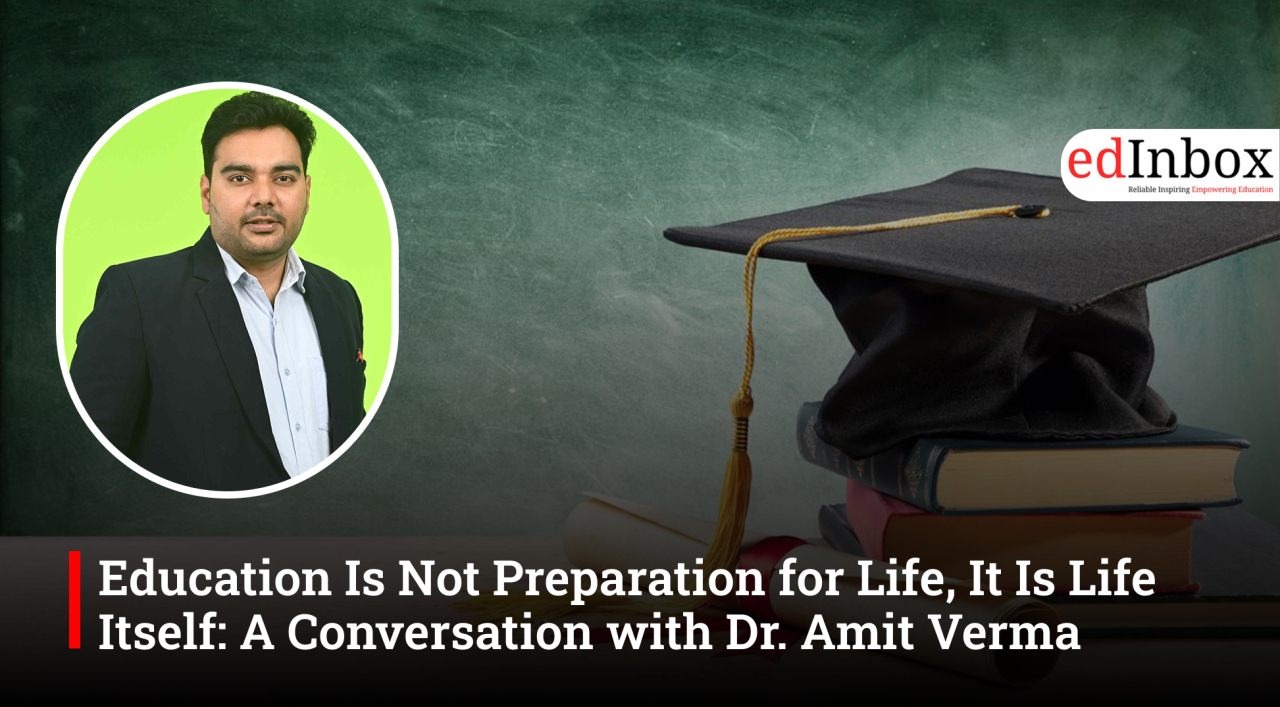
In wide-ranging conversation, with Edinbox Communication PR Head Pooja Khanna, Associate Professor of Journalism and Mass Communication and Assistant Registrar (Helpdesk) at the Centre for Distance and Online Education, Manipal University Jaipur. Dr. Amit Verma reflects on misconceptions around career success, the gaps between education and industry, the growing importance of human skills in the age of AI, and the responsibility of education media platforms.
Besides being the Vice Chair of the Participatory Communication Research (PCR) section of the International Association for Media and Communication Research (IAMCR), Dr. Verma is the Editor in Chief of two international peer-reviewed journals, Journal of Communications and Management and Health and Humanities. Over the course of his twelve years of academic and professional career, he has created five MOOCs for the SWAYAM platform, published more than thirty, five research articles, written five books, and been awarded seven Indian patents. His works cover media literacy, community media, digital communication, and participatory social empowerment practices.
Q.1 From your experience working closely with students and institutions, what do you
think is the biggest misconception students have about building a successful career
today?
Answer: One of the biggest misconceptions I see among students is the belief that a degree
alone guarantees success. Many students assume that once they enroll in a reputed institution
or complete a professional course, their career will automatically fall into place. In reality, a degree is only a starting point, not the destination. Another misconception is that success
comes quickly. Social media has created an illusion of overnight achievements, which makes
students are impatient with the learning process. Careers, especially in media and communication, grow through consistent effort, experimentation, failures, and self-reflection.
Students often underestimate the value of curiosity, adaptability, and long-term commitment.
I also feel that many students focus too much on job titles rather than skills. They chase designations without understanding what competencies those roles require. A successful
career today is built by continuously learning, unlearning, and relearning not by following a
fixed formula.
Q.2 Education is often described as “industry-driven,” yet many graduates still feel
unprepared. Where do you believe the real disconnect lies?
Answer: The disconnect does not lie in intent but in execution. Institutions genuinely want to
align education with industry needs, but the challenge is that industries evolve faster than
academic systems. By the time after introducing National Educational Policy 2020 all
curriculums are revised and implemented, the industry may have already moved ahead.
Another major issue is the limited exposure students get to real-world problem-solving. Many
programs emphasize theory without sufficiently integrating practice, reflection, and
application. Industry readiness is not only about technical knowledge; it is also about
understanding workplace culture, teamwork, communication, and decision-making under
pressure. Additionally, students are rarely trained to think independently. They are taught
what to think, not how to think. When graduates enter the professional world, they struggle
because real workplaces demand initiative, adaptability, and critical judgment skills that
cannot be memorized from textbooks.
Q.3 You’ve seen education from multiple angles. What changes in the system are urgent,
not optional, if we truly want student outcomes to improve?
Answer: One urgent change is shifting the focus from content delivery to learner engagement.
Education should move beyond lectures and exams to include discussion, reflection, project-
based learning, and mentorship. Students must be active participants, not passive receivers.
Second, assessment methods need serious reform. Marks and grades should not be the sole
measure of learning. Portfolios, practical projects, community work, and internships should
carry real academic value. Third, we must invest in faculty development. Teachers need
continuous training not only in subject knowledge but also in digital tools, pedagogy, and
student psychology. A strong education system depends on empowered educators. Finally,
institutions must create safe spaces for failure. Students should be encouraged to experiment
without fear. Learning improves when mistakes are treated as part of growth, not as
weaknesses.
Q.4 In a time when AI and digital tools are everywhere, what human skills do you
believe will matter more, not less, for students?
Answer: As technology advances, human skills become even more important. Critical
thinking is at the top of that list. Students must learn how to question information, verify
sources, and make ethical judgments especially in a time of misinformation and algorithm-
driven content. Communication skills will also matter more than ever. The ability to express
ideas clearly, listen actively, and engage respectfully across cultures cannot be replaced by
machines. Empathy is another key skill. Whether in media, education, or any profession,
Understanding human emotions and social realities is essential. Technology can process data,
but it cannot replace human sensitivity. Lastly, adaptability and emotional resilience will
define successful professionals. Change is constant, and students who can manage
uncertainty with confidence will thrive in any environment.
Q.5 How important is honest communication in education, and how can platforms like
Edinbox maintain credibility while working with institutions?
Answer: Honest communication is the foundation of trust in education. Students and parents
make life-shaping decisions based on the information they receive. If that information is
exaggerated or misleading, the consequences can be long-lasting. Platforms like Edinbox
play a crucial role as bridges between institutions and learners. To maintain credibility, they
must prioritize transparency over promotion. This means presenting both strengths and
limitations of institutions, courses, and career paths. Credibility is built when platforms ask
critical questions, verify claims, and focus on student interests rather than marketing
narratives. Long-term trust is far more valuable than short-term visibility.
Q.6 Students are overwhelmed with choices, rankings, and advice. From your
perspective, how should they filter what actually deserves their attention?
Answer: Students should begin by understanding themselves before looking outward. Instead
of chasing rankings or trends, they should ask: What am I genuinely interested in? What
What kind of work energizes me? Rankings and reviews can be referencing points, but they are referencing the deciding factor. Students must look deeper at curriculum relevance, faculty engagement, learning support, and opportunities for practical exposure. I also advise students
to limit the number of voices they listen to. Too much advice creates confusion. A few trusted
mentors, combined with self-reflection, are far more effective than endless online opinions.
Q7. As an academic leader and administrator, what subtle but impactful challenges
have you encountered in your professional journey, and how have you addressed them?
Answer: In my journey as an academic and administrator, some of the most impactful
challenges were not always visible or openly discussed. One such challenge was balancing
multiple roles teaching, research, administration, and student support without allowing any
one responsibility to suffer. This often-required long hours, careful prioritization, and the
ability to make difficult decisions. Another subtle challenge was managing expectations from
different stakeholders. Students, faculty members, and institutional leadership often have
varying perspectives and priorities. Navigating these differences demanded patience, clear
communication, and a strong sense of fairness. Many times, leadership is less about authority
and more about listening, mediating, and building consensus. There was also the challenge of
change management. Introducing new systems, digital processes, or learner-centric
approaches is not always immediately accepted. Resistance to change can slow progress. I
addressed this by focusing on dialogue, explaining the purpose behind decisions, and
involving colleagues and students in the process. Overall, I believe these challenges
strengthened my leadership approach. They taught me the importance of empathy,
transparency, and consistency. Leadership in education is not about visibility or position; it is
about responsibility, trust, and the ability to serve the academic community with integrity.
Q.8 What role do storytelling and real-world narratives play in helping students make
better academic and career decisions?
Answer: Storytelling makes education relatable. When students hear real stories of struggles,
failures, and gradual success they gain a realistic understanding of career paths. This is far
more powerful than idealized success stories. Real-world narratives help students see that
careers are non-linear. They learn that uncertainty is normal and that growth often comes
from unexpected directions. Stories humanize learning and reduce fear. In media education
especially, storytelling builds connection and critical awareness. It helps students understand
society, culture, and responsibility beyond textbooks.
Q.9 Looking ahead, what kind of conversations should education media portals lead to
stay relevant and responsible?
Answer: Education media portals should move beyond rankings and admissions-focused
content. They need to lead conversations on learning quality, mental well-being, digital
ethics, media literacy, and employability in a changing world. They should highlight diverse
learning journeys, not just elite success stories. Voices from rural, marginalized, and non-
traditional learners deserve space and visibility. Most importantly, education portals must
encourage dialogue not just consumption. Responsible platforms should help learners think,
question, and engage meaningfully with education.
Q.10 If you had to offer one piece of advice that students rarely hear but truly need,
what would it be?
Answer: My advice would be this Do not rush to become successful; focus on becoming
capable. Success follows capability, not the other way around. Take time to understand
yourself, build strong foundations, and develop habits of learning. Do not compare your
journey with others everyone’s path is different. In a fast-moving world, patience, integrity,
and continuous growth are rare but powerful qualities. Students who cultivate these will not
only build careers but also meaningful lives. I would like to conclude this discussion with a
thought that strongly resonates with my understanding of education today. As John Dewey,
one of the most influential thinkers on learning, rightly observed:
“Education is not preparation for life; education is life itself.” (Dewey, 1916)
This quote reminds us that education is not merely about degrees, jobs, or rankings, but about
shaping thoughtful, responsible, and engaged individuals who can contribute meaningfully to
society.
Education Is Not Preparation for Life, It Is Life Itself: A Conversation with Dr. Amit Verma
Typography
- Smaller Small Medium Big Bigger
- Default Helvetica Segoe Georgia Times
- Reading Mode