
As Shantanu Narayen prepares to step down after nearly two decades at the helm of Adobe, his journey offers more than just a leadership timeline—it reflects the evolution of global technology itself. From the classrooms of Hyderabad Public School and Osmania University to the innovation corridors of University of California Berkeley, Narayen’s path mirrors the rise of India-born leaders shaping Silicon Valley. In this conversation-style profile, we trace how a strong academic foundation, strategic risk-taking, and an eye for technological shifts helped him transform Adobe from a traditional software company into a cloud and AI-driven powerhouse.
Q: You began your journey in Hyderabad. How did your early education shape you?
Shantanu Narayen: I grew up in Hyderabad and studied at the Hyderabad Public School. It was an environment that encouraged curiosity and discipline. Interestingly, the school has produced several global leaders, including Satya Nadella and Ajay Banga. That ecosystem played a subtle but important role in shaping ambition.
Q: What drew you towards engineering at Osmania University?
Narayen: I pursued Electronics and Communication Engineering at Osmania University, graduating in 1981. At that time, India’s tech ecosystem was still evolving, but the fundamentals—circuits, communication systems, signal processing—gave me a strong technical base that stayed relevant throughout my career.
Q: You moved to the United States soon after. What motivated that decision?
Narayen: I wanted deeper exposure to computing. I went to Bowling Green State University for a Master’s in Computer Science, which I completed in 1986. That period was transformative because computing was becoming central to everything.
Q: Your early career included stints at major tech firms. What did you learn there?
Narayen: I started in Silicon Valley with startups like Measurex, then moved to Apple and later Silicon Graphics. These roles helped me understand product thinking, innovation cycles, and how technology companies scale.
Q: You also ventured into entrepreneurship. Tell us about that phase.
Narayen: In 1996, I co-founded Pictra, a digital photo-sharing startup. It gave me first-hand experience of building something from scratch—understanding customers, product-market fit, and the realities of running a business.
Q: Why did you decide to pursue an MBA later in your career?
Narayen: I felt the need to complement my technical knowledge with business acumen. I earned my MBA from the UC Berkeley Haas School of Business in 1993. It broadened my perspective on leadership, strategy, and organisational growth.
Q: Your journey at Adobe is often seen as transformational. How did it begin?
Narayen: I joined Adobe in 1998 as Senior Vice President of Worldwide Product Development. Over time, I became COO in 2005 and CEO in 2007.
Q: One of your biggest decisions was shifting Adobe’s business model. What drove that?
Narayen: The move from boxed software to a cloud-based subscription model was about staying ahead of change. Customers wanted flexibility, continuous updates, and integrated ecosystems. That shift defined Adobe’s future.
Q: How are you navigating the current wave of AI disruption?
Narayen: AI is reshaping creativity. At Adobe, we’ve integrated generative AI tools like Firefly into our ecosystem. It’s about empowering creators, not replacing them.
Q: You’ve announced plans to step down as CEO. What’s next?
Narayen: After nearly two decades as CEO, I will transition once a successor is appointed, while continuing as Chair. It’s a natural evolution, especially at a time when the industry is undergoing rapid AI-driven change.
Q: Looking back, what defines your journey the most?
Narayen: Continuous learning—from Hyderabad to Silicon Valley, from engineering to business, and from products to platforms. Adaptability has been the key.
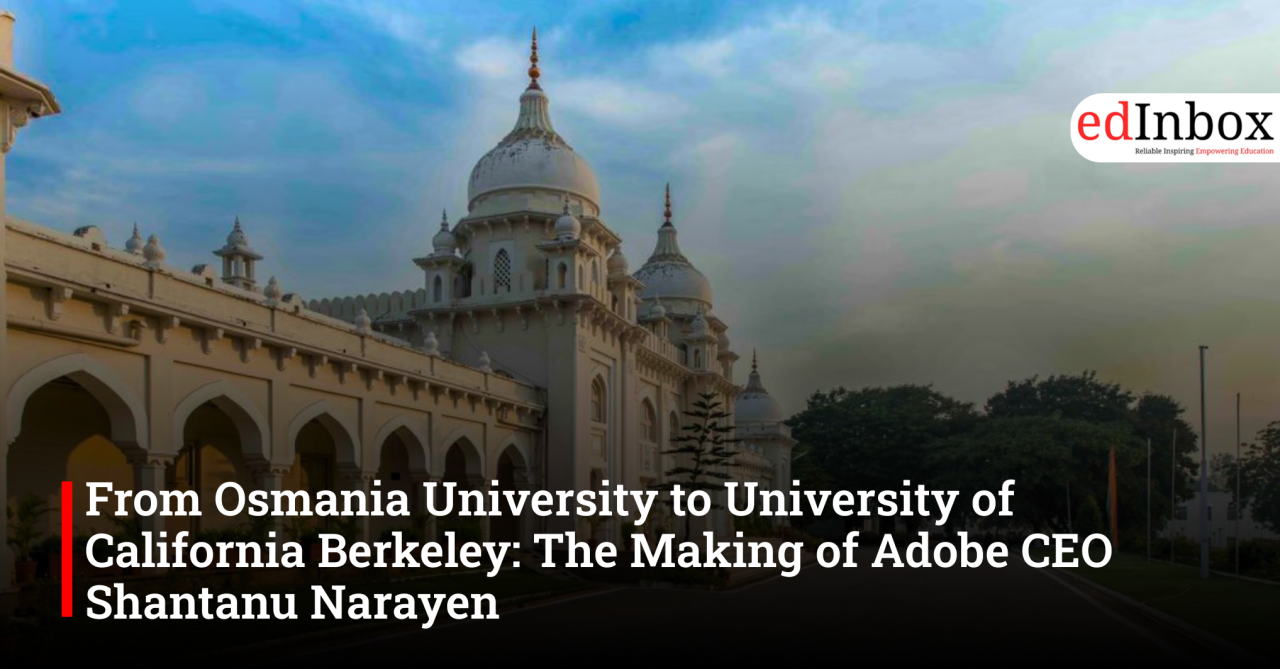
From Osmania University to University of California Berkeley: The Making of Adobe CEO Shantanu Narayen
Typography
- Smaller Small Medium Big Bigger
- Default Helvetica Segoe Georgia Times
- Reading Mode