
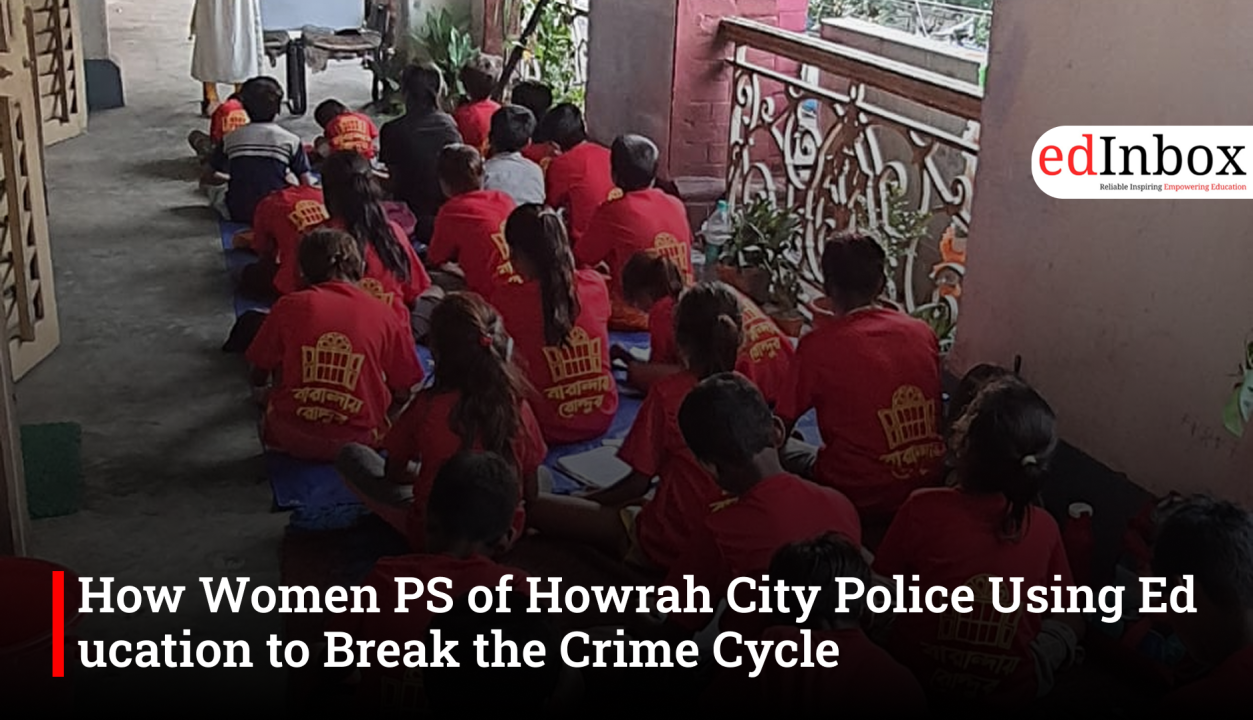
Every afternoon, sunlight spills across the balcony of the Women’s Police Station in Howrah. By 4 pm, it is no longer a corridor of authority but a classroom, lined with notebooks, chalk dust, and children who once slept on railway platforms. For them, this balcony is not just a place of learning. It is where the Indian Constitution finally found them.
The initiative, called “Barandaye Roddur” (Sunshine on the Balcony), began in March 2024 with 25 children. Today, it reaches 71 first-generation learners, many of whom had fallen out of the education system during the COVID-19 pandemic. Run by the Women’s Police Station under Howrah City Police, the programme is an unusual but powerful assertion of a basic human right: every child’s right to education.
According to UNICEF, India has nearly 6 million out-of-school children, with urban poverty, migration, and pandemic disruptions pushing thousands permanently out of classrooms. Data from ASER 2023 shows that learning loss among children from low-income households has been the sharpest, particularly in reading and basic numeracy. These gaps are not academic failures; they are right failures.
The children at Barandaye Roddur used to be ragpickers, platform dwellers, slum residents and among those most likely to be left behind. Many had attended primary school before COVID-19 shut classrooms and cut mid-day meals. As families slipped deeper into poverty, education became expendable. By the time schools reopened, children had aged out, lost routine, or been absorbed into survival labour.
“Once a child remains out of school for two or three years, the system quietly gives up on them,” says Inspector-in-Charge Kakali Ghosh Kundu, who leads the programme. “We refused to.”
The idea was simple but radical: if children could not return to school, the school would come to them—even if that meant a police station verandah. What began as informal teaching has now evolved into a structured, rights-based intervention. Trained teachers are appointed and paid, learning outcomes are reviewed regularly, and logistics—from books to meals—are institutionally supported.
“We are not running a charity class,” said Howrah Police Commissioner Akash Magharia. “This is an investment in crime prevention through education. When the state fails to educate a child, it later pays through the criminal justice system.”
The police identify vulnerable children during patrols near railway stations, ghats, and informal settlements—areas identified by child rights groups as high-risk zones for trafficking, child labour, and substance abuse. Instead of criminalising survival behaviours, officers intervene with trust, routine, and learning.
The results are measurable. All enrolled children are now formally admitted to government schools, a critical step toward restoring their constitutional rights under the Right of Children to Free and Compulsory Education Act, 2009. NGOs, local institutions, and alumni from government schools and St. Xavier’s College, Kolkata, support the transition as mentors and resource persons.
Education here extends beyond textbooks. Children receive regular health check-ups, hot meals, and access to yoga, dance, and vocational exposure. In 2026, several students performed at the Kolkata International Book Fair,once invisible children now visible on a public stage.
Globally, rights experts argue that education is the strongest long-term crime prevention tool. UNESCO estimates that every additional year of schooling reduces the likelihood of youth involvement in violent crime by nearly 20 per cent. Barandaye Roddur operationalizes that insight at ground level.
In a city still recovering from pandemic-induced inequality, this sunlit balcony offers a quiet lesson in governance: human rights do not need grand buildings,only political will, institutional accountability, and the courage to see children not as future offenders, but as rights-bearing citizens.
As chalk scrapes against the blackboard and children repeat the alphabet in unison, the message is unmistakable. This is not policing softened by compassion. This is the State fulfilling its most fundamental promise,one child, one lesson, one reclaimed future at a time.
How Women PS of Howrah City Police Using Education to Break the Crime Cycle
Typography
- Smaller Small Medium Big Bigger
- Default Helvetica Segoe Georgia Times
- Reading Mode