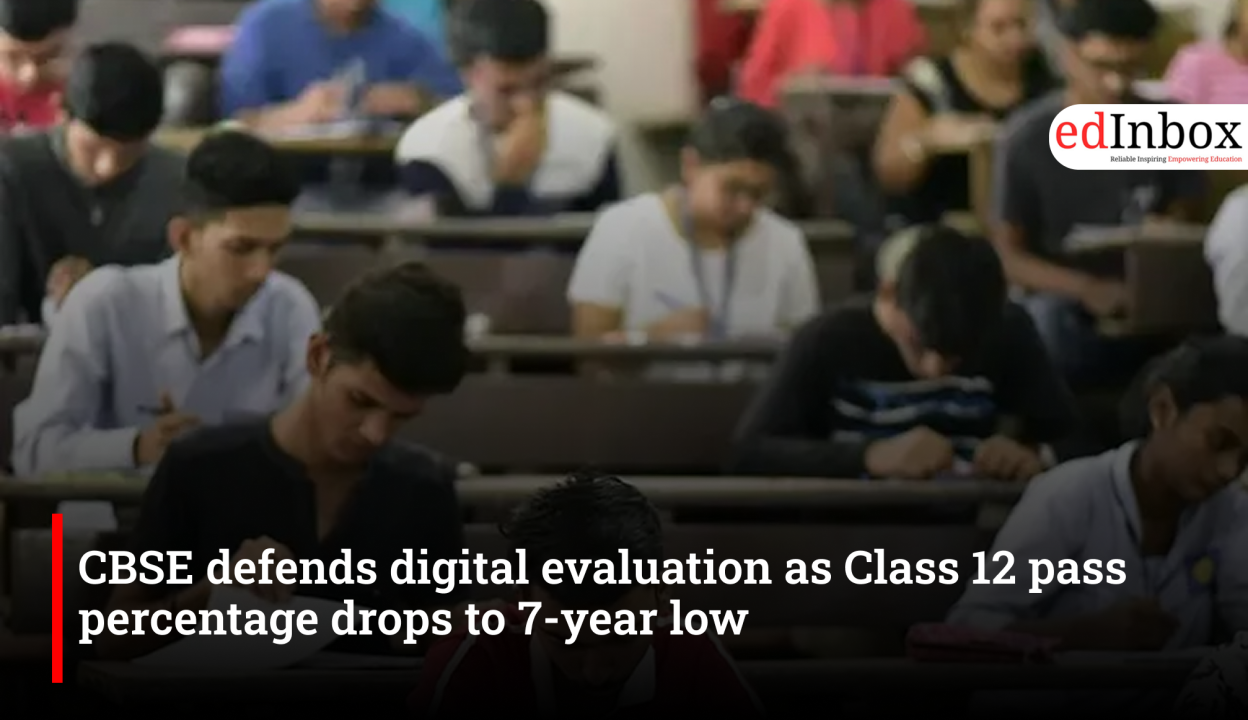
Central Board of Secondary Education has defended its newly implemented digital evaluation process after the 2026 Class 12 board examination results recorded the lowest pass percentage in seven years.
The overall pass percentage fell to 85.20%, a decline of 3.19 percentage points from last year, affecting more than 1.77 million students across India.
The sharp drop has triggered widespread concern among students, parents, and educators — especially in science streams — with many blaming the board’s new On-Screen Marking (OSM) system for unexpectedly low scores.
What changed this year?
For the first time at full national scale, CBSE implemented the On-Screen Marking system, under which:
Physical answer sheets were scanned digitally
Examiners evaluated scripts online instead of handling paper copies
Marking schemes were integrated into the software
Totalling and tabulation became automated
CBSE says the system was introduced to improve:
Transparency
Accuracy
Standardisation
Monitoring of evaluators
The reform aligns with broader education changes under National Education Policy 2020, which emphasises competency-based assessment over rote memorisation.
Students allege unfair marking and technical problems
Soon after results were declared, thousands of students voiced frustration on social media, claiming their marks were significantly lower than:
School assessments
Pre-board examinations
Competitive exam performance
Many students specifically pointed to declines in:
Physics
Chemistry
Mathematics
Some alleged problems included:
Diagrams not being evaluated properly
Scanned pages appearing blurred or faint
Margin work being ignored
Stepwise calculations not receiving partial marks
Difficulties reading light handwriting on screen
Teachers and evaluators also reportedly raised concerns about:
Server crashes during evaluation
Limited examiner training
Tight deadlines
Variable scan quality
For students targeting institutions such as the Indian Institutes of Technology and National Institutes of Technology, the lower scores have created anxiety over admission cut-offs and eligibility requirements.
CBSE says OSM improves fairness
CBSE has strongly defended the new system, arguing that digital evaluation reduces human error and increases consistency across examiners.
According to board officials, OSM:
Eliminates totalling mistakes
Tracks marking patterns
Ensures adherence to standard marking schemes
Prevents manipulation or moderation inconsistencies
The board has also emphasised that the tougher competency-based question patterns introduced under NEP 2020 contributed to lower scores, especially in analytical subjects.
Some education experts believe the removal of informal moderation practices may have reduced the advantage previously enjoyed by borderline students.
Re-evaluation and grievance process announced
In response to growing backlash, CBSE has opened a structured grievance redressal and re-evaluation process.
Students can:
Request scanned copies of evaluated answer sheets from May 19–22
Verify marking and scan quality
Apply for re-evaluation between May 26–29
The board has advised students to compare:
Awarded marks
Official marking schemes
Answer sheet scans
CBSE stated that corrective action would be taken if discrepancies are identified during review.
Educators divided over the impact
The result decline has exposed a divide among educators.
Critics argue:
The digital transition was implemented too quickly
Science papers were unusually difficult
Teachers and evaluators were insufficiently trained
Supporters of OSM, however, say the system modernises evaluation and reduces subjective marking inconsistencies.
Many experts believe results may stabilise over the next few years as schools adapt teaching methods to digital assessment standards.
Teachers are increasingly advising students to:
Write more clearly
Structure answers stepwise
Label diagrams properly
Avoid faint handwriting
Present calculations systematically
Bigger shift in India’s assessment culture
The controversy reflects a broader transformation underway in India’s education system.
As boards move toward competency-based learning and digital evaluation, students are being tested not only on content knowledge but also on presentation, analytical reasoning, and structured problem-solving.
The 2026 CBSE results may ultimately become a turning point in how Indian board examinations are taught, written, and assessed in the coming decade.