
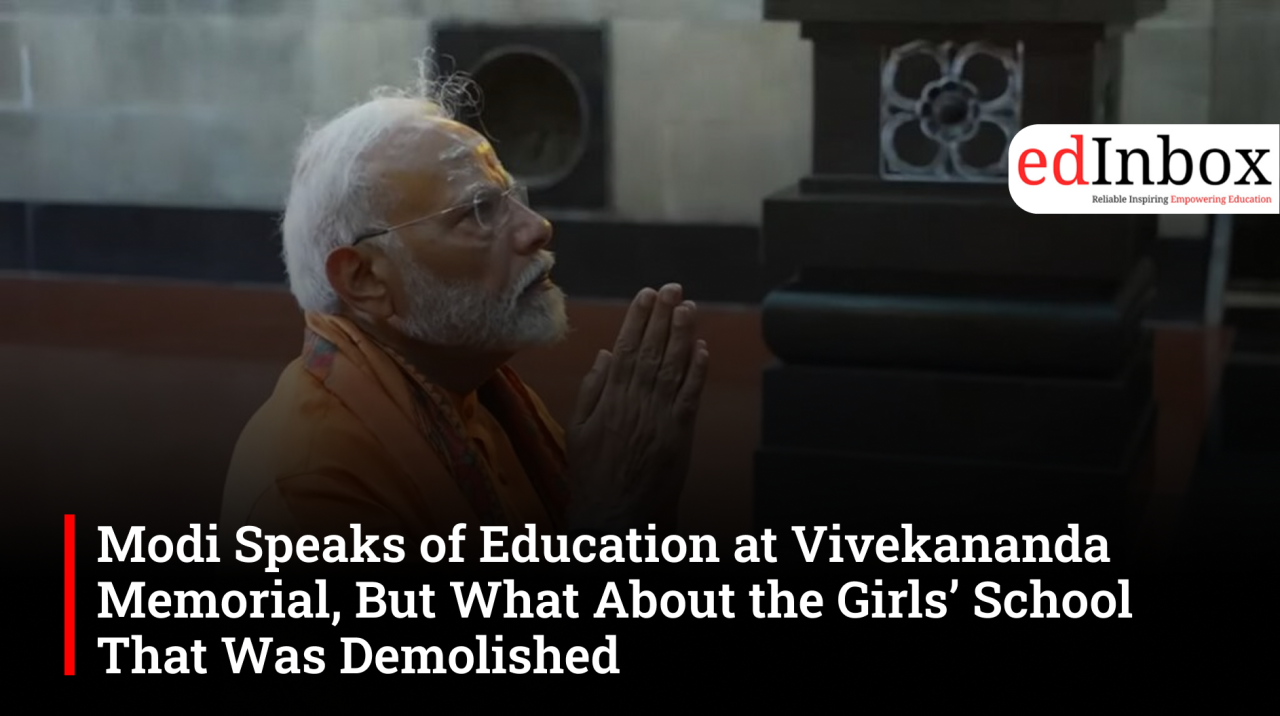
Prime Minister Narendra Modi recently spoke about the power of education and nation-building while inaugurating the Swami Vivekananda Cultural Youth Centre in Mysuru.
“Friends, Swami Vivekananda believed that educating the youth was the ultimate foundation for nation-building,” he said at the event.
The words were fitting for a memorial dedicated to a man whose life and philosophy were deeply connected with education, youth and the awakening of human potential.
But there was one history beneath those words that remained unspoken.
The memorial now stands on the site of the historic NTM School — a nearly 140-year-old institution that had played a pioneering role in educating girls in Mysuru.
That school is gone.
And that, for many Mysoreans, is the uncomfortable story behind the new memorial.
A Memorial Rose Where a Girls’ School Once Stood
The Swami Vivekananda Cultural Youth Centre, established by the Ramakrishna Ashrama on Narayana Shastri Road, stands beside the historic Niranjana Mutt, where Swami Vivekananda is recorded to have stayed during his visit to Mysuru in November 1892.
Spread over about 36,591 square feet, the memorial is intended to preserve Vivekananda’s memory, philosophy and vision for future generations.
But the land carries another important history.
The NTM School, associated with the educational legacy of Maharani Kempananjammanni Devi of Mysuru, had opened its doors to girls at a time when educating them was far from being accepted as a social norm.
For generations of students, it was not merely a building.
It was a classroom, a community and a gateway to a different future.
Thousands of girls passed through its doors.
They learned to read. They learned to think. They learned to imagine lives beyond the limitations imposed on them by their circumstances.
And eventually, the school itself became the subject of another struggle — a struggle to prevent its disappearance.
Mysoreans Did Not Oppose Vivekananda
The debate was never simply about choosing between a school and a Vivekananda memorial.
Those who protested the demolition did not necessarily oppose the memorial.
They wanted both.
They wanted Mysuru to honour Vivekananda while preserving a historic institution dedicated to the education of girls.
They petitioned. They protested. They approached the courts. Former students, citizens, activists, Kannada organisations, progressive thinkers, farmers’ leaders and social organisations came together under the Save NTM School Struggle Committee.
Their message was simple:
Build the memorial, but do not erase the school.
But in 2022, the historic school was eventually demolished under heavy police protection.
By the next morning, its walls had disappeared.
A chapter of Mysuru's educational history had been reduced to rubble.
And now, a memorial stands there.
For Me, This Is Personal
As a Mysorean, I carry a deep sense of grief about what happened to the NTM School.
But this story is even more personal because I am the daughter of Rajasekhar Koti, founder-editor of Andolana newspaper.
My father did not merely report the struggle to save the school.
He became part of it.
Whenever I think about the NTM School, I remember not just the institution, but the people who refused to allow its children to disappear along with it.
And I remember one particular morning.
It was an ordinary morning. I was busy getting my children ready for school and attending to household work.
It was around 8.30 am when I received a call from Appaji.
“Papu, I’m near your house. Come outside.”
I was surprised. He rarely came to my house at that hour.
When I stepped outside, I saw his Qualis parked in our apartment parking lot.
But what caught my attention was that the car was filled with schoolchildren.
“Appaji, who are all these children?” I asked.
“They are children from NTM School,” he replied.
The Day My Father Became “Driver Uncle”
The situation around the school had frightened many parents. Some had stopped sending their children to classes.
My father was worried.
He feared that if the number of students fell, the authorities could use the declining enrolment as a justification to merge or eventually close the school.
So he went from house to house.
He met parents and told them:
“Send your children to school. I will take responsibility for getting them there safely and bringing them back home.”
That morning was the first day he had taken on that responsibility.
The children lived around my neighbourhood. He had picked them up from their homes and was taking them to school when he stopped at my house.
Soon, the children began calling him affectionately:
“Driver Uncle.”
Every morning, he picked them up.
Every evening, he brought them home.
A few days later, he arranged a school vehicle at his own expense.
For my father, keeping those children in school was as important as preserving the school building itself.
Because he understood something fundamental:
You cannot save a school by saving only its walls. You save it by making sure its children continue to walk through its doors.
A Newspaper Editor Who Became Part of the Struggle
Until the end of his life, Appaji remained deeply involved in the NTM School struggle.
Every important development concerning the school found its way into Andolana.
Whenever protests were held, he went there.
He stood with students, parents and activists.
At one point, he faced confrontation at a protest site.
He still did not step back.
He supported the legal battle and stood alongside those who continued to fight for the school's survival.
And he was not alone.
Many Mysoreans stood together because they understood that this was about more than an old building.
It was about history.
It was about girls' education.
And it was about whether a society values the institutions that helped create its educational journey.
What Does It Mean to Speak About Education Here?
This is why the Prime Minister's words about education at the Vivekananda memorial stayed with me.
If educating the young is the foundation of nation-building, what exactly did we build when a historic school was demolished to make way for a memorial?
If Vivekananda's philosophy was about awakening the potential within every human being, can we truly honour that philosophy by erasing a place where generations of girls discovered their own potential?
If a memorial is meant to keep a great man's ideas alive, should it not also preserve the institutions that embodied those ideas?
These are not questions against Vivekananda.
They are questions about how we choose to remember him.
What About the Girls?
I wish that, while speaking about education in Mysuru, the Prime Minister had also spoken about the school that once stood beneath the memorial.
I wish someone had remembered the Maharani whose vision helped create a space for girls' education when society had barely begun to accept the idea.
I wish someone had remembered the girls who studied there.
The teachers who taught them.
The parents who struggled to educate their daughters.
And the citizens who fought to keep the institution alive.
Because these, too, are part of Mysuru's history.
These are not footnotes.
They are the story.
A School Preserves the Future
A memorial can preserve the memory of a great person.
But a school preserves the future of a generation.
That is perhaps the greatest irony of what happened here.
In Vivekananda's name, a memorial rose.
But in its shadow, a 140-year-old institution dedicated to education fell.
As a Mysorean, I am sorry that we could not save the NTM School.
As Appaji's daughter, I am sorry that despite the protests, petitions, legal battles and countless voices raised in its defence, we eventually had to watch it disappear.
We lost the battle to save the school.
But I do not believe its story should disappear with its walls.
Somewhere beneath the stone and silence, I still hear the sound of a school bell.
And I still hear children calling my father:
“Driver Uncle.”
Perhaps that is the memory we should preserve too.
Modi Speaks of Education at Vivekananda Memorial, But What About the Girls’ School That Was Demolished?
Typography
- Smaller Small Medium Big Bigger
- Default Helvetica Segoe Georgia Times
- Reading Mode