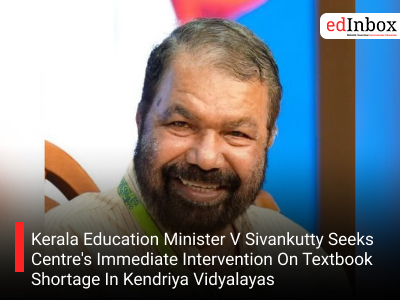
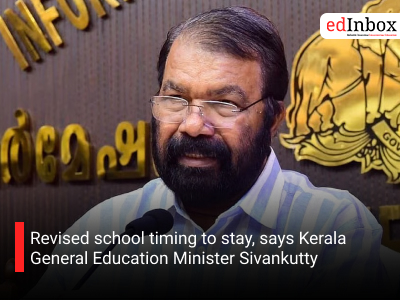
Following the announcement of special orientation classes for higher secondary students on diverse socially relevant issues at the onset of the new academic year, the general education department has organized similar sessions for students ranging from lower primary to high-school level.

The June 3 to 13 orientation programme will include topics such as road safety, body hygiene, health and physical fitness, discipline in the use of digital devices, safeguarding public property and mutual help. An hour each day will be devoted to these sessions, General Education Minister V Sivankutty informed the media here on Wednesday.

"For better recall of what children have learned in the last academic year, equivalent experiences need to be provided for them to help them transition into new textbooks after the summer break in a smooth manner. Appropriate interventions need to be made to fill up learning gaps," Sivankutty said.

Such bridging programs at the start of the academic year must also involve social values inculcation, he said.  The school learning resource groups have been instructed to develop the module for every class in a manner that it is seen as an organic learning process for students.

The Assistant Educational Officers and District Educational Officers have been instructed to organize the activity. While Block Resource Centres and district institutes of education and training will provide academic assistance, the SCERT will do the job of preparing the material.

The orientation programs will guarantee the engagement of all the students belonging to Classes II to X. In the process of developing the modules, school resource groups have been advised to make them suitable to the respective age groups of the students.

The general education department has also published a schedule detailing the subject that needs to be tackled on a specific day for every section of students. Previously, the minister had declared a six-hour-long orientation process, distributed across two weeks during the onset of the new academic year, for Plus-II students.

Thousands of Odisha students now wait to celebrate. Council of Higher Secondary Education (CHSE) will announce the results of Class 12 board exams on Friday, May 21, 2025, at 4 PM. Students who cleared Arts, Science, Commerce, and Vocational streams in the first half of this year wait with hope in their hearts.

Class 12 exam was conducted from Feb 18 to March 27 at 148 centers of the state. The job was huge with over 16,000 teachers combining to conduct the exam without any hassle.

Access CHSE Odisha Class 12 Results via any of the following given modes:

Official Websites:

Visit chseodisha.nic.in or orissaresults.nic.in

Enter roll number and registration number to view and download your marksheet.

Via SMS

Send RESULT FOR12 to 56263 and see your score on your mobile. 

DigiLocker:

Students enrolled on DigiLocker can also download online marksheet here.

Online Marksheet Will Show

The marksheet will show:

Student name and roll number

Stream (Arts/Science/Commerce/Vocational)

Marks subject-wise

Total marks and division

Pass/fail result

Students should note that it is an online temporary result. Hardcopy marksheets and certificates will be sent by your school within one week or two.

In the event of any discrepancy or mistake in your online result, please do not hesitate to inform your school administration at the earliest. For technical assistance in accessing the result, students may approach Common Service Centres (CSCs), nearby cyber cafes, or school-based help centres.

In 2024, the result was announced on May 26 and in 2023 on May 31. In 2023, the total pass percentage was 78.88%, whereas in 2024 Science was 86.93%, Commerce was 82.27%, and Arts was 80.95%.

Only 400 of the 1,800 students reported to school at Christ School on the LoC on Monday. (Express photo by Aiswarya Raj)

It is not a good morning; not for our school, not for Poonch," starts Fr. Shijo Kanjirathingal, principal of Christ School, Poonch, as he takes over the thinly gathered morning assembly — the first since the school reopened on Monday after last week's shelling by Pakistan that killed at least 13 civilians and injured 60 in Poonch.

Three students of the school are among those killed: Urwa Fatima and her twin brother Zain Ali of Class 5, and Class 8 student Vihaan Bhargav. "This ground belongs to them and they were meant to be here," continues the principal.

Heads bowed, tears in some faces, the assembly breaks up after a prayer of silence.

Established in 1990, the school caters to 1,200 students from pre-school to Class 12. On this day, hardly 300 have arrived. Scars from shelling all over the campus — broken glass panes and a hit eucalyptus tree — attest to the horror experienced by the residents of this violence-scarred land.

When shelling began early on May 7, the school cancelled all classes, but its basement was used as a bunker for families in the area.

"We have one more school, Christ School, Degwar, which is only 3 km short of the Line of Control. We felt that school was particularly exposed and were concerned about them, but to our surprise, we got hit. Poonch town has never been so shelled before," alleges Fr Kanjirathingal.

In one of the junior wing classrooms, 24-year veteran teacher Amrit Kaur explains that most of the children haven't reported for classes, so they have been forced to merge children from two sections. "They are too young to comprehend what's going on, but we have requested them to come forward if they wish to speak.". I informed them they must be courageous because they are kids on the front lines," says Kaur. Behind her, the door was partially torn apart — the result of a splinter.

In the school's senior wing, Ranjeet Kaur, class teacher of 8A, weeps quietly. On May 7, her student Vihaan Bhargav was travelling from Poonch to Jammu with his family when shrapnel struck them. Bhargav was seated between his parents, in the front seat of their vehicle. His cousin, Rajvansh Singh, who is a Class 7 student at Christ School, Degwar, and was in the same vehicle, was badly injured.

Vihaan joined our school only last month. I had shifted him to the front bench after his parents requested me to pay special attention to him. I simply did not wish to attend school today. You see a child daily, and then he is no longer there. I asked my students to move into another room; I was not able to set foot in the room without Vihaan," she tells us.

Shells of last week that also fell on Christ School, Poonch (Express/Aiswarya Raj)

About 6 km away, at the Degwar campus of the school, principal Fr Liju explains that the school intends to hire a counsellor for the students. "Until 2019, there used to be ceasefire violations along the border, and we would have to return the students to their homes. But since then, things have been peaceful.I went around the campus this morning and instructed the staff to keep an eye out for unexploded shells," he says.

On Monday, the school did not hold the morning assembly. "Only 400 students have reported today. We did not want to push anyone," he explains. The 1,800-student CBSE school was established in 2014.

On the school verandah, Class 7 pupil Puneet Pal Singh is being questioned by his teachers about whether he has spoken to his best friend Rajvansh Singh, who was injured when a shell exploded on the roof of his house on May 7. Puneet and Rajvansh, who were classmates from their kindergarten days, would play cricket whenever they got an opportunity, according to the teachers.

I phoned Puneet's mother on May 7, but she didn't pick up. I kept calling. Then she answered and said he is in a hospital in Amritsar. Three days ago, we talked again, and the doctors were thinking of amputating. I have been praying since then," says Puneet.

Kerala became the first state in India to implement robotics education as a mandatory subject for all Class 10 students from June 2, 2025. Under the sixth chapter of the ICT textbook titled "The World of Robots," the syllabus teaches students the fundamentals of robotics through practical experiments such as building circuits, sensor work, and computer programming.

In a first-of-its-kind initiative, Kerala has become India's first state to make it compulsory for all 4.3 lakh class 10 students to study robotics from next academic year on June 2.

The placement of robotics in the tenth-grade ICT textbook, that is the sixth chapter entitled "The World of Robots" in the first book, will make the students better positioned to understand basic concepts of robotics from interactive activities, an official report reported on Sunday.

These are circuit manufacturing, aided by sensors and actuators, and electronic device actuation through computer programming, according to K Anvar Sadath, CEO, KITE and Chairman, ICT Textbook Committee, in a release.

KITE is the technical arm of the General Education Department of the Kerala state government.

It has already provided 29,000 robot kits to high schools in the state to facilitate the simple deployment of this curriculum.

"This ambitious effort is a sequel to Kerala's earlier record of introducing the learning of Artificial Intelligence (AI) among all seventh-grade students, another first at the national level last year," Sadath elaborated.

Supplementing an ongoing focus on skills-proof in future, the learning of AI has now also been added to the ICT books of classes 8, 9, and 10 as well.

The piloting of the robotics curriculum through experimentation with the Little KITEs (Kerala's IT club students) has helped to direct this bulk rollout to all class 10 students, the statement added.

The initial practical exercise in the book asks the students to use parts from available robotic kits like Arduino breadboards, IR sensors, servo motors, and jumper wires to build an automatic sanitiser dispenser that turns on automatically as soon as it senses a hand, it stated.

The students will further learn to develop AI-driven smart home automation systems, which include face-recognition-based smart doors.

In order to make all of this possible, they will make use of the 'Face Detection Built-in Model' of the Pictoblocks software programming IDE, using laptop webcams and Arduino kits that are available from KITE, in order to program door-openers.

KITE's new way of teaching robotics is aimed at enabling students to make use of advanced technologies to address a broad variety of real-world problems.

KITE has already completed training on the new ICT textbook of tenth grade for 9,924 teachers in the first phase.

Special robotics training for teachers will be conducted in July, Sadath informed.

In addition to this, KITE will give additional robotic kits and support to unaided schools according to the state syllabus if required.

The ICT textbook is also being distributed to all Malayalam, English, Tamil, and Kannada medium students, the official added later

The Central Board of Secondary Education (CBSE) will shortly initiate the process of re-valuation and re-verification of marks registration for the CBSE Board Result 2025. The aspirants who are not satisfied with their result in the examination will shortly be able to apply for these facilities. Registration shall apparently initiate soon, and the applicants shall be able to fill up the same online on the official site of the CBSE at cbse.gov.in.

The re-checking facility would be a photocopy of marked answer book, re-checking of marks, and re-marking. All these facilities would be provided online here, and students would need to follow the schedule fixed. The procedure details and due date would be announced by CBSE in a separate circular in due course of time. These new changes are part of a new scheme under which students can see their answer books before recheck, providing them with more transparency regarding the marks and the marking.

Step-by-step guidelines to apply for CBSE Class 10, 12 re-valuation and re-verification 2025

Students who are interested to apply for re-verification or re-valuation can go through the below steps:

  • Official CBSE website: Go to the official CBSE website at cbse.gov.in.
  • Click re-valuation link: On the home page, look for and click the re-valuation and re-verification link. The link for re-valuation will direct you to the correct page for the application process.
  • Register on portal: You will be redirected to a new page where applicants are required to register themselves by entering required information such as their roll number and so on.
  • Account login: Once registered successfully, students need to log in to their account for application form filling up.
  • Application form filling up: Carefully fill up the application form along with all other information for re-verification or re-evaluation.
  • Payment: Finally, candidates are required to pay the application fee according to guidelines mentioned. Make the payment successfully before submitting it.
  • Online completion: Fill out the form and remit. Click the submit button once filled. Save the confirmation page to your files.
  • Print for reference later: Print completed application form and payment receipt. This might be requested later.

The process of re-checking CBSE 2025 consists of a number of steps to ensure accuracy. Initially, students can get a photocopy of their marked answer book. They can then look at it and may opt for verification of marks, i.e., total errors, missing marks, or unattempted questions. They may opt for re-evaluation, where a few questions will be re-checked.

This whole process will be carried out online, and CBSE will issue a separate circular that has the precise dates and process for registration. Students should ensure that they update themselves on the official website so that they don't miss the necessary registration.

For further details or clarification, students can check cbse.gov.in, where the latest news and notification will be posted.

Revolutions happen every day in Indian classrooms. A teacher in a rural village learns how to make algebra work for struggling students. A preschool teacher creates a disability-friendly classroom. An edtech innovator develops products to bridge the digital divide. The Education Excellence Awards 2024-25 is here to celebrate these everyday heroes transforming lives through education.

We are looking for these exceptional individuals and institutions this year who go that extra mile. The teacher whose unconventional pedagogy has students really passionate about history. The school that has found ways to include first-generation learners. The teacher who counsels students way beyond class hours. The organization that's delivering quality education to local languages. These are the people and institutions redefining what education can achieve in India.

Consider the case of Mrs. Gupta, who had turned her tiny government school classroom in Bihar into a math heaven with bottle tops and street games. Or the Sunshine Preschool team in Chennai, where all children, from all abilities, learn together. These are not success stories to be sniffled over - they're blueprints for how we can improve education nationally. When we talk about this success, we inspire others and show that what can be achieved.

Anyone can nominate - maybe you have a wonderful teacher at your child's school, or a university lecturer who inspired you. After nominations close, we'll scrutinize every entry in depth. Finalists can ask us to visit their classrooms or conduct interviews with students and parents. We want to witness the real difference they're making. Final winners will be honored at a special event in New Delhi later this winter.

The champions will be recognized nationally, but there is more value. Their winning approaches will be shared with teachers everywhere in India. Policymakers will learn from their practices. Most importantly, it confirms the outstanding effort they are making every day, much of it unseen and underfunded.

As the National Education Policy 2020 is being pushed to its implementation in India, these teachers are at the forefront. They show that the change-generating education is not going to happen from policy documents but from dedicated individuals in classrooms, schools, and communities throughout the country.

The day for which thousands of students waited so eagerly has finally come! Tamil Nadu Directorate of Government Examinations (DGE) announced the SSLC (10th) and HSE +1 (11th) results on the 16th May 2025. School Education Minister Anbil Mahesh Poyyamozhi announced the overall pass percentage and toppers list, which brought joy and nervous thrill in the state.

How Did the Students Perform Test This Year?

Class 10 (SSLC): 93.80% pass percentage

Class 11 (HSE +1): 92.09% pass percentage

Together, more than 17 lakh students wrote these important exams, 9,08,080 in Class 10 and 8,94,264 in Class 11. For those who did not clear the exams this time too, there is good news—supplementary exam details will be released soon.

How to Check Your Results Online

If you’re one of the many students refreshing your browser anxiously, here’s how to access your marksheet quickly:

Via DigiLocker (Fast & Official)

Visit digilocker.gov.in or download the DigiLocker app

Log in with your mobile number, Aadhaar, or username (First-time users must register first!)

Go to "Issued Documents" or search for "TN Board"

Click on "Class 11 Marksheet 2025"

Enter your roll number and information

View & Download your result—save it for later!

Websites and other information:

tnresults.nic.in

dge.tn.gov.in

Supplementary Exams: Dates and information will be released soon for those who need a second dose.

College Admissions: Class 11 marks decide stream choice in Class 12—hold on to your documents!

Celebrate (or Regroup): If you cracked it or need to repeat, recall—this is just a milestone along your educational path.

More Articles ...