
The School and Mass Education Department has introduced a major reform in vocational education by removing stream-based restrictions for Plus II students, allowing them to freely choose subjects and trade combinations across Arts, Science and Commerce streams.
Under the new policy, vocational students will no longer be bound by the traditional division of Humanities, Science or Commerce while selecting their Basic Foundation Course (BFC) subjects. The decision has been implemented under provisions of the Orissa Higher Secondary Education Act, 1982.
The reform means students enrolled in vocational trades can now opt for any BFC subjects of their choice, irrespective of the trade they pursue, subject to availability in their respective Higher Secondary Schools.
Officials from the Council of Higher Secondary Education said the move abolishes the earlier grouping system that restricted students to stream-specific subject combinations.
Previously, vocational students studying trades such as Poultry, Horticulture, Auditing and Accounting were required to select additional BFC subjects only from Science or Commerce streams, while students in Music trade were confined to Arts-related subjects.
With the latest notification, these limitations have been removed. A vocational student can now combine subjects from Arts, Science and Commerce according to individual interest and career goals.
Education officials said the decision assumes importance ahead of admissions for the 2026–27 academic session in Higher Secondary Schools across Odisha.
The reform aligns closely with the vision of the National Education Policy 2020, which promotes multidisciplinary learning, flexibility and student-centric education pathways. The policy framework encourages institutions to move away from rigid academic silos and enable learners to pursue diverse combinations of subjects and skills.
A senior CHSE official noted that earlier restrictions were largely linked to infrastructural limitations and resource constraints in schools. However, the government concluded that such limitations should not prevent students from studying subjects aligned with their interests and future aspirations.
Education experts believe the decision could significantly improve the attractiveness of vocational education by offering students greater academic freedom and reducing the long-standing perception that vocational streams provide limited learning choices.
The reform is also expected to support interdisciplinary learning and improve employability by allowing students to combine technical trade skills with subjects from other disciplines, creating broader academic and career opportunities.
Observers say Odisha’s move reflects a wider national shift towards more flexible and skill-oriented education models aimed at preparing students for evolving workforce demands and diverse career pathways.
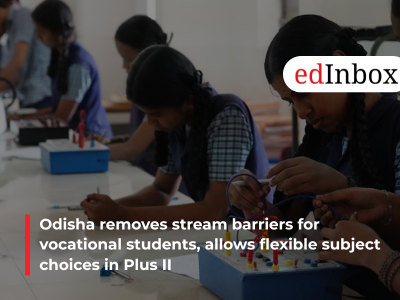
Odisha removes stream barriers for vocational students, allows flexible subject choices in Plus II
Typography
- Smaller Small Medium Big Bigger
- Default Helvetica Segoe Georgia Times
- Reading Mode