
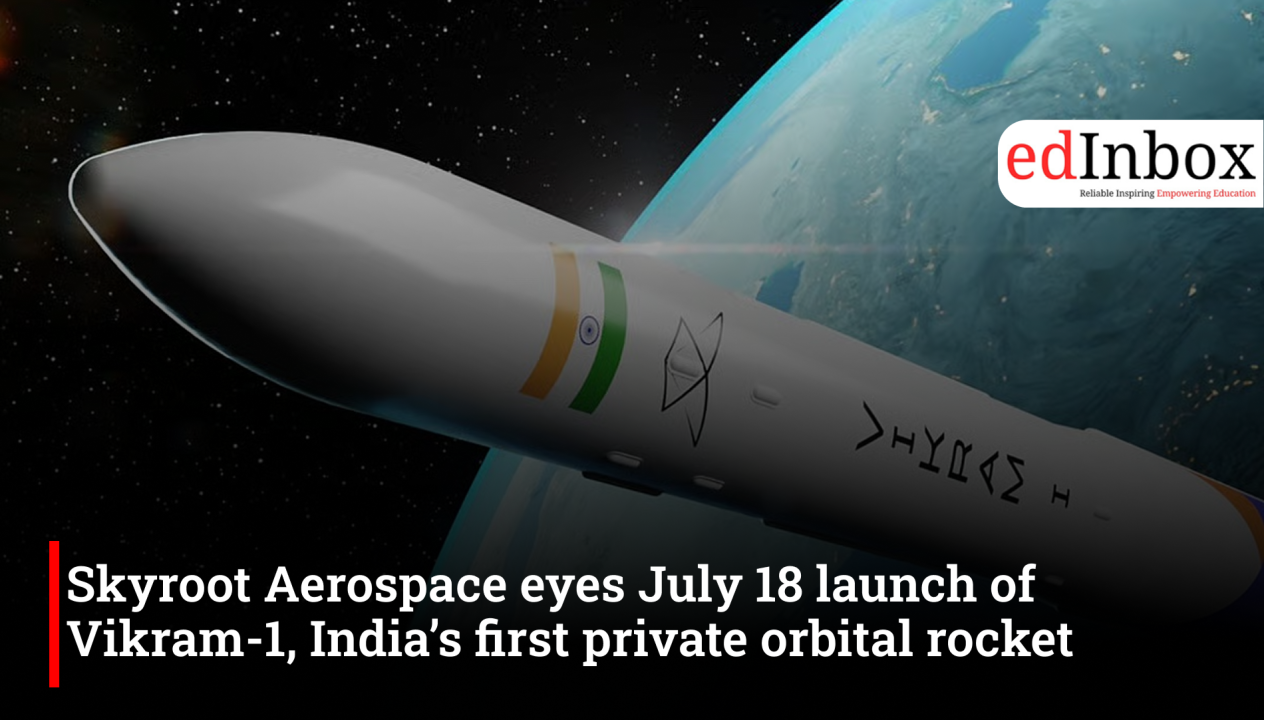
Indian space startup Skyroot Aerospace is set to create history as it targets July 18 for the maiden launch of Vikram-1, India’s first privately developed orbital launch vehicle. The mission, named Mission Aagaman, is expected to mark a major milestone for the country’s rapidly growing private space sector and strengthen India’s position in the global commercial launch market.
The launch is scheduled from the First Launch Pad at the Satish Dhawan Space Centre (SDSC-SHAR) in Sriharikota. If successful, Vikram-1 will become the first privately built Indian rocket to attempt an orbital mission, showcasing the technological capabilities of India's emerging space-tech ecosystem.
Mission Aagaman is designed to validate the performance of the Vikram-1 rocket and several critical onboard technologies under real flight conditions. Ahead of the launch, authorities have issued the required airspace and maritime advisories, identifying restricted zones along the rocket’s flight path and impact corridor.
The orbital mission follows the success of Vikram-S, Skyroot’s suborbital rocket launched in November 2022, which made the company the first private Indian startup to send a rocket into space. According to Skyroot Aerospace, data collected during the Vikram-S mission helped validate nearly 80% of Vikram-1’s technology stack, significantly reducing developmental risks.
Skyroot Aerospace targets global satellite launch market
While Vikram-1 represents a breakthrough for India’s private space industry, Skyroot Aerospace is positioning itself as a global launch service provider. Speaking earlier this year, co-founder and CEO Pawan Kumar Chandana said the company expects 70–80% of future launch demand to come from international customers across the United States, Europe, and Southeast Asia, where dedicated launch opportunities for small satellites remain limited.
Instead of competing directly with heavy-lift launch providers like SpaceX, Skyroot is focusing on the expanding small satellite launch market. The company aims to offer dedicated launches into customer-specific orbits, a model Chandana described as providing “a cab or Uber to space,” allowing satellite operators to reach precise orbital destinations without sharing rides on larger rockets.
India’s private space sector gains momentum
The Vikram-1 launch comes at a time when India’s commercial space sector is witnessing rapid growth following policy reforms that opened the industry to private participation.
Skyroot Aerospace recently raised $60 million from global investors, including GIC, Temasek, Sherpalo Ventures, and funds managed by BlackRock, pushing its valuation beyond $1.1 billion. The achievement made Skyroot India’s first space technology unicorn, underlining growing investor confidence in the country's private aerospace ecosystem.
Although competitors such as Agnikul Cosmos are also developing orbital launch vehicles, Skyroot currently enjoys an early-mover advantage in India's private launch industry.
A successful Mission Aagaman would not only validate Vikram-1’s orbital launch capability but also establish India as a stronger player in the global commercial launch market, opening new opportunities for private space companies and satellite operators worldwide.
Skyroot Aerospace eyes July 18 launch of Vikram-1, India’s first private orbital rocket
Typography
- Smaller Small Medium Big Bigger
- Default Helvetica Segoe Georgia Times
- Reading Mode