
India proudly celebrates its Green Revolution — a transformation that turned a food-deficit nation into a food-secure powerhouse. Between 1961 and 2025, the country increased foodgrain production by nearly 300%, even though the net-sown area grew by only about 38%. Science, policy support, extension networks, financing, logistics and collective national resolve made the impossible possible for a population that nearly tripled.
India’s performance in producing wood and other tree-based products is the opposite. We are one of the largest importers of wood and wood-based finished products—$ 6.8 billion in 2023 and projected to rise at 15% per annum. A deeply concerning prospect for a country of our size, needs and ability. As importers of wood, we only enrich other countries at the cost of our farmers, while our wood-based industrial sector continues to be stuck in a low-scale trap. When we outsource wood production to other countries, we also surrender the co-benefits (jobs, water, soil, habitat, carbon) a growing tree delivers.
With its geographical and climatic profile India should be a net (and big!) exporter of wood and wood-based products. But for that we need to get our act together. India needs to urgently formulate and launch its response to reverse this situation. The fact that trees in agricultural landscapes are now seen as a key to safeguarding the robustness of agri-food systems from climate change is a golden opportunity. The bridge we need to build rests on eight strategic pillars.
Intensive and targeted R&D:
Quality of planting stock is key to the growth rate, form and quality of tree products. Unlike agriculture, where we launched a ‘no stone left unturned’ initiative to enhance yields of primary agricultural crops, trees have been largely ignored, sporadic industry driven efforts for a handful of species notwithstanding. Yields per hectare of pulp and timber species in India is less than half of what other countries with comparable conditions achieve. India needs to invest in a focused, sustained and credible national tree yield improvement program for commonly planted tree species anchored by credible research institutions under rigorous supervision to ensure quality standards are maintained and to ensure supply chain integrity.
Better managed and equipped tree nurseries:
The nursery sector in India is largely unregulated resulting in a great deal of sub-optimalisation at all levels. Quality of planting material is only one side of the coin. Tree nurseries – their operational integrity and commitment to species specific standardised quality norms is the other. It is time to roll out an integrated National Nursery Rating and Planting Material Accreditation System to enable the tree nursery sector to catch up with international best practices and spearhead the transformational change India so sorely needs in this sector. The work done by ICAR-Central Agroforestry Research Institute, Jhansi can be an excellent starting point in this direction.
Robust extension and outreach:
The current agriculture extension system, front-ended by KrishiVigyan Kendras (KVKs), does not consider tree crops as a part of its syllabus and this needs to change. There are inherent efficiencies as the target audiences in each geography for tree crops is largely the same as for other agricultural crops. Given the KVK infrastructure and farmers’ use of it, the next step of expanding their remit to include tree crops can be done rather easily. A large body of tree farming related extension materials are already available to meet extension and training needs relevant to tree farming.
Marketing infrastructure:
Unlike perennials, trees allow great flexibility regarding time of harvesting. This makes knowledge of past and future trends in demand, supply and prices critical to optimise returns from tree farming. However, the market intelligence and analysis available to tree growers to make informed decisions about liquidating standing trees is grossly inadequate. Easily accessible on-line trading and price discovery platforms that enable a tree grower to make evidence-based planting and harvesting decisions are a need of the hour. Software tools to serve this need are already available but lack ownership at the appropriate levels for their rapid activation and adoption.
Finance and insurance products:
Access to institutional credit and crop insurance complements working capital, eases liquidity, and de-risks the farming activity to a certain extent. Outstanding advances to agriculture sector reached an all-time high of ₹25.10 lakh crore in 2023-24. However, the share of tree farming in this amount is less than a pittance. For tree farming to achieve the same success as agriculture, credit and insurance products for tree farming need to be integrated within existing channels for servicing agriculture credit needs. The idea of considering “agroforestry model/system” as the unit for financial/insurance products rather than agricultural crops and tree crops separately. All agro-climatic zones have distinct and well documented agro-forestry models/systems which can serve as a starting point.
Enhanced localised value addition:
Almost all the post-harvest value addition to tree produce takes place outside the farming ecosystem. Promoting the development of rural SMEs focused on tree and wood products can enhance rural incomes, upskill farming communities and provide new opportunities. For the timber and wood sector for instance, a host of post-harvest value addition activities (like peeling, pulping, seasoning, chipping, and briquetting) require simple machinery and can be easily integrated with secondary processing. For decentralized manufacturing and entrepreneurship to take off institutional mechanisms for incubation of hyper-local tree-based entrepreneurship are already available but need to be scaled up.
Supportive EXIM and taxation policy:
EXIM policy in India is not adequately reflective of the need to nurture India’s wood production ecosystem. India has traditionally kept tariffs low on log imports (25%) relative to processed wood products (lumber – 31% and veneers – 31%) to shift value-addition to India. Low tariffs on imported wood impacts the viability of homegrown wood adversely impacting tree farming on Indian soil. As our timber production on farms increases, so must our discouragement of imports. Farm grown wood is subjected to 18% GST against 0-5% on other agricultural produce. This not only reduces competitiveness but also drives a substantial part of wood trade into the informal domain.
Ease of business:
It is a fact that, except for a few fast-growing species, it is extremely difficult to harvest a tree at time of maturity or need. Rationalizing the regulatory framework, a colonial relic as it stands, for harvesting and transporting wood and other tree products is a low-hanging fruit for the governments to encourage landowners, individuals or institutions; to utilise the land they own for tree planting, wherever there is an opportunity. Slicing the strangulating red tape around harvesting and transporting timber will result in an audible sigh of relief across the country! Procedures and rules regarding tree-felling and transit recently notified in Assam are an example that can be emulated by other states.
India has everything it needs for a robust and decentralised tree-based manufacturing ecosystem. This includes demand, climate, land, technological know-how and labour and, most importantly, a farming economy screaming for diversification. What is required is recognition at the upper echelons of decision making of the fact that a growing tree yields not only wood at the time of harvest, it also renders hugely significant environmental and ecological benefits while it grows. We need a “whole of nation” approach, like the one that underpinned the first green revolution. If we do for trees, what we did in the 1960's for cereals, we can not only make India a wood production powerhouse of Asia while securing our social, environmental and economic interests.
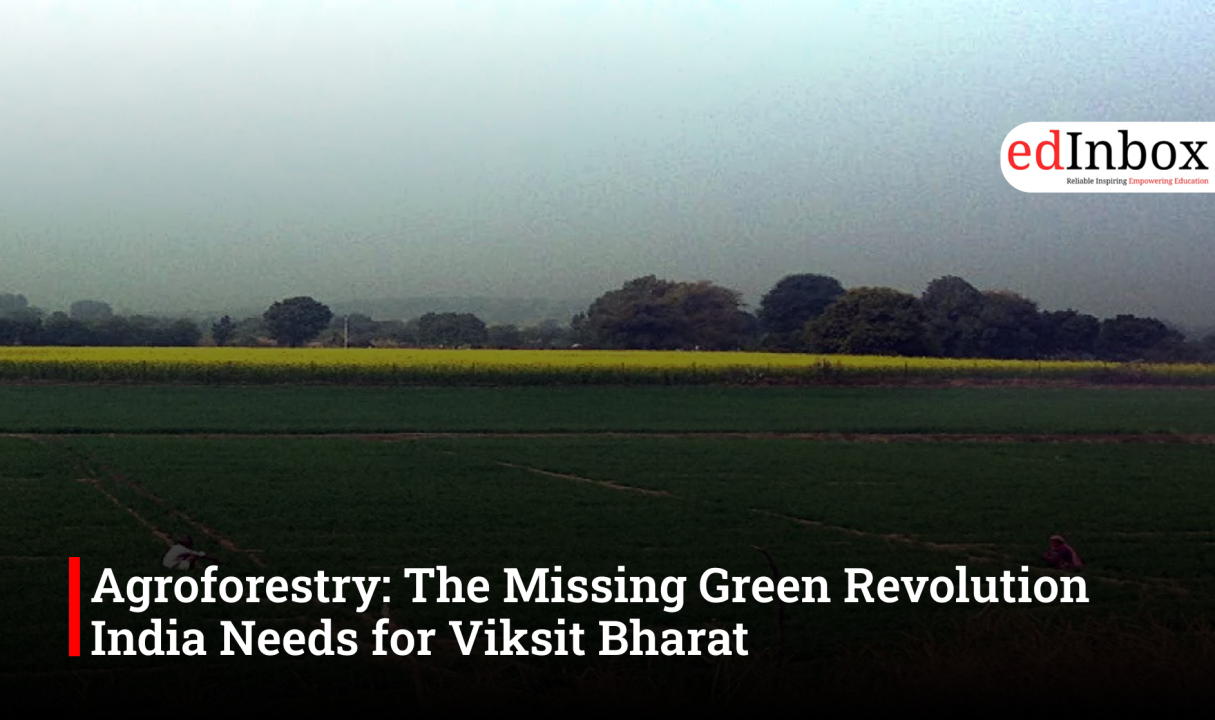
Agroforestry: The Missing Green Revolution India Needs for Viksit Bharat
Typography
- Smaller Small Medium Big Bigger
- Default Helvetica Segoe Georgia Times
- Reading Mode