
As India faces increasingly frequent and intense heatwaves, a new report has raised concerns that the country's budgetary priorities are yet to fully address the growing climate and public health emergency. The study found that India still lacks a dedicated national funding framework specifically focused on heatwave preparedness, climate adaptation, public health protection, and heat resilience.
The report, Standing the Heat: An Analysis of Heatwave Financing in India’s Union Budget, was jointly released by the Centre for Budget and Governance Accountability (CBGA), Greenpeace India, and Budget Analysis and Research Centre (BARC) Trust. Researchers analysed Union Budget allocations between 2020-21 and 2026-27 across 130 schemes administered by 16 ministries.
According to the findings, only 27 schemes were identified as directly relevant to managing heat-related risks. Between 88% and 93% of expenditure flowed through broader development programmes rather than dedicated heatwave mitigation and response initiatives.
The report highlights significant implications for education, research, healthcare and workforce productivity. With rising temperatures disrupting classrooms, affecting student health, and increasing risks for outdoor workers and farming communities, experts argue that climate resilience must become a central component of future public policy.
A key concern flagged in the report is the lack of dedicated heat-related programmes under the Ministry of Environment, Forest and Climate Change. Similarly, the Ministry of Labour has no specific occupational heat protection scheme or compensation framework for workers exposed to extreme temperatures.
The report also points to underutilisation of health preparedness funds. In 2024-25, only ₹14.92 crore was spent under the Health Sector Disaster Preparedness and Response Scheme against an allocation of ₹94 crore.
Researchers further noted that the Ministry of Science and Technology received zero allocation for identified heat-relevant schemes from 2025-26 onward. This could affect climate research, heat forecasting, innovation and evidence-based policymaking at a time when changing El Niño and La Niña patterns are making heatwave prediction more challenging.
Experts believe the findings underscore the need for stronger investment in climate education, environmental research, public health preparedness, agricultural resilience, and disaster management to protect vulnerable populations from the escalating impacts of extreme heat.
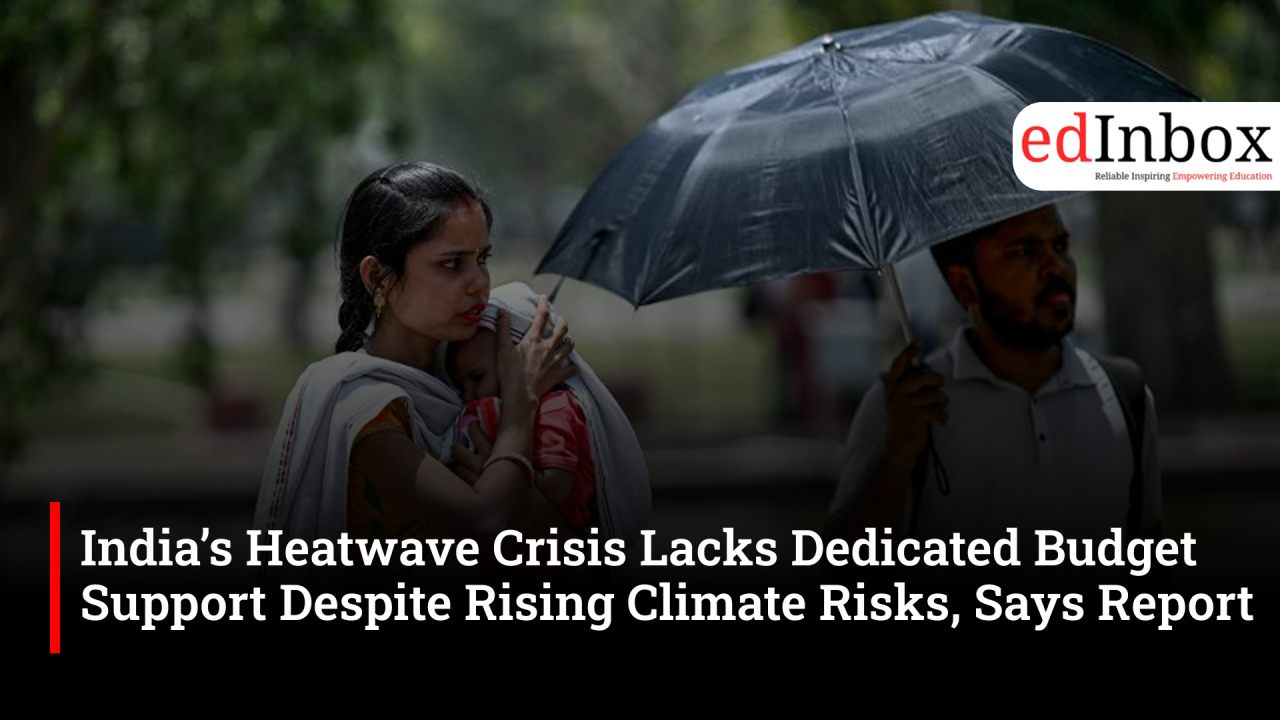
India’s Heatwave Crisis Lacks Dedicated Budget Support Despite Rising Climate Risks, Says Report
Typography
- Smaller Small Medium Big Bigger
- Default Helvetica Segoe Georgia Times
- Reading Mode