
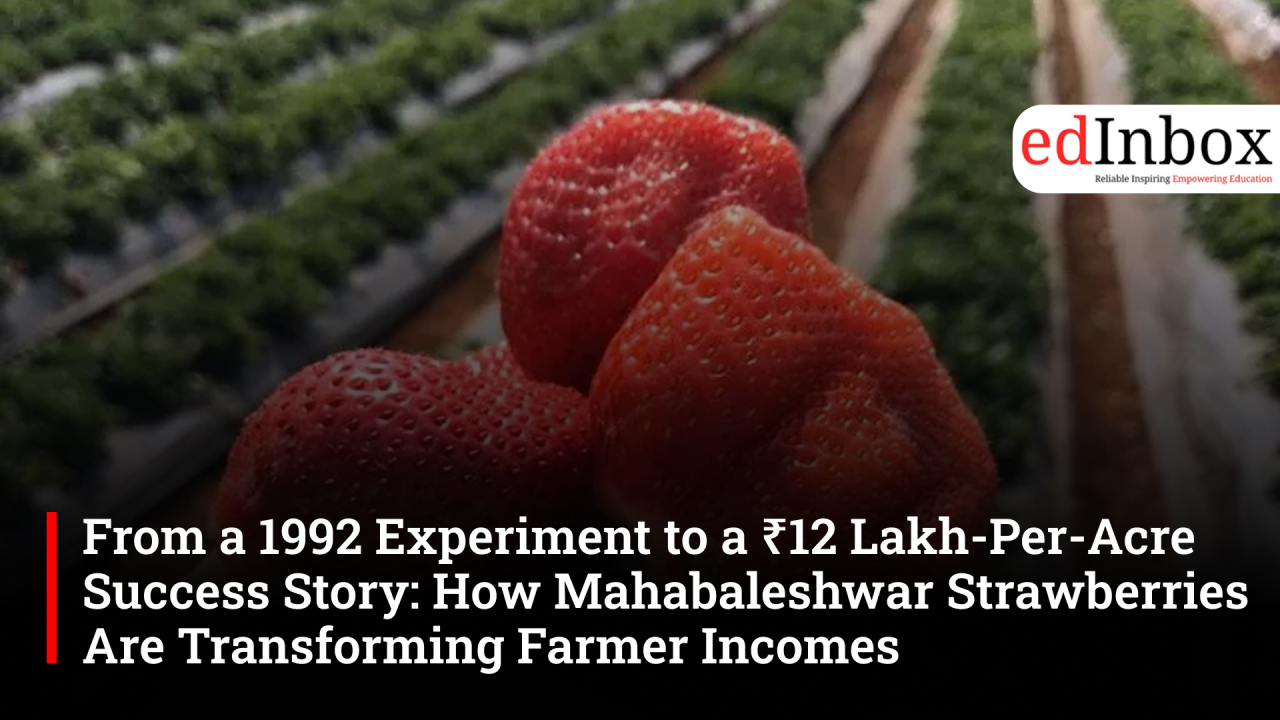
What began as a small agricultural experiment in 1992 has evolved into one of India's most successful horticulture success stories. Today, strawberry farming in Mahabaleshwar supports thousands of farmers across Maharashtra, with many growers reportedly earning between ₹10 lakh and ₹12 lakh per acre during a successful harvest season.
The transformation can be traced back to Balasaheb Bhilare, a farmer from Bhilar village near Mahabaleshwar, who imported Chandler strawberry seedlings from California in 1992. His experiment proved highly successful, encouraging other farmers in the region to adopt strawberry cultivation. Over the years, Bhilar, Panchgani and Mahabaleshwar emerged as India's leading strawberry-producing belt.
Agriculture experts attribute the success of strawberry cultivation in Maharashtra to the region's unique geographical and climatic conditions. Cool temperatures, moderate sunshine and dry weather during the growing season help produce sweet and flavourful berries. The area's distinctive red, iron-rich soil further enhances crop quality and productivity.
A major milestone came in 2010 when the Mahabaleshwar Strawberry received a Geographical Indication (GI) Tag. The recognition strengthened the fruit's market identity, improved consumer trust and enhanced its commercial value across domestic markets.
Today, farmers cultivate several popular varieties, including Nebula, Melissa, R1, Sweet Sensation and imported varieties such as Winter Dawn and Camarosa. With approximately 25,000 saplings planted per acre, strawberry farming has emerged as a lucrative alternative to traditional crops.
The industry's success has also expanded beyond fresh fruit sales. Many farmer families now operate processing units producing strawberry pulp, toppings, frozen fruits and other value-added products, creating additional income streams and reducing post-harvest losses.
The growth of strawberry farming has become an important case study for agricultural students and rural entrepreneurship programmes, demonstrating how innovation, crop diversification and market linkages can transform local economies.
As demand for fresh strawberries and processed products continues to rise, the Mahabaleshwar model is increasingly being viewed as an example of how scientific farming practices can generate sustainable livelihoods and boost farmer incomes across India.
From a 1992 Experiment to a ₹12 Lakh-Per-Acre Success Story: How Mahabaleshwar Strawberries Are Transforming Farmer Incomes
Typography
- Smaller Small Medium Big Bigger
- Default Helvetica Segoe Georgia Times
- Reading Mode