
For generations, Kerala's forest communities have lived alongside wildlife, adapting their daily lives to the rhythms of elephants, tigers and other animals. But today, that fragile coexistence is under unprecedented strain. As human-wildlife conflict intensifies across the state, conservationists, tribal rights activists and affected families argue that the crisis extends far beyond animal behaviour—it reflects a deeper failure of ecological management and inclusive conservation.
From elephant attacks in Wayanad to crop raids in central Kerala, residents increasingly find themselves caught between shrinking forest resources and conservation policies that, they say, protect wildlife while leaving vulnerable communities without long-term support.
Wayanad becomes the epicentre of Kerala's wildlife conflict
In Chekadi ward of Pulpally gram panchayat, on Wayanad's eastern edge, the boundary between forest and human settlement has almost disappeared.
Sixty-five-year-old Kattunaika tribal woman Bhasavi knows the consequences of that reality. Two years ago, while collecting firewood—a practice that had sustained her family for decades—she was attacked by an elephant.
Although she survived, the injuries left her partially paralysed.
"I went because that is how we live," she says, explaining how regular hospital visits and mounting medical expenses have transformed everyday life for her family.
Another resident of the same tribal colony, octogenarian Kali Nooran, also continues to struggle after surviving an elephant attack while grazing cattle.
According to local residents, compensation mechanisms largely focus on fatalities, leaving survivors of permanent disabilities without adequate rehabilitation or livelihood support.
"There is compensation if someone dies," says farmer C R Rajesh. "For people who live like this year after year, there is nothing. No rehabilitation. No livelihood plan."
A tiger attack that changed a family's future
For B Pradeepkumar of Noolpuzha, the impact of wildlife conflict began in 2015 when his father, O Bhaskaran, was killed by a tiger.
Government records treated the incident as another compensated wildlife fatality. For the family, however, the financial and emotional consequences have lasted more than a decade.
"They told us my father died for conservation," Pradeepkumar says. "But conservation did not feed us."
After years of appeals, he eventually secured temporary employment as a forest protection watcher. The work pays only when assignments are available, offering little financial security.
Today, he patrols the same forests where his father lost his life, warning villagers about wildlife movement while continuing to face economic uncertainty.
Why are elephants and tigers entering human settlements?
Experts say Kerala's wildlife conflict cannot be explained simply by increasing animal populations.
Wayanad lies at the intersection of protected forests, plantations, tribal settlements, expanding tourism infrastructure and fragmented wildlife corridors. As forests lose native grasslands and water availability declines, animals increasingly move into agricultural and residential areas searching for food.
Environmental groups point to invasive plant species such as Senna spectabilis and lantana, which have spread extensively inside protected forests, replacing native vegetation that herbivores depend upon.
"The forest is closed for people, not for animals," says environmental activist N Badusha of the Wayanad Prakrithi Samrakshana Samithi.
He argues that restrictions on collecting minor forest produce have weakened traditional livelihoods while ecological degradation inside forests continues largely unaddressed.
"Elephants do not leave forests because they seek conflict. They leave because forests no longer sustain them."
Tribal communities question the 'fortress conservation' model
Tribal rights activists argue that the state's conservation approach has increasingly excluded indigenous communities that historically coexisted with forests.
According to activist K K Surendran, restrictions on forest access have disrupted traditional knowledge systems that once enabled safer interaction with wildlife.
"Earlier, people lived with the forest," he says. "Now they are treated as intruders."
As livelihood opportunities shrink, many tribal families continue entering forests under increasingly risky conditions, heightening the chances of dangerous encounters with elephants and other wild animals.
Tourism adds another layer of pressure
Conservationists also identify rapidly expanding tourism as a significant but often overlooked contributor to wildlife disturbance.
Resorts, night safaris, increased traffic and brightly illuminated tourist facilities disrupt natural wildlife movement corridors.
Residents argue that displaced animals rarely wander into luxury resorts. Instead, they emerge near tribal colonies, labour settlements and small farms located along forest edges.
"The forest is open for tourists, closed for people who depend on it," says Pradeepkumar. "That tells us whose lives matter."
Kerala's wildlife conflict extends beyond Wayanad
Although Wayanad remains the state's most visible hotspot, human-wildlife conflict now affects multiple regions.
The northern districts of Wayanad, Kannur and Kasaragod experience recurring elephant, tiger and leopard encounters. Central Kerala, including Nilambur, Palakkad and Thrissur, faces growing crop damage from elephants and wild boar. Southern districts around Konni, Ranni and Idukki report repeated elephant intrusions alongside persistent agricultural losses.
Interestingly, official data indicate that snakes account for the highest number of wildlife-related human deaths in Kerala, largely outside forest areas, highlighting that wildlife conflict is increasingly becoming a statewide public safety challenge involving multiple species.
Climate variability, prolonged dry spells, forest fires and changing fruiting cycles are further intensifying competition for food and water between humans and wildlife.
Experts call for ecological restoration over reactive management
Kerala has strengthened rapid-response teams, compensation mechanisms and emergency protocols to address wildlife emergencies.
However, researchers argue these interventions remain largely reactive.
They recommend restoring degraded grasslands, removing invasive plant species, protecting wildlife corridors, improving water availability inside forests, regulating tourism infrastructure and creating sustainable livelihood support for forest-dependent communities.
Without addressing these structural issues, experts warn that elephants, tigers and other wildlife will continue venturing beyond protected forests regardless of compensation packages or emergency response measures.
A conservation model at a crossroads
For families like Bhasavi's and Pradeepkumar's, the debate is not about choosing between wildlife conservation and human development.
Instead, they seek a model that protects both biodiversity and the people who have shared these landscapes for generations.
As Kerala confronts rising human-wildlife conflict, the central question is no longer whether conservation should continue, but whether it can evolve into a system that safeguards ecosystems without leaving forest communities to shoulder the costs alone.
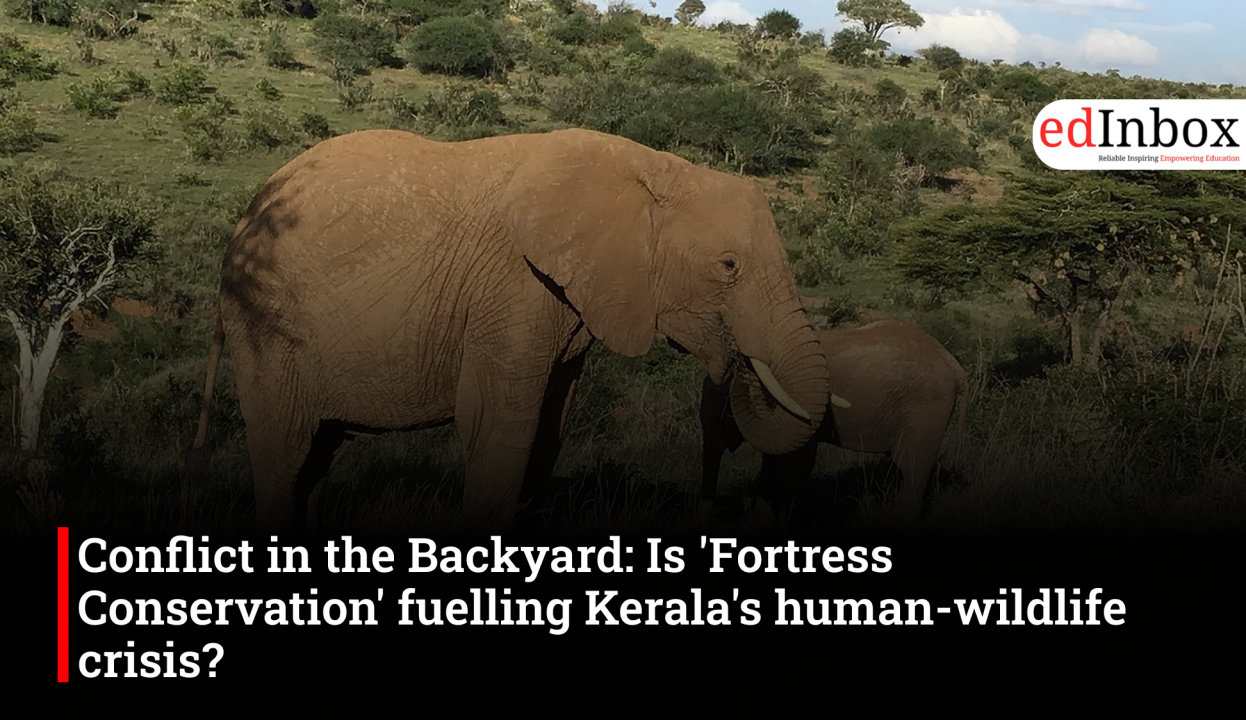
Conflict in the Backyard: Is 'Fortress Conservation' fuelling Kerala's human-wildlife crisis?
Typography
- Smaller Small Medium Big Bigger
- Default Helvetica Segoe Georgia Times
- Reading Mode