
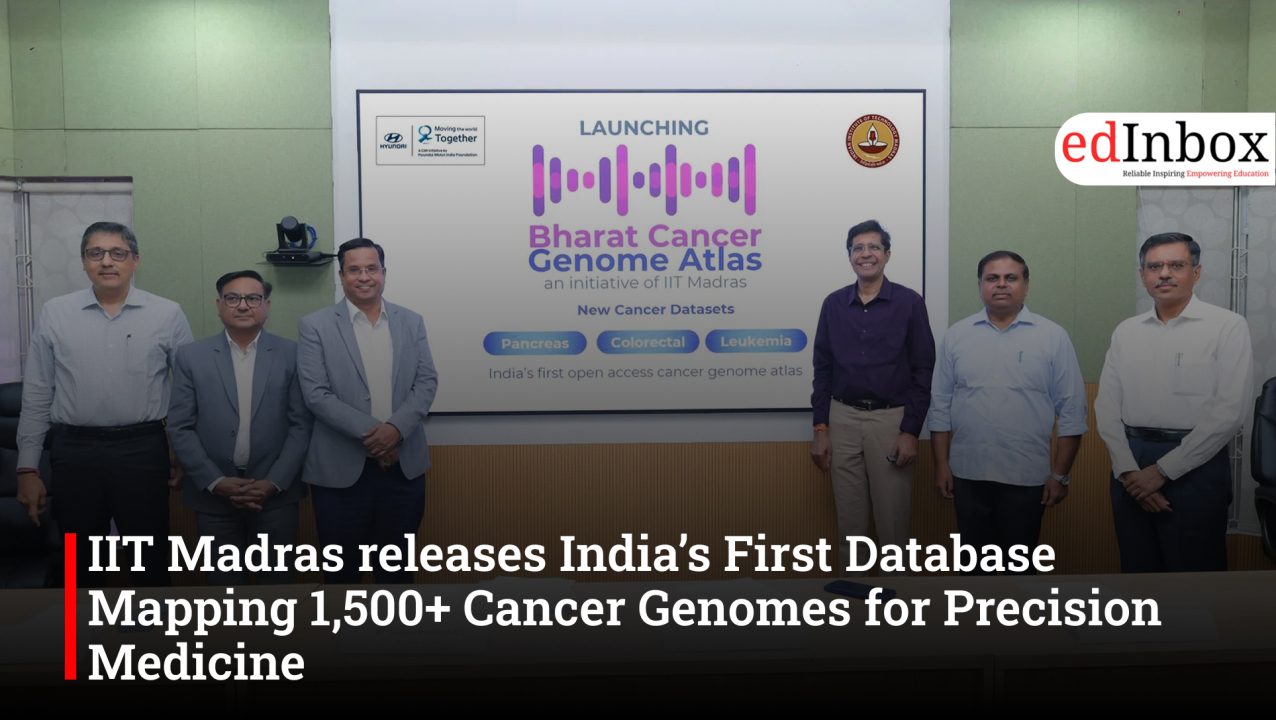
On World Cancer Day, IIT Madras launched an unprecedented cancer genome database that encapsulates paediatric leukaemia, colorectal and pancreatic cancers, the diseases that have a heavy mortality burden in the country.
This effort was a response to India's chronic omission from international cancer genome research and it also hopes to facilitate better diagnosis and treatment outcomes by leveraging population, specific genomic data.
The public database (bcga.iitm.ac.in) developed under the Bharat Cancer Genome Atlas (BCGA) and clinician, oriented Bharat Cancer Genome Grid (BCG2) offers anonymous whole genome sequencing data of Indian cancer patients thus granting researchers and clinicians in India and worldwide an opportunity to investigate the genetic mutations of the Indian populace.
Currently, the database contains genomic information for nearly 1, 500 cancer samples that were sequenced and the whole genome sequencing took place at IIT Madras.
Approximately 30% of the samples came from hospitals in Tamil Nadu, whereas the rest of the samples were obtained from medical institutions located in different regions of the country, including the North, East, such as Mizoram, thus capturing the genetic diversity of India.
Indian Council of Medical Research has recently reported that one out of nine people in India will develop cancer over their lifetime, and the cancer incidence rate has been increasing at a rate of almost 13 per cent annually since 2022.
In spite of this increasing problem, India does not have genomic datasets that comprehensively represent the country's genetic diversity, thus, at times, Indian doctors have to depend on treatment protocols based on data from Western populations.
Project coordinator S Mahalingam, Head of the Centre of Excellence on Cancer Genomics and Molecular Therapeutics at IIT Madras, told TNIE that with the help of the database it would be possible to identify actionable mutations which in turn will guide targeted therapies.
Identifying the mutated gene in a patient helps us to not only prevent unnecessary chemotherapy and its side effects but also to use different drugs, which are already available, if they match the gene, he said. Besides, 57% of Indian cancer patients have clinically significant mutations that are still being analysed for their treatment potential.
Depending on sequencing depth, the cost of whole genome sequencing of one patient is currently between Rs 60, 000 and Rs 1 lakh.
Mahalingam said, initially, the expense of high, throughput sequencing and panel, based tests will be high, but gradually, as more Indian, specific recurrent mutations are identified, the costs will come down.
The project team already has nearly 8, 000 patient samples, and they are planning to keep increasing the database.
Director of IIT Madras, V Kamakoti, remarked that Indian cancer patients are genetically unique in many ways and, therefore, they possibly have higher mortality rates for some cancers such as breast cancer.
"Western therapies may not always be efficacious for Indian patients since the drugs are targeted to Western genomic data only. This atlas helps to fill a major gap and will facilitate better diagnosis, treatment, and drug development, " he remarked.
Dr SG Ramanan, a senior medical oncologist at Apollo Hospitals, emphasized the importance of training doctors to utilize complex genomic data.
Isnt it obvious that education is the key? Molecular tumour boards, where experts determine which mutations are drivers and which are passengers, will undoubtedly play a critical role in seeking to agree upon clinical decisions, he added.
It got support of Rs 56 crore as principal CSR from Hyundai Motor India under its Hyundai Hope for Cancer program and an additional Rs 3 crore to be used for treatment of the children from the economically weaker sections.
Officials of IIT Madras hailed the programme as a landmark for personalized, cost effective cancer care in India.
IIT Madras releases India’s First Database Mapping 1,500+ Cancer Genomes for Precision Medicine
Typography
- Smaller Small Medium Big Bigger
- Default Helvetica Segoe Georgia Times
- Reading Mode