
Could vast rivers of molten rock still be flowing beneath the surface of Venus? A fresh analysis of decades-old radar data from the Magellan mission suggests the answer may be more intriguing than scientists once imagined.
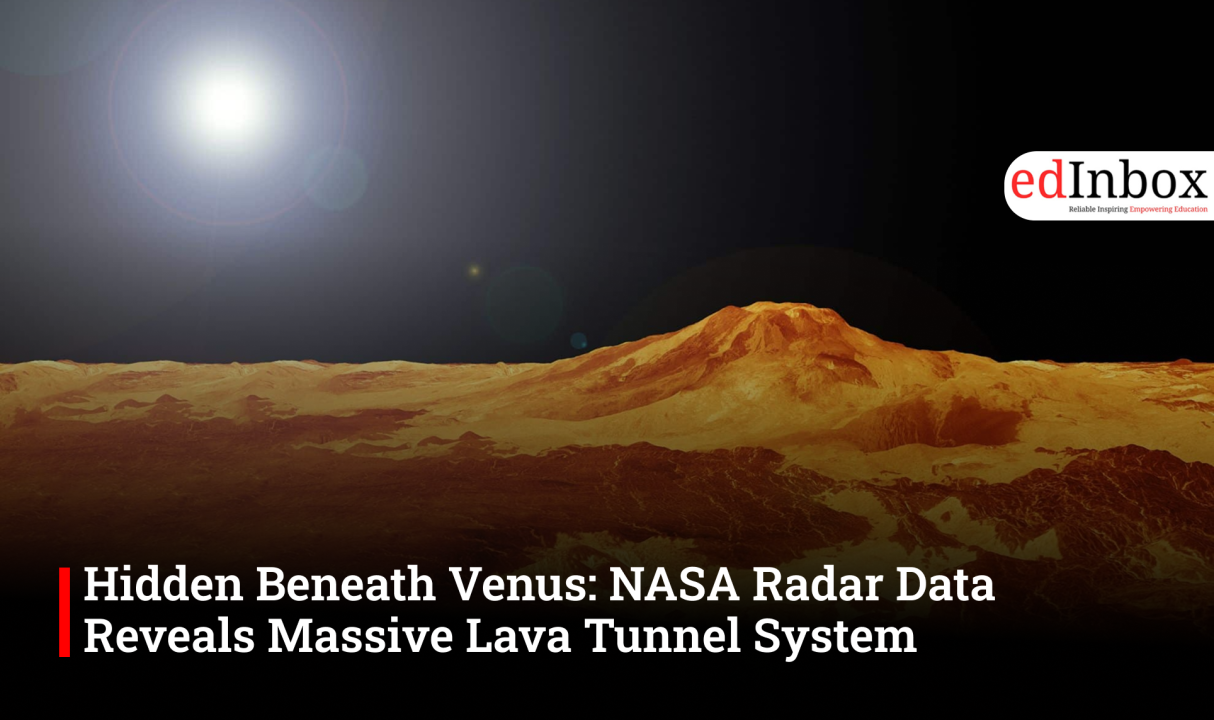
Researchers from the University of Trento have identified what appears to be a huge subsurface lava tube beneath Nyx Mons, a massive shield volcano on Venus’s western hemisphere. The findings, published in the February 2026 issue of Nature Communications, mark the first radar-based detection of such a structure on the planet.
The scale of the tunnel is staggering. Scientists estimate the underground conduit to be nearly 1,000 meters wide, with a roof about 150 meters thick and a central chamber rising roughly 375 meters high—far surpassing anything found on Earth. By comparison, one of Earth’s largest lava tubes in Lanzarote measures just 28 meters across.
The discovery hinges on a feature known as a “skylight”—a collapse in the roof of a lava tube. Radar signals entering this opening behave differently from those hitting solid ground. In this case, scientists observed a “missing signal” pattern, indicating the radar wave likely entered a hollow cavity before re-emerging, a strong signature of an underground void.
One such feature, dubbed “pit A,” stood out in radar imagery due to a bright streak extending beyond its rim—evidence of this unusual signal behavior. The radar was able to trace the tunnel for about 300 meters before losing contact. By mapping surrounding collapse pits and terrain, researchers estimate the entire lava tube system could stretch up to 45 kilometers.
Even more compelling is the possibility that large sections—around 13 kilometers—remain intact and unexplored. Venus’s unique conditions, including lower gravity and a dense atmosphere, allow lava to stay molten longer, forming a huge underpass beneath a hardened crust in a process known as over-crusting. This enables the creation of lava tubes on a scale far exceeding those on Earth or the Moon.
Scientists ruled out other explanations, such as impact craters or tectonic voids, as these would produce different radar signatures. Instead, the data closely matches known lava tube formations on Earth.
Future missions like VERITAS and EnVision are expected to investigate further. Equipped with advanced subsurface radar, these missions could reveal even more hidden structures beneath Venus’s harsh, cloud-covered surface.
The discovery not only reshapes our understanding of Venusian geology but also raises a fascinating possibility: these massive underground tunnels might one day serve as shelters for robotic—or even human—exploration in one of the solar system’s most extreme environments.
Hidden Beneath Venus: NASA Radar Data Reveals Massive Lava Tunnel System
Typography
- Smaller Small Medium Big Bigger
- Default Helvetica Segoe Georgia Times
- Reading Mode