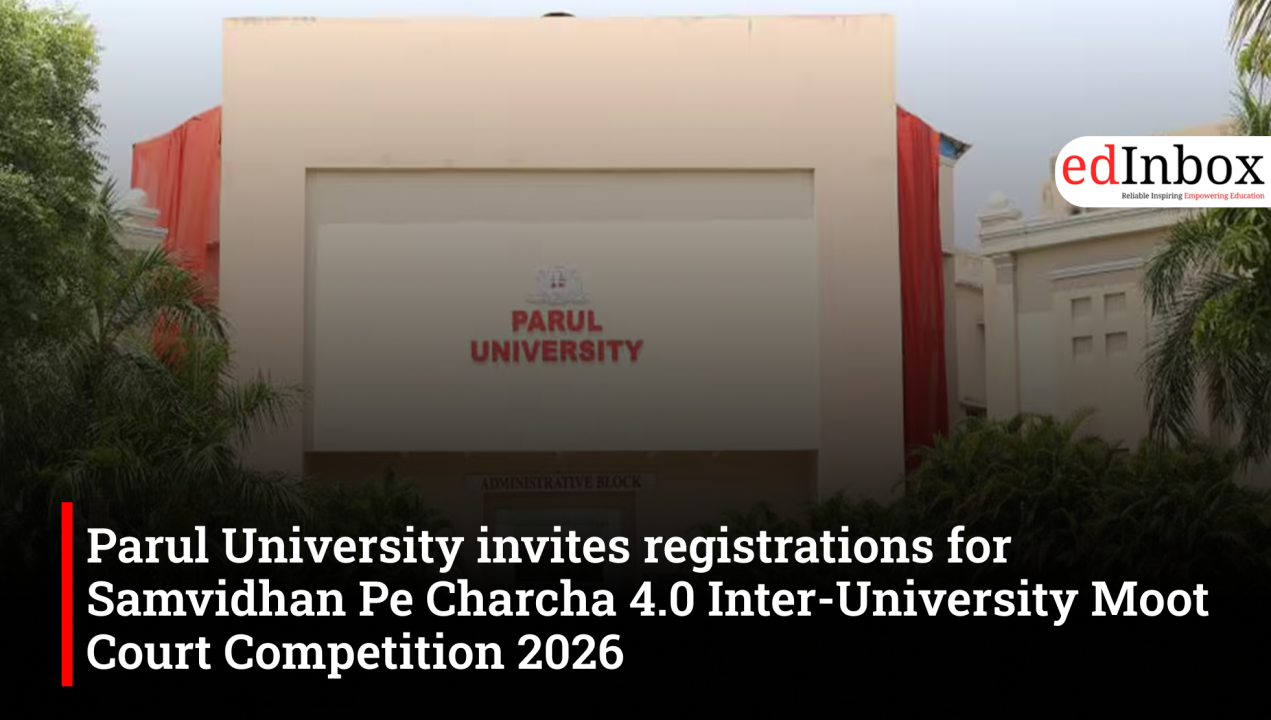
Parul University has opened registrations for Samvidhan Pe Charcha 4.0, the 4th Inter-University Moot Court Competition 2026, inviting law students from across the country to participate in one of its flagship constitutional law competitions. The event offers a total prize pool of ₹5 lakh, with registrations open until August 25, 2026.

The competition will be held from September 24 to 27, 2026, bringing together aspiring legal professionals to showcase their advocacy, legal research, and courtroom skills.

Important dates

  • Registration opens: June 15, 2026
  • Last date to register: August 25, 2026
  • Last date for memorial submission: September 15, 2026
  • September 24: Reporting, exchange of memorials, casting of lots and Researcher Test
  • September 25: Preliminary rounds and Octa Finals
  • September 26: Quarter-finals and Semi-finals
  • September 27: Final round, prize distribution and valedictory ceremony

Registration process

Participants must complete the online registration by:

  1. Making the registration fee payment through the designated portal.
  2. Filling out the registration form.
  3. Emailing the completed registration form along with payment proof to This email address is being protected from spambots. You need JavaScript enabled to view it..
  4. Registration will be confirmed upon receiving an official acceptance email from the organisers.

Registration fee

  • ₹3,000 (Non-refundable, without accommodation)
  • ₹6,000 (Non-refundable, with accommodation)

Prize details

The competition offers cash prizes worth ₹5,00,000, including:

  • Winner: Ever-Rolling Trophy, Winner's Trophy, ₹1,75,000, and Certificate of Merit
  • Runner-up: Trophy, ₹1,25,000, and Certificate of Merit
  • Second Runner-up: Trophy, ₹80,000, and Certificate of Merit
  • Best Mooter: Trophy, ₹40,000, and Certificate of Merit
  • Best Memorial: Trophy, ₹40,000, and Certificate of Merit
  • Best Researcher: Trophy, ₹40,000, and Certificate of Merit

All participants will receive participation certificates.

The moot court competition aims to strengthen advocacy, constitutional interpretation, legal drafting, and courtroom advocacy skills among law students while providing a platform for inter-university academic engagement. Interested participants are advised to complete their registration before the August 25, 2026 deadline.


The Supreme Court's draft Regulations for Use of Artificial Intelligence (AI) in Courts, 2026 could mark a turning point for legal education in India, prompting law schools to strengthen courses on artificial intelligence, judicial ethics, technology law, and AI governance. The draft regulations, released by the Supreme Court's AI Committee, lay down the country's first formal framework for the responsible use of AI in judicial processes, signalling new competencies that future legal professionals may need.

The preliminary draft makes it clear that AI can only assist judicial processes and cannot replace human decision-making. It states that AI systems must function "solely in an assistive capacity" and remain "strictly subservient to human judgment and judicial authority."

Draft rules define AI's role in courts

The proposed regulations prohibit AI-assisted sentencing without mandatory human oversight, ban AI systems from profiling litigants, accused persons, witnesses or other parties, and disallow the use of "opaque" or "unexplainable" AI systems in any stage of court proceedings.

The framework represents the first official attempt by the Supreme Court to codify how artificial intelligence may be deployed within India's judicial system while safeguarding fairness, transparency and accountability.

Implications for legal education

Although the regulations are still in draft form, they are expected to influence how law schools prepare future lawyers, judges and legal researchers.

Experts believe legal education may increasingly incorporate subjects such as:

  • Artificial Intelligence and Law
  • AI ethics and responsible use
  • Algorithmic accountability
  • Explainable AI in judicial systems
  • Data privacy and digital rights
  • Cyber law and technology regulation
  • Legal analytics and AI-assisted legal research

The emphasis is likely to shift from simply understanding legal doctrine to equipping students with the skills to evaluate AI-generated outputs, identify risks, and ensure compliance with ethical and constitutional principles.

Human judgment remains central

A key principle of the draft regulations is that AI cannot replace judicial discretion. While AI tools may assist in legal research, document management or case analysis, final decisions must always remain with judges.

The proposed prohibition on opaque or unexplainable AI also highlights the growing importance of explainable AI (XAI)—systems whose reasoning can be understood and scrutinised by human users. This could become an important area of study in future law curricula as courts increasingly adopt digital technologies.

Preparing future legal professionals

The Supreme Court's draft regulations underscore the need for legal professionals who understand both technology and law. As AI becomes more common in litigation support, legal research and court administration, law graduates will require not only technical awareness but also a strong grounding in ethics, constitutional values and procedural fairness.

If adopted, the regulations could encourage universities and law schools to revise their curricula, ensuring graduates are equipped to work in a judicial system where AI serves as a tool to assist—but never replace—human judgment.


In a significant ruling on student privacy and data protection, the Supreme Court of India has directed the Central Board of Secondary Education (CBSE) to amend its APAAR (Automated Permanent Academic Account Registry) ID consent forms to provide parents with a clear option to refuse consent or opt out of the scheme. The direction seeks to reinforce the voluntary nature of APAAR and follows an earlier judgment of the Orissa High Court, which held that parents must be given an explicit choice before their children's data is enrolled in the academic identity system.

The order comes amid growing concerns over the collection, storage and processing of children's personal data and the linkage of APAAR IDs with Aadhaar, raising important questions about privacy, informed consent and digital governance in education.

A Bench comprising Chief Justice of India Surya Kant, Justice Joymalya Bagchi and Justice V. Mohan was hearing a petition filed by parents of four students challenging the constitutional validity of the APAAR scheme.

Parents raise privacy concerns over APAAR and Aadhaar linkage

The petitioners argued that although the government describes APAAR as a voluntary initiative, it functions as a mandatory requirement in practice because it is linked to Aadhaar and is increasingly associated with various academic processes.

Appearing for the petitioners, Senior Advocate Indira Jaising contended that compelling children to obtain Aadhaar-linked academic identities violates their constitutional right to privacy. Referring to the Supreme Court's landmark K.S. Puttaswamy v. Union of India (2019) judgment, she argued that children cannot be forced to obtain Aadhaar numbers for accessing educational services.

The petition further questioned the legality of collecting and processing children's personal information without ensuring meaningful and informed parental consent.

Supreme Court to implement Orissa High Court ruling nationwide

During the hearing, the Bench noted that the Orissa High Court, in a judgment delivered in December 2025, had already addressed the issue of consent.

The High Court had ruled that if APAAR is genuinely voluntary, the consent form must explicitly allow parents to decline participation at the very beginning instead of assuming consent. It directed authorities to revise the consent form by incorporating a clear opt-out option.

After being informed that the Orissa High Court's decision had not been challenged, the Supreme Court observed that the ruling should be implemented across the country.

According to the Bench, CBSE will be directed to implement the High Court's directions on a pan-India basis, ensuring that parents nationwide receive the option to either consent to or refuse the generation of an APAAR ID for their children.

CBSE circulars subject to Data Protection Act

While discussing the larger objectives of the APAAR initiative, the Chief Justice observed that the scheme aims to create a unique academic identity for students, maintain lifelong academic records, improve curriculum implementation and help authorities monitor educational indicators such as teacher-student ratios.

However, the Court also acknowledged the petitioners' contention that even legitimate policy objectives must be pursued through lawful, proportionate and constitutionally compliant mechanisms.

The Bench clarified that CBSE's implementation of APAAR will remain subject to all applicable laws, including the Digital Personal Data Protection Act, 2023, which governs the collection, storage and processing of personal data.

What the ruling means for parents and schools

The Supreme Court's direction reinforces that participation in the APAAR scheme cannot be presumed through a one-sided consent process. Schools affiliated with CBSE are expected to revise their consent forms to provide parents with an explicit choice to opt out, ensuring that consent is informed and voluntary.

The detailed order is expected to be uploaded by the Court, after which CBSE will be required to implement the revised consent mechanism across the country.

The ruling is likely to have significant implications for student data governance, digital identity initiatives in education and the implementation of privacy safeguards in schools, while reaffirming the importance of parental consent in matters involving children's personal information.


The Bar Council of India (BCI) has officially declared the All India Bar Examination (AIBE) XXI Result 2026 on July 18. The national certification exam recorded an overall pass percentage of 65.92%, with 1,15,805 candidates qualifying to receive the Certificate of Practice (CoP), enabling them to practise law across courts in India.

Candidates who appeared for the examination can now download their AIBE XXI scorecards from the official examination portal.

AIBE XXI Pass Percentage 2026

According to the BCI, 65.92% of candidates successfully cleared the examination, reflecting the overall qualifying performance in this edition of the All India Bar Examination. The exam was conducted on June 7, 2026, for law graduates enrolled with their respective State Bar Councils.

The AIBE is a mandatory certification examination that assesses the fundamental legal knowledge and professional competence of advocates before they begin legal practice.

How to Check AIBE XXI Result 2026

Candidates can access their results by visiting the official AIBE portal.

Steps to download the AIBE XXI scorecard:

  1. Visit the official AIBE website.
  2. Click on the AIBE XXI Result 2026 link.
  3. Enter your application number and date of birth.
  4. Submit the login credentials.
  5. Download and save the scorecard for future reference.

Details Mentioned on the Scorecard

The AIBE XXI scorecard includes:

  • Candidate's name
  • Roll number
  • Application number
  • Marks obtained
  • Qualifying status
  • Category details

Candidates are advised to verify all details carefully after downloading the result.

Certificate of Practice After Qualifying

Candidates who qualify the AIBE become eligible to receive the Certificate of Practice (CoP) through their respective State Bar Councils. The certificate authorises advocates to practise law before courts, tribunals, and other judicial forums across India.

The All India Bar Examination is conducted by the Bar Council of India to establish a minimum benchmark of professional competence for newly enrolled advocates. It is an essential requirement for law graduates seeking to begin legal practice in the country.


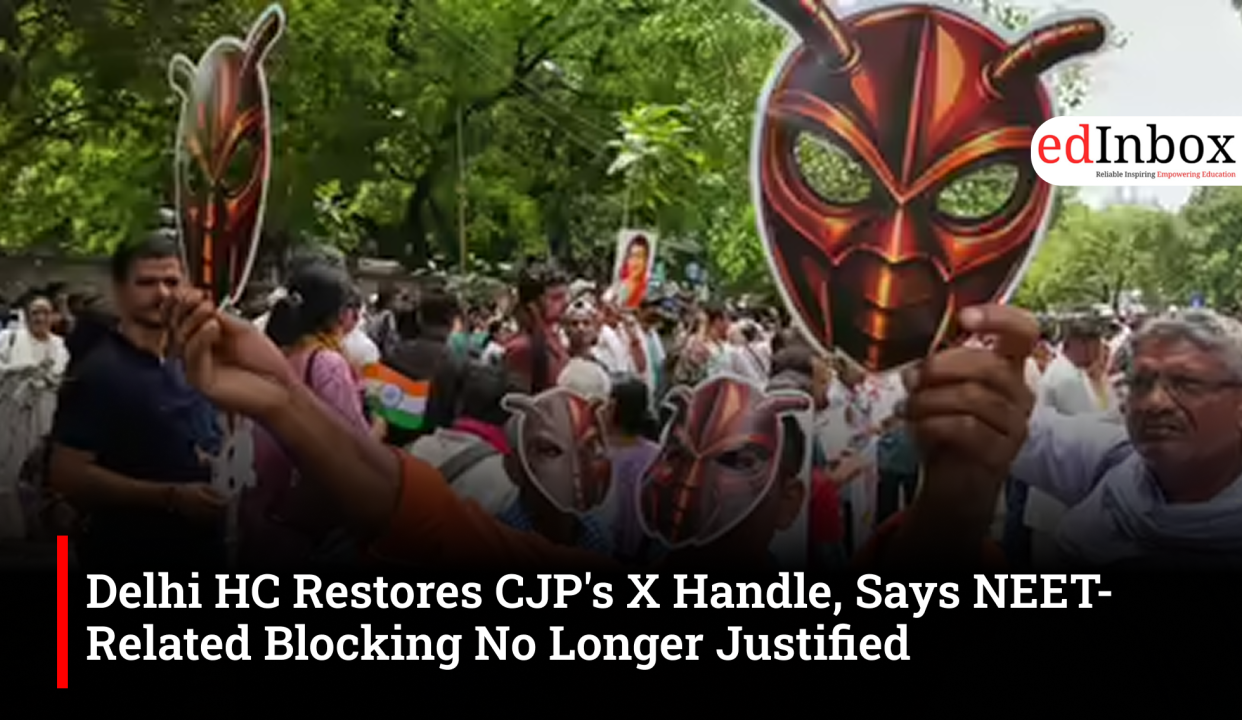
The Delhi High Court on Tuesday ordered the restoration of the Cockroach Janta Party (CJP)'s X (formerly Twitter) account, setting aside the Centre's earlier order to block the handle. The court observed that the government's primary concern—linked to the NEET examination controversy—was no longer relevant, making continued blocking of the account unjustified.

Court Revokes Blocking Order

The CJP's original X account was withheld on May 21, following concerns related to online content surrounding the NEET examination controversy. While revoking the order, the Delhi High Court held that since the circumstances cited by the Centre had changed, there was no basis to continue restricting access to the account.

The court's decision restores the group's presence on the social media platform after months of legal proceedings.

CJP's Rise Through Online Campaigns

Launched in May, the internet-based movement rapidly gained popularity through memes, satire, and commentary on issues including:

  • Alleged examination paper leaks.
  • Unemployment.
  • Education policy.
  • Student-related concerns.

After its original account was blocked, the group resumed activity under the alternate handle "Cockroach is Back", continuing its online campaigns.

Protest at Jantar Mantar Continues

The court's ruling comes as the CJP-led protest at Jantar Mantar in New Delhi continues to demand the resignation of Union Education Minister Dharmendra Pradhan over alleged examination irregularities.

According to the group, the protest entered its 18th day, highlighting concerns over repeated examination controversies and alleged paper leaks.

Sonam Wangchuk's Hunger Strike

Environmentalist and education reform advocate Sonam Wangchuk completed the ninth day of his indefinite hunger strike in support of the movement.

A medical bulletin stated that:

  • He has lost 6.9 kg since beginning the fast.
  • His blood pressure was recorded at 107/67 mm Hg.
  • His blood glucose level stood at 72 mg/dL.

Allegations Against Police

CJP founder Abhijeet Dipke alleged on X that police personnel had been instructed to photograph women volunteers participating in the protest.

He claimed that officials were seen taking photographs of women protesters and left the area after being questioned. Authorities have not publicly responded to these allegations.

Support for Student Protests

Dipke also participated in a student protest in Chhatrapati Sambhajinagar, backing demands for offline examinations.

Meanwhile, members of the All India Students' Association (AISA) continued their own hunger strike at Jantar Mantar, accusing the government of failing to prevent recurring examination irregularities and paper leaks.

Background: NEET Controversy

The protests stem from allegations surrounding irregularities in the National Eligibility cum Entrance Test (NEET) examination controversy, including claims of paper leaks. The controversy led to the cancellation and subsequent re-conduct of the examination, triggering widespread student protests and public debate over examination integrity.

Significance

The Delhi High Court's decision reinforces judicial scrutiny of restrictions on social media accounts, particularly when the original grounds for blocking no longer exist. The restoration of the CJP's X account also comes amid continuing nationwide discussions on examination transparency, student protests, and accountability in India's education system.


Indian law graduates seeking international career opportunities now have a more direct route to practise law in the United Kingdom through the Solicitors Qualifying Examination (SQE), a standardised qualification pathway that enables overseas candidates to become solicitors in England and Wales without obtaining a UK Master of Laws (LLM) degree.

Introduced in 2021, the SQE replaced the previous solicitor qualification system and applies equally to domestic and international candidates. The new framework is increasingly attracting interest from Indian LLB graduates because it offers a regulator-recognised route to legal practice while potentially reducing the cost of pursuing a legal career in the UK.

To qualify as a solicitor in England and Wales, candidates must complete four key requirements. They must first hold a recognised university degree or an equivalent qualification. They are then required to pass SQE1, which assesses functioning legal knowledge across core subjects such as constitutional law, contract law, dispute resolution and business law. Successful candidates must subsequently clear SQE2, which evaluates practical legal skills, including client interviewing, advocacy, legal research, drafting and case analysis.

In addition to passing both examinations, aspiring solicitors must complete two years of Qualifying Work Experience (QWE), which can be gained through law firms, legal clinics, in-house legal teams or other approved legal settings. Candidates must also satisfy the regulator's character and suitability requirements before being admitted to the profession.

The SQE pathway is gaining popularity among Indian graduates partly because it offers a more affordable alternative to pursuing a UK LLM, which can often cost between ₹30 lakh and ₹60 lakh. However, legal experts caution that qualifying through the SQE does not guarantee employment with leading international law firms. Recruitment remains highly competitive, with employers placing significant emphasis on academic performance, practical experience, communication skills and commercial awareness.

As awareness of the SQE continues to grow in India, the pathway is expected to encourage more law graduates to explore international legal careers. While the qualification broadens access to the UK legal profession, long-term success will continue to depend on a combination of examination performance, qualifying work experience, professional networking and the ability to adapt to a global legal environment.

IIT Ropar, Punjab and Haryana High Court, PhD scholar, faculty harassment, higher education, and court order are in focus after the Punjab and Haryana High Court directed the Indian Institute of Technology (IIT) Ropar to immediately reinstate a PhD Chemistry scholar, holding that her resignation was not voluntary and observing that the institute appeared to have acted in undue haste to remove her from the programme.

The case concerns Fatima Maqsood, who approached the High Court after her resignation from the PhD programme was accepted on November 22, 2025, a day after she submitted a complaint alleging harassment by eight faculty members. In her complaint to the institute's Director, she alleged that despite earlier warnings issued by the administration, the harassment had continued.

According to the court order, Maqsood submitted her resignation citing continued harassment that had caused distress to both her and her 67-year-old father. The resignation was processed and accepted on the same day, with recommendations from her supervisor, approval from the Head of Department and acceptance by the Registrar.

Hearing her petition, Justice Kuldeep Tiwari questioned the institute on whether any disciplinary proceedings or misconduct notices had ever been initiated against the scholar. The institute's counsel acknowledged that no such notice had been issued and that no disciplinary action had been contemplated.

The High Court noted that IIT Ropar continued to oppose Maqsood's reinstatement even after she filed an affidavit undertaking not to make further complaints against anyone at the institute and to focus on completing her doctoral research. The court observed that the institute's continued resistance reflected an apparent unwillingness to allow her to resume her studies.

Rejecting arguments related to Maqsood's subsequent enrolment at another research institution, the court held that those developments had no bearing on the legality of the resignation accepted in November 2025.

Relying on previous judgments of the Supreme Court and the Allahabad High Court concerning resignations made under compelling circumstances, Justice Tiwari ruled that Maqsood's resignation could not be considered voluntary. The court set aside the resignation order and directed IIT Ropar to allow her to rejoin the PhD Chemistry programme immediately.

The court also advised the institute's Director to facilitate a supportive environment for the scholar to complete her research, while clarifying that IIT Ropar would remain free to initiate disciplinary action if she violated the undertaking submitted before the court.

More Articles ...