
The Union Budget 2026, 27 has brought in a significant and progressive announcement in the field of education.
While presenting the budget in the Parliament on Sunday, Finance Minister Nirmala Sitharaman unveiled the plan of setting up five University Townships in different parts of the country.
These University Townships will be set up adjacent to major industrial and logistics corridors, thus higher education being directly connected with industry and job opportunities. The goal of this programme is to build a scenario in which education, research, innovation and skill development would be the functions of a single, well thought out area.
According to the Finance Minister, the Central Government will collaborate with State Governments in the development of these University Townships. The Centre will be ready to help the states in establishing universities, setting up infrastructure and creating modern facilities suitable to the regional needs.
Each University Township will feature facilities for modern residential housing so that students coming from outside the region will have no problems with accommodation. Besides academic institutions, the townships will have skill centres, where on top of theoretical education, students will be given the opportunity for practical and hands, on training.
The campuses will be equipped with the latest technology laboratories, cutting, edge colleges, research centres and innovation hubs that will provide both students and researchers with access to the most advanced technology.
The government's attention is mainly on not handing out degrees but on preparing students for the industry by encouraging start, ups, applied
The government’s focus is not just on awarding degrees, but on making students industry-ready, encouraging start-ups, applied research and innovation-driven learning. According to the government, these five University Townships will not only improve the quality of education, but also generate local employment opportunities.
Increased economic activities in the surrounding areas are envisaged that will allow the youth to grow up and have their share of opportunities without the need to go far away from their homes. The project is viewed as a major step that will lead to the empowerment of India's youth and India becoming a Developed Nation by 2047.
Moreover, the finance minister mentioned that a National Institute of Design (NID) will be set up in the Eastern part of India. The main purpose is to raise the level of design education, art thinking, and innovation locally. Currently, most of the top design colleges are located in a few areas of the country, and as a result, students of Eastern India have to leave their homes to get a good education.
The newly established NID will offer a variety of design fields such as product design, fashion design, graphic design, industrial design and digital design so that students from the region can benefit from world class education without having to leave their region. Besides preparing for the job market, students of the institution will also be expected to be able to start their own businesses and create new products.
The government clarified that it is design which has become a key element of the various initiatives like Make in India, Startup India, and Aatmanirbhar Bharat because strong design skills presence makes Indian products more competitive at the world market level.
The government put a spotlight on the fact that design is a major component of the Make in India, Startup India and Aatmanirbhar Bharat initiatives, as through excellent design skills manufactured Indian products can much better compete in the global markets. Specialists are of the opinion that the newly established NID will not only be able to add industrial and economic growth of Eastern India through its design inputs, be the anchor by its design expertise to local industries thereby creating jobs and also help reduce the regional imbalance in the country. Researchers in the field see the movement as an essential measure to nurture the creative economy, enable the youth and make national development more balanced.
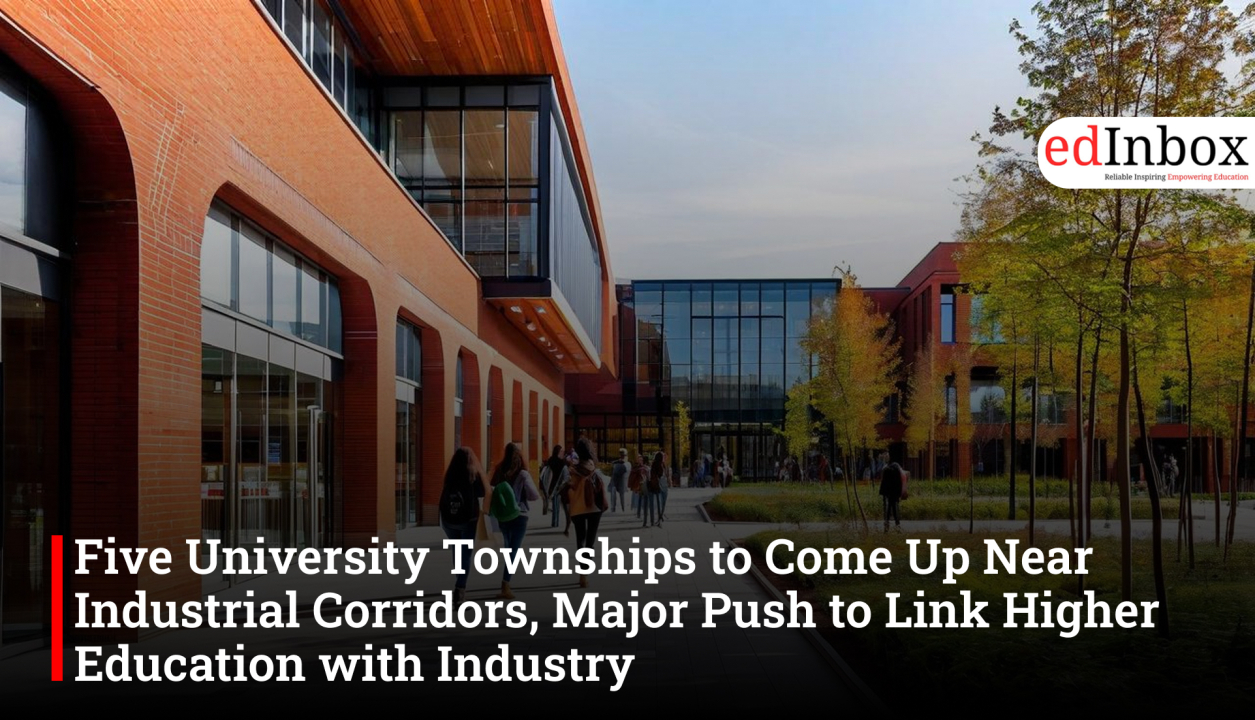
Five University Townships to Come Up Near Industrial Corridors, Major Push to Link Higher Education with Industry
Typography
- Smaller Small Medium Big Bigger
- Default Helvetica Segoe Georgia Times
- Reading Mode