
Youth distress cases show alarming growth in our nation, and the fewer mental health professionals in Arunachal Pradesh have made it a land where youth distress significantly impacts the community.
So the question must not be whether we need to provide support to students with mental health issues, but rather how quickly we can mobilise and react. Educational Institutions represent a significant opportunity for intervention, where we can provide supports to students through introducing Psychology into our students' curriculum and by implementing it into our Institutional Structure as a source of support.
Psychology does more than just give students insight into potential career paths. It also teaches fundamental life skills such as self-awareness, resilience, emotion regulation, empathy, and healthy coping strategies. As students experience a variety of challenges that may create a psychosocial stress environment (such as academics, identity issues, family expectations, and a changing society), it is important that they learn how to recognize and manage their own emotional well-being. Students who do not have the means to articulate their emotional distress or regulate their emotions will remain silent until the point of developing emotional distress to the point of complete breakdown.
Promoting this initiative in our state would offer substantial advantages, and serve a dual purpose. Academically, it would open pathways for local students to pursue the subject without leaving the state, gradually strengthening Arunachal’s mental health workforce. At present, many youths are forced to move elsewhere for their education in this field, as no schools and only two higher education institutes in the state (department of psychology at Rajiv Gandhi University and St Claret’s College, Ziro) offer seats in the discipline.
The establishment of Campus Health Centres for Children in Schools will be a preventative means to establish campus counselling services and student assistance programs, develop peer form-based support initiatives for mental health, and create safe environments where students can seek support without fear, stigma or judgement. By developing a fundamental understanding of psychological concepts, students, teachers, and administrators will be able to identify early warning signs, respond with sensitivity, and lower stigma and provide psychological first aid to people in crisis situations. It is anticipated that through this shared understanding of basic psychology, a Culture of Kindness will emerge on Campus Health Centres for Children in Schools. In all of the Centres for Children in Schools, we anticipate that awareness of psychological concepts will, ultimately, support a culture of kindness in which people will help each other and support each other emotionally. In a Culture of Kindness, those who are feeling distressed will seek assistance rather than experiencing it as a sign of weakness; instead they will consider it to be a strength. Awareness of these issues will result in the establishment of safe environments for all students and the entire education community, therefore decreasing the overall burden of mental health on everybody.
There are also national policy frameworks providing direction and assistance for the need for mental health support for students. For example, The National Education Policy, 2020 acknowledges mental health, emotional well-being, and life skills as integral elements of a comprehensive education system. The policy specifies that every educational institution must have trained counselors, social workers, and mental health professionals on their staff. The policy also stresses the importance of educating the public (both educators and parents) about mental health, stresses the need to provide early warning signs for psychological distress and also includes the need to train all teachers and students in emotional regulation, stress management, and psychosocial support. Similarly, The University Grants Commission has repeatedly directed higher education institutions to provide structured counselling services, hire appropriately qualified psychologists, and create accessible mental health support systems for students. At the K-12 level, The National Council of Educational Research and Training recommends Guidance and Counselling Programs, Peer Support Programs, and Socio-Emotional Learning Frameworks to enhance Resilience in Children and Adolescents. However, creating and promulgating policy is inadequate in itself. What Arunachal needs is effective implementation of these frameworks within the education sectors to impact local realities.
Today, educational institutions need to become more than just buildings where students come to learn, they must also become safe spaces where students can come to discuss their emotional well-being, wants and needs. Adding psychology to the curriculum and providing counselors on campus is an academic structural change, but rather an investment toward emotional safety, the feeling of belonging and hope for a bright future. In order for Arunachal to create a community of resilient, mentally healthy, and hopeful students, we need to work together as a community to turn such dreams into a reality.
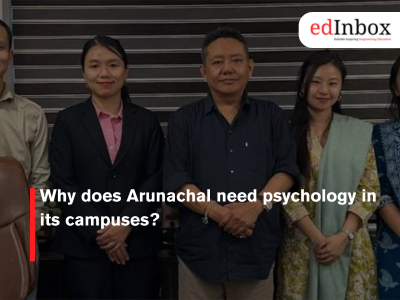
Why does Arunachal need psychology in its campuses?
Typography
- Smaller Small Medium Big Bigger
- Default Helvetica Segoe Georgia Times
- Reading Mode