
For decades,education systems across the world have focused almost exclusively on academic performance. Grades ranking competitive exams and outcomes became the definition of success. Somewhere along the way student wellbeing was treated like a nice to have rather than a necessity.That era is over.
Today Mental health curricula in education are no longer optional.They are essential. As students navigate academic pressure, social media overload identity struggle and an increasingly uncertain future.Schools are now rethinking and moving forward to handle mental health ,manage emotions and build resilience. Schools cannot focus only on marks and results while ignoring how students are actually feeling.Student wellbeing matters just as much as academic success,especially at the stage where students are making life shaping decisions.
What Students Are Really Dealing with- Stress is not new,but the intensity has changed .Many students feel anxious about the future,scared of disappointing their parents, or exhausted from trying to meet impossible standards. Some feel lonely even when surrounded by people.Other struggle silently,thinking something is wrong with them. The truth is simple.Nothing is wrong with you.The system just has not taught you how to deal with pressure. This is where mental health education becomes important. It helps students understand that emotions are normal, stress is manageable and asking for help is not weakness.
What Is a Mental health Curriculam- A mental health curriculum is not about diagnosing problems or forcing students to share personal details. It is about learning skills that help in everyday life. It teaches students how to understand emotions instead of ignoring them.They teach you to handle exam pressure and academic stress.Mental Health Curriculum helps to build confidence and self awareness,develop emotional intelligence.These skills not just help you just in exams,it teaches you to handle family relationships and future career.
Why Student Wellbeing Impacts Learning Outcomes- Student wellbeing is not separate from education,it is the foundation of it. Research consistently shows that students with strong emotional and mental health support better focus and memory,improve academic performance ,strong motivation engagement and reduce behavioural issues.Marks matter but they are not everything they understand when they know to balance emotions.Emotional intelligence is what helps students to stay calm during exams bounce back from poor results and communicate their feeling clearly.
Class 12th is a turning point.Decision made here shape future paths,but students cannot make healthy choices if they are not emotionally overwhelmed.Ignoring mental health leads to burn out self doubts and long term stress. Supporting mental health creates confident, balanced students who can handle challenges without breaking under pressure.Mental Health Curricula in education exists to remind students that success does not come at the cost of wellbeing.You are allowed to aim high and take care of yourself at the same time.
You are not weak for feeling stressed.You are human.Education should teach you how to succeed without losing yourself in the process.
What needs to be changed- mental health should be integrated ,not isolated.It should be accessed regularly in the schools ,every child is different and has different levels of emotional intelligence and handling behavioral skills. However schools must access the child behavior,emotions quotient and the reaction and responses they give when they are appearing in the exams, or attending the school in the normal life.Schools initiate to include mental health as curriculum so students will understand that studying mental health curricula is as important as maths or science is.
At Edinbox,conversations around mental health education, emotional intelligence and student wellbeing aim to support students beyond textbooks,helping them grow into confident learners and resilient individuals.
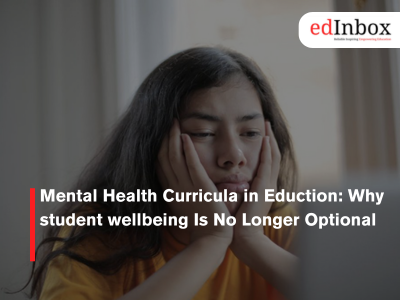
Mental Health Curricula in Eduction:Why student wellbeing Is No Longer Optional
Typography
- Smaller Small Medium Big Bigger
- Default Helvetica Segoe Georgia Times
- Reading Mode