
What instantly comes to the mind when we say "education"? For most of us, at least in K-12 conversations, the answer is "schools." Parents start searching based on board, fees, location, and peer groups.
Seldom does the search start with the more profound question: What do we want education to do? Stop and consider for a moment: education is far larger than mere schooling. It has to do with understanding the self, understanding the world, and building a life which fits into the world or sometimes helps reshape it. Schools should be a means to those ends and not the ends in themselves.
That distinction matters because institutions designed for a different time-period still carry significant ripple effects.
That design satisfied real needs of the time: safe places for children while adults worked, standard literacy and numeracy, pipelines into formal employment. But what worked in the last century doesn't necessarily work for today.
Two trends make this mismatch urgent: the nature of work and skills is shifting fast, as employers expect a large chunk of today's core skills to change within the coming decade, roughly two-fifths of the skills are likely to be transformed or become outdated by 2030.
Second, the "half-life" of many skills has been shortened: what took a decade to become old now loses strength in about four years in many fields. In other words, curricula built to last a generation risk producing adults trained for the past, not the world they will inherit.
There's also time: education works through long feedback loops. What we teach a child today usually shows its results 15-20 years later. That delay hides the cost of mistakes and rewards complacency. When a system is slow to show consequences, it is easy to keep on repeating these exam cycles, standardized metrics, and age-segregated cohorts without asking whether the map still matches the terrain.
I am not arguing that the schools should be phased out altogether; many schools do brilliant work. But we need to stop treating them as sacrosanct and unquestioned. When schools become equated with the definition of education, our imagination for alternatives narrows.
It's here the imagery of the garden/forest helps. Schools can be fabulous gardens- ordered, tended, lovely. Ecosystems survive on diversity; forests are a mess, interdependent, resilient. An education system designed for survival needs both.
Third spaces are those diverse, adventurous places taking risks schools often cannot. They are maker labs, museum workshops, peer mentor circles, community studios, and hybrid online-offline platforms where kids tinker, fail, iterate, build portfolios without the relentless pressure of marks.
Third spaces treat learning as a process, curiosity in motion rather than as an outcome to be measured by periodic exams. We already have openings. India's National Education Policy 2020 explicitly creates space for multiple pathways and non-formal modes of learning, an invitation to experiment beyond traditional classrooms.
On the ground, initiatives such as Atal Tinkering Labs build hands-on curiosity and design thinking in thousands of schools; MuSo-style spaces and other local makerspaces foster community projects and small ventures from prototypes. These examples illustrate how third-space ideas can be scaled up and linked with wider ecosystems.
Third spaces do more than supplement schools-they create healthy competition. When kids come back from these workshops curious, resourceful, and self-directed, that puts practical pressure on the schools to change.
That tension is generative, not oppositional: It drives the ecosystem to improve. Think of it like biodiversity: when many models coexist and iterate, the system as a whole grows stronger. Yet designing third spaces well takes intentionality. These would be safe, inclusive spaces with facilitators rather than lecturers, guiding inquiry, linked with local communities. Assessment of learning would be through portfolio evidence, peer review, and public showcases rather than standardized marks. But funders and policymakers must treat them as serious investments, not afterthoughts, and build pathways that let children easily move between school, community lab, and self-directed study without extra red tape or hurdles. We have to protect childhood. The present over-instrumentalised model trains children to be cogs, measured, bracketed, and ranked, often at the cost of curiosity, play, and agency.
Childhood is not merely preparation for adulthood; in itself, it's a phase for exploration and wonder. Third spaces protect that room for play, failure, and sustained curiosity. What do we do practically? Start simple and serious. Fund third spaces with clarity and scale, not as soft charity projects. Give parents and communities real choices and wherewithal to support them. Finally, to start-ups in this space, adopt a posture of humility and iteration: if the pilot fails, learn fast and pivot; if it works, scale thoughtfully. Keep in schools their fundamental social role, while making space for more variety in how kids learn. Let schools be gardens again: tended, organized, alive. But let us also leave space for forests to flourish - untamed, hardy, and teeming with surprise. On a landscape that prizes curiosity no less than expertise, if we want kids who can manage ambiguity, we need both.
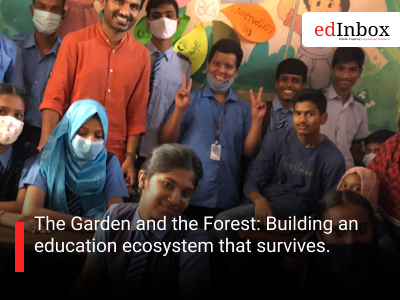
The Garden and the Forest: Building an education ecosystem that survives.
Typography
- Smaller Small Medium Big Bigger
- Default Helvetica Segoe Georgia Times
- Reading Mode