
In a student-friendly move aligned with the National Education Policy 2020, Panjab University has approved a provision allowing students enrolled in four-year undergraduate (UG) honours programmes to obtain a recognised degree or certificate after completing three years—without exiting the course.
The decision, cleared by a university committee and approved by the Vice-Chancellor, will apply across the university and its affiliated colleges.
Bridging a Critical Gap
The reform addresses a long-standing issue faced by students who complete three years of a four-year programme but are unable to apply for competitive examinations due to the absence of a formal graduation degree at that stage.
Under existing NEP provisions, students can receive a degree after three years only if they formally exit the programme. The new mechanism removes this limitation.
Students will now be eligible to receive a three-year degree or certificate while continuing into the fourth year, subject to certain conditions, including a nominal administrative fee. However, those who complete the fourth year will be required to surrender the interim certificate when receiving their final honours degree.
Flexibility Without Academic Disruption
University officials said the move is designed to offer flexibility without altering the academic integrity of the four-year honours structure. It ensures that students are not forced to discontinue their studies prematurely just to meet eligibility criteria for jobs or competitive exams.
The policy will be implemented uniformly across all departments and affiliated colleges under Panjab University.
Law Students Raise Parallel Demand
Meanwhile, the decision has sparked related demands from students enrolled in five-year integrated law programmes such as BA LLB and BCom LLB. Student leader Gurnoor Kanda has been protesting, urging the university to grant a corresponding undergraduate degree after three years in these courses as well.
He argues that the absence of such a provision restricts law students from applying to various competitive examinations.
Regulatory Hurdles Remain
University authorities, however, have indicated that changes to law programmes are more complex. Legal education in India is governed by the Bar Council of India, which prescribes course structures and degree norms. Any modification to degree awards in integrated law programmes would require approval from the regulatory body.
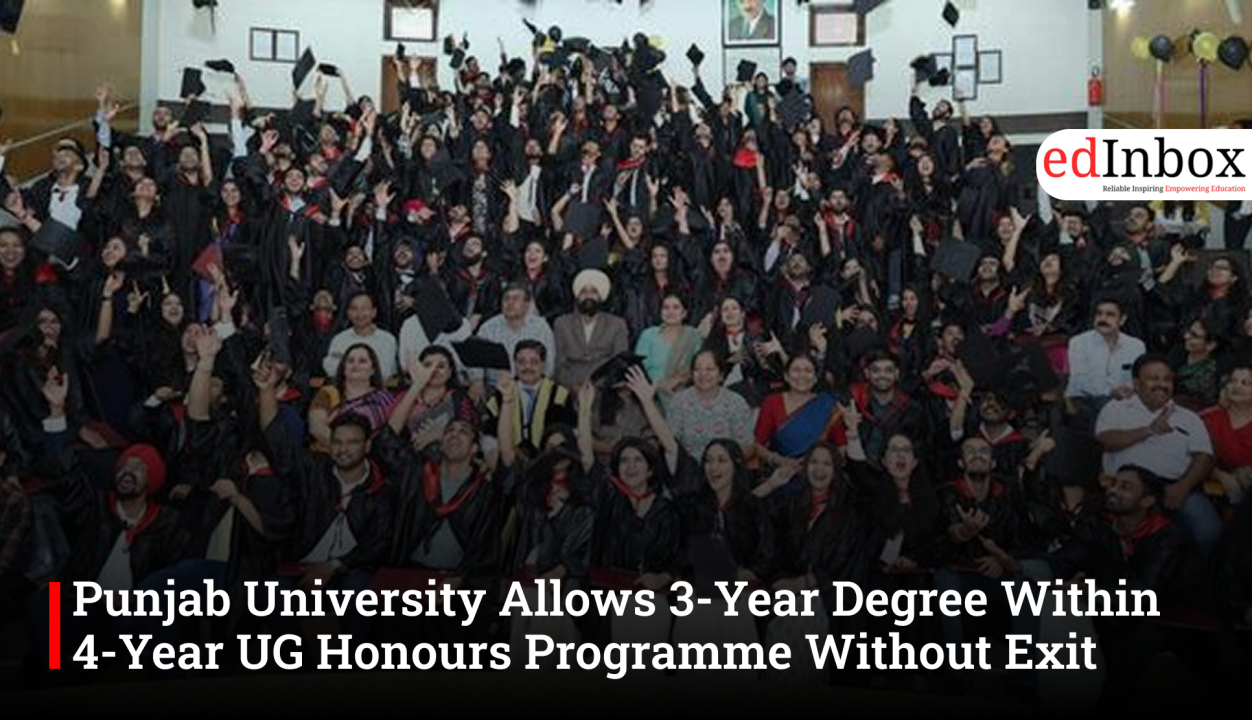
Panjab University Allows 3-Year Degree Within 4-Year UG Honours Programme Without Exit
Typography
- Smaller Small Medium Big Bigger
- Default Helvetica Segoe Georgia Times
- Reading Mode