
New Delhi: In a significant step toward aligning higher education with the National Education Policy 2020, University of Delhi has approved a series of academic reforms aimed at enhancing flexibility, global exposure, and digital learning.
The decisions, taken at the university’s latest Academic Council meeting, are expected to reshape postgraduate education and student mobility in the coming years.
One-Year PG Programmes Get Green Signal
Among the most notable changes is the introduction of one-year postgraduate (PG) programmes for students graduating from the four-year undergraduate framework. The move is designed to streamline higher education pathways and reduce the time required to earn advanced degrees.
The shorter PG courses are likely to be rolled out across multiple disciplines, including humanities, languages, mathematics, computer science, and journalism. Officials indicated that the reform is timed with the graduation of the first batch under the four-year undergraduate programme structure.
Semester Abroad Programme Approved
In a bid to internationalise education, the university has also approved a Semester Away Programme, allowing students to spend one semester at a foreign institution.
Credits earned during this period can be transferred toward a Delhi University degree, subject to equivalence and course alignment. The initiative is expected to expand global exposure while maintaining academic continuity within the university system.
Expansion of Online and Distance Learning
The School of Open Learning and the Centre for Open Learning will see an expansion of undergraduate and postgraduate programmes from the 2027–28 academic session.
Proposed courses include English, Commerce, Computer Science, Multimedia, MBA programmes, and foreign language certifications. However, officials noted that implementation will depend on infrastructure readiness and academic preparedness.
MOOC Credits Through SWAYAM
In another move toward digital integration, DU has approved allowing students to earn up to 5% of their academic credits through online platforms such as SWAYAM and other recognised MOOCs.
While the proposal supports flexible learning, it has also sparked debate among some council members, who raised concerns about academic standards and clarity in execution.
Focus on Research and Innovation
To strengthen research quality, departments have been asked to compile lists of top academic journals within 30 days, along with scoring systems and rankings. This aims to standardise publication benchmarks across disciplines.
Additionally, the university has approved renaming its Research Council as the Research, Innovation and Entrepreneurship Council, signalling a broader focus on applied research and innovation-driven outcomes.
New Academic Programmes Approved
The Academic Council also cleared new DM super-speciality programmes at Lady Hardinge Medical College and Maulana Azad Medical College, with two seats each annually.
Further, a two-year M.Ed programme with 50 seats has been approved for Maharishi Valmiki College of Education, subject to regulatory compliance.
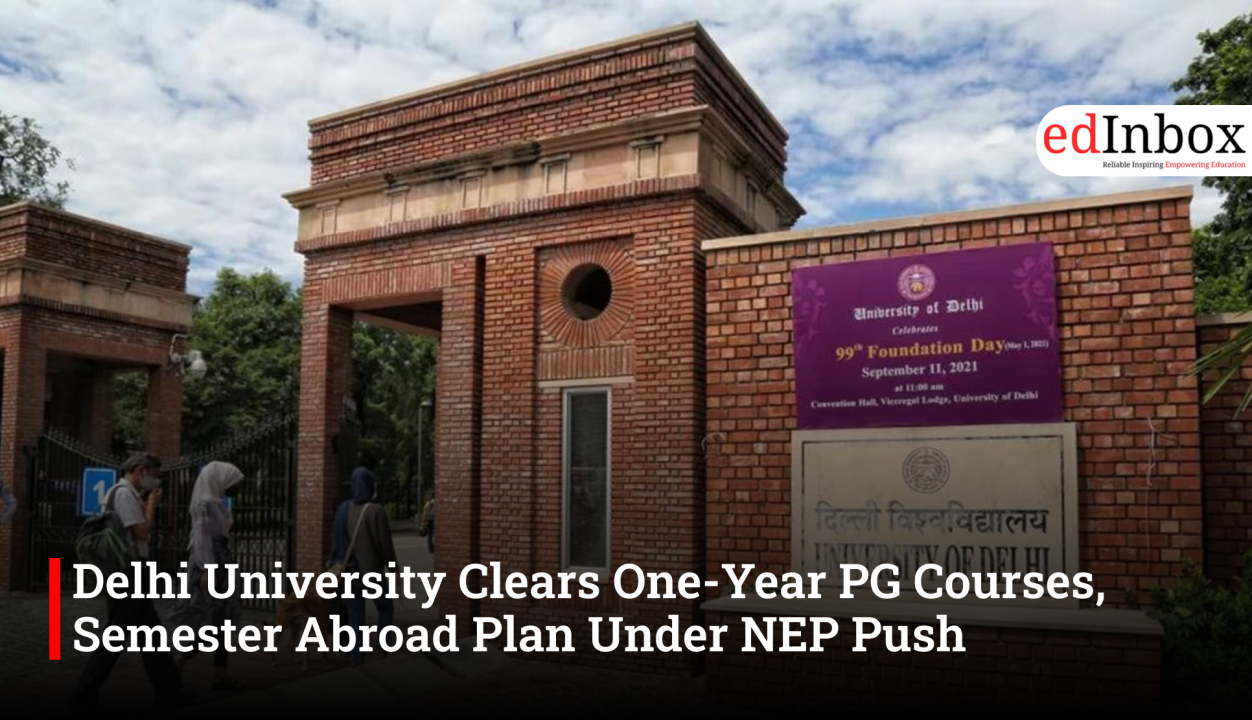
Delhi University Clears One-Year PG Courses, Semester Abroad Plan Under NEP Push
Typography
- Smaller Small Medium Big Bigger
- Default Helvetica Segoe Georgia Times
- Reading Mode