
National Human Rights Commission member Priyank Kanoongo on Tuesday alleged that an “education mafia” was attempting to obstruct efforts aimed at ensuring affordable school education through the wider use of government-published textbooks.
In a post on X, Kanoongo said he had directed state governments to promote the use of National Council of Educational Research and Training and State Council of Educational Research and Training books in private schools instead of expensive textbooks published by private companies.
According to Kanoongo, the directive was issued under powers available through the Protection of Human Rights Act 1993 and within the framework of the Right of Children to Free and Compulsory Education Act 2009.
“The education mafia is employing a policy of ‘saam daam dand bhed’ to pressure and overturn my order,” Kanoongo said, adding that attempts to stay or stop the directive would not succeed.
He further stated that the effort was intended to protect economically weaker and middle-class families from excessive education-related expenses.
NHRC had earlier issued notices over the costly private books
Earlier, the National Human Rights Commission had issued notices to the Ministry of Education, the Central Board of Secondary Education, and all states and Union Territories over allegations that schools were compelling parents to purchase costly books from private publishers.
The commission had expressed concern that prescribing multiple supplementary books and workbooks imposed a heavy financial burden on families.
NHRC also noted that such practices may violate provisions of the National School Bag Policy 2020, which seeks to regulate the weight of school bags and discourage unnecessary academic materials.
Complaint alleged financial burden on families
The action reportedly followed a complaint submitted by Namo Foundation, which alleged that many schools were forcing students to buy expensive private textbooks despite the availability of subsidised NCERT materials.
The complaint argued that privately published books often cost significantly more than government textbooks, increasing educational expenses for low-income and middle-class households.
Supporters of wider NCERT and SCERT adoption argue that standardised government textbooks help reduce education costs while maintaining curriculum uniformity. Critics, however, have previously argued that some schools prefer private materials for supplementary content and customised learning approaches.
The issue has renewed debate around affordability, regulation of private schools, and the commercialisation of school education in India.
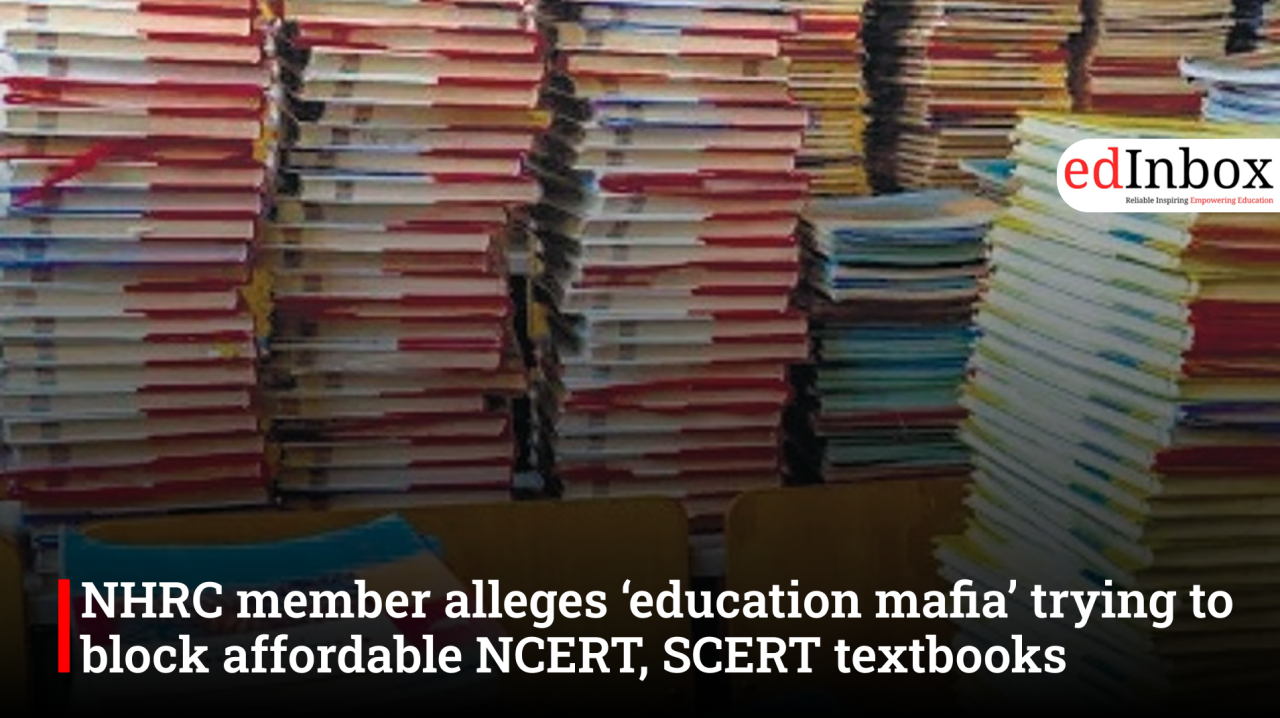
NHRC member alleges ‘education mafia’ trying to block affordable NCERT, SCERT textbooks
Typography
- Smaller Small Medium Big Bigger
- Default Helvetica Segoe Georgia Times
- Reading Mode