
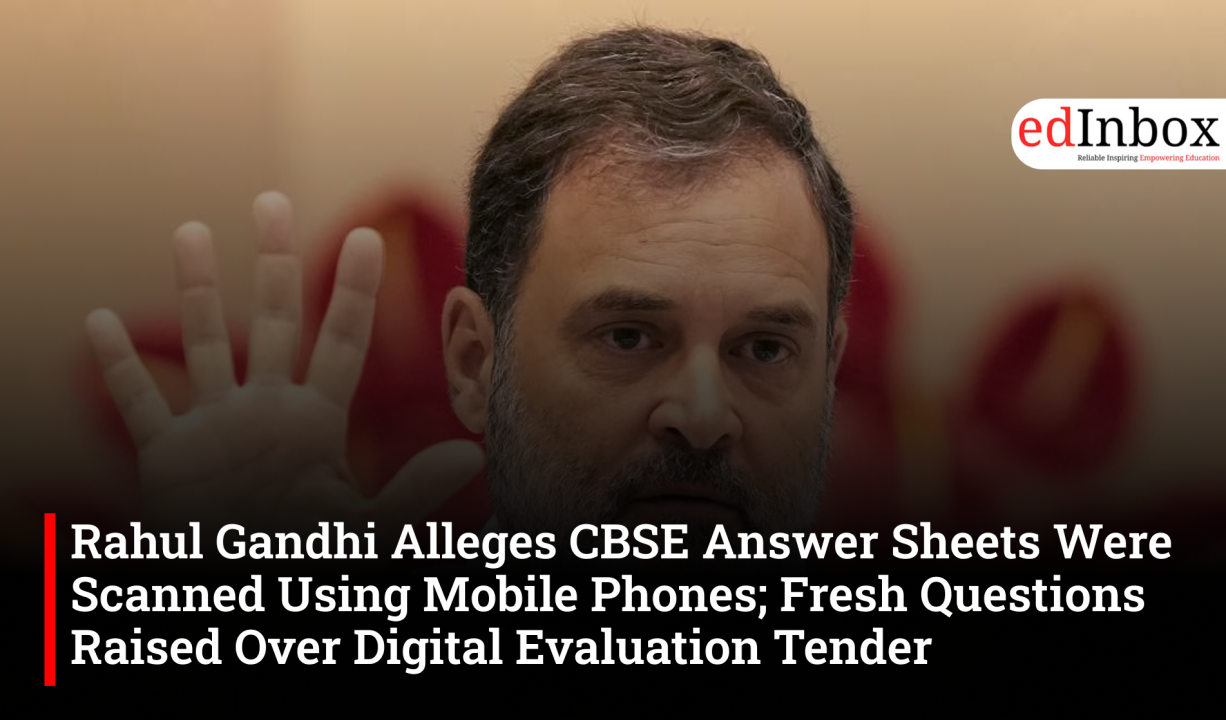
Congress MP Rahul Gandhi has intensified his criticism of the government and the Central Board of Secondary Education (CBSE) over allegations surrounding the board's On-Screen Marking (OSM) system, claiming that answer sheets may have been scanned using mobile phones instead of professional scanning equipment.
The allegations are linked to CBSE's large-scale digital evaluation initiative for Class 12 examinations and have reignited debate over the board's tender process, data security measures and evaluation standards.
In a post on X, Gandhi cited concerns raised by student researcher Sarthak Sidhant, whose document-based investigation has drawn attention to alleged changes in the tender conditions related to the digitisation of answer books.
Rahul Gandhi Questions Changes in CBSE Tender Conditions
According to Gandhi, CBSE's initial tender issued in May 2025 reportedly required answer sheets to be scanned using automated robotic scanners, with preserved spines and a minimum scanning resolution of 300 DPI. However, he alleged that a revised tender issued later removed or diluted some of these technical requirements.
"CBSE's May 2025 tender required answer sheets to be scanned with automatic robotic scanners, spines preserved, at a minimum of 300 DPI. The tender re-issued in August quietly removed all of it," Gandhi wrote on X.
He further alleged that answer sheets were scanned using mobile phones after the revised conditions came into effect, claiming that issues such as blurred images, missing pages and incomplete scans may have resulted from the altered process.
Student Researcher Raises Concerns Over Scanned Answer Sheets
The controversy gained momentum after social media discussions involving Class 12 student researcher Sarthak Sidhant and ethical hacker Nisarga Adhikary, who have both raised questions regarding the implementation of the OSM system.
Adhikary claimed that vulnerabilities in the online marking portal could potentially allow access to scanned answer booklets. Screenshots of answer sheets circulated online subsequently became a subject of scrutiny.
While examining some of the images, Sarthak pointed to visible drop shadows and fold marks appearing on certain scanned answer sheets. He questioned whether such characteristics would normally appear if professional document scanners had been used.
In a post on X, he asked whether the observed shadows and folds indicated that answer sheets may have been digitised using alternative methods rather than dedicated scanning equipment.
Questions Over Vendor Selection and Procurement Process
At the centre of the controversy are allegations related to the procurement process and the selection of the vendor responsible for digitising answer books.
Critics have alleged that technical eligibility criteria and security requirements were modified between the original and revised tenders. Some have questioned whether these changes influenced the awarding of the contract to private vendor COEMPT Edu Teck, which was tasked with digitising answer sheets for the OSM system.
Opposition leaders and student groups have argued that the procurement process should be examined to ensure transparency and accountability.
CBSE Digital Evaluation System Faces Scrutiny
The On-Screen Marking system was introduced as part of CBSE's efforts to modernise the evaluation process and improve efficiency through digital assessment.
However, recent allegations have led to broader discussions about data security, scanning quality, evaluation accuracy and the safeguards required when handling examination records affecting millions of students.
The controversy has also attracted attention from cybersecurity researchers, education activists and student communities who are seeking greater clarity regarding the implementation of the digital evaluation platform.
Allegations Yet to Be Independently Verified
The claims regarding mobile phone scanning, tender modifications and security vulnerabilities have been widely circulated on social media and amplified by opposition leaders. However, the allegations remain contested, and no official findings have yet been released publicly to conclusively establish the claims.
The developments have nevertheless intensified scrutiny of CBSE's digital evaluation process, with students, parents and education stakeholders closely watching for further responses from the board and concerned authorities.
Rahul Gandhi Alleges CBSE Answer Sheets Were Scanned Using Mobile Phones; Fresh Questions Raised Over Digital Evaluation Tender
Typography
- Smaller Small Medium Big Bigger
- Default Helvetica Segoe Georgia Times
- Reading Mode