
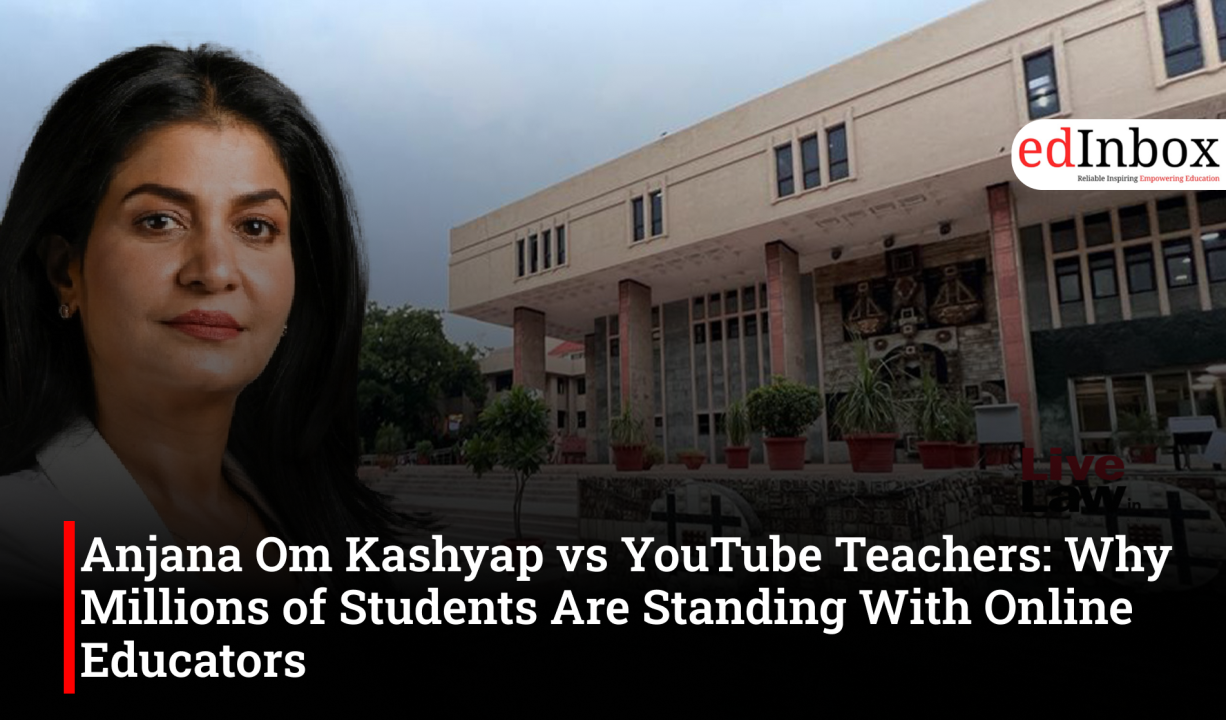
Are YouTube Teachers Teaching for Fame, or Because They Remember What It Felt Like to Struggle? The recent controversy between journalist Anjana Om Kashyap and some of the top YouTube educators has once again put the online education landscape in India under the spotlight.
The debate has been mostly about whether YouTube teachers value views over knowledge, but a more profound and intriguing question has emerged:Why did YouTube teachers become so reliable in the first place?
It's not the number of subscribers, viral videos or social media trends; the reasons why millions of students trust online educators is not something that can be understood from the screen but rather from the realities of Indian education itself, where access has often been based on geography, affordability and circumstance.
YouTube teachers are not just teachers for many students, they are opportunities that were not available to previous generations. And this is why these teachers are being chosen over anyone else.
The Students Who Could Not Afford Coaching
In India, quality education for decades was often expensive and many families could not afford it. Coaching institutes started to be associated with competitive exams, special study material and costly classroom programmes, leaving a divide between students who could afford these and those who could not.
A student from Delhi, Kota or Hyderabad would have more opportunities than a student from a remote village or small town. There was talent everywhere, but access was not.
YouTube education in India changed all that. A student who was studying for UPSC, NEET, JEE, SSC or Banking exams could suddenly learn from experienced teachers without paying coaching fees sometimes in the tens of thousands of rupees. What began as free educational videos gradually evolved into one of the largest learning movements the country has witnessed.
Why do students feel a personal connection with online teachers?
YouTube teachers are so beloved because many students see themselves in the struggles of these teachers.
Many of India's most popular online teachers are from humble beginnings. There are many who have openly discussed learning with meager resources, travelling far for learning, borrowing books or preparing for exams without elite coaching institutes.
These experiences affect their teaching, either intentionally or unintentionally. They frequently teach as if they were talking to a friend. Their guidance is not just academic, it's about motivation, confidence and perseverance. Students are not just consumers of content, they are creators of trust. This trust is what makes it so easy to get a response to criticism of an online educator, compared to criticism of a regular internet personality.
Fame Was a Result, Not the Starting Point
There's little doubt that fame is a factor in the current digital education landscape. Some teachers have emerged as national celebrities, with millions of subscribers and brands that rival the big media. But it was not always the beginning of fame.
The majority of effective learning pathways started with a simple concept: to make knowledge available to learners who needed it. Many popular teachers' earliest videos were recorded with little equipment, poor production quality and little assurance of success. But they were not sophisticated, they were accessible. Students responded because they felt these teachers were addressing real problems rather than merely creating content. The fame came later.
The Criticism Is Not Entirely Wrong
Meanwhile, the controversy over Anjana Om Kashyap's comments should not be ignored. With the growth of online learning, the commercial potential grew as well. The educational channels turned into businesses. The number of subscribers became marketable assets. Free lessons evolved into paid courses, subscription models and large-scale learning platforms.
Educators who started with free content now charge up to, and sometimes more than, coaching institutes for premium programmes. Some critics say that the industry has become more marketing, branding and revenue oriented.
That's a fair statement. As with all successful industries, commercial interests have been drawn to the growth of online education. But is it wrong? Of course not, because if there’s no money, people would be compelled to not take such good-cause initiatives. Additionally, it is not harming students.
The Bigger Story Is Still About Access
While the emphasis on commercialisation is important, it is essential to not forget the bigger change that YouTube teachers have introduced in Indian education. Thousands of teachers keep uploading free lectures, revision classes, current affairs discussions and exam strategies to the site every day, and students who may never buy a paid course are still benefiting from it. Many of these teachers work outside the spotlight, but their content is delivered to learners in areas where educational resources are scarce.
A free YouTube lecture can be more useful to a student who is studying for a government exam in a rural area than any discussion about the business of online learning. That's why so many students still stand up for digital educators even in the face of criticism.
The distinction between influence and impact
The debate also brings up a key difference. Views, subscribers and social media engagement are used to measure influence. The impact is measured by lives changed, examinations cleared and opportunities created.
There are some YouTube teachers who clearly have influence. The real question is if they make an impact. Based on the millions of students who attribute their admission to universities and competitive exams to online teachers, and their access to quality learning, the answer seems to be yes.
Not all teachers are great, and not all channels are reliable. As with any ecosystem, there are true contributors and opportunists in online education. The difficulty for students is to differentiate between the two. And genz + gen alpha are smart enough to differentiate, unlike the older generations.
Perhaps the Answer Is Both
It's not necessarily easy to answer whether YouTube teachers are teaching for fame or because they recall their struggles.
There are definitely some who are driven by recognition, influence and business growth. Others seem to be motivated by a sincere wish to make education more accessible than it was to them when they were students. Most likely, many are somewhere in between those two extremes.
The influence they have had on Indian education cannot be denied. YouTube teachers are not famous, and that's not why millions of students continue to trust them. It is because for so many students nationwide, these teachers came when they needed someone to guide them at a time when it was hard to find someone to help them.
Maybe that's why this debate is so resonant. For every viral teacher, every trending controversy and every social media argument, there is a student who just wanted a fair chance to learn and make the most out of the accessibility the internet brings.
Anjana Om Kashyap vs YouTube Teachers: Why Millions of Students Are Standing With Online Educators
Typography
- Smaller Small Medium Big Bigger
- Default Helvetica Segoe Georgia Times
- Reading Mode