
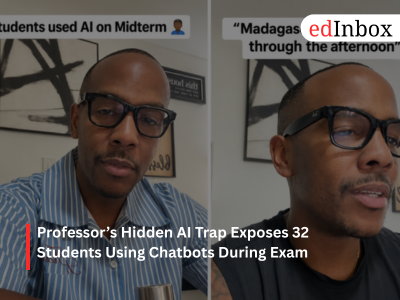
A history professor at Alcorn State University has sparked widespread discussion on the use of artificial intelligence in education after a cleverly designed hidden prompt exposed 32 students who appeared to rely on AI chatbots during an examination.
The incident involved Jason Gibson, who embedded an invisible instruction inside an exam question on the Industrial Revolution. The hidden text, formatted in white font against a white background, was invisible to students reading the question normally but could be copied along with the visible text if pasted into an AI chatbot.
When the exam papers were submitted, Gibson noticed an unusual pattern. Out of 35 submissions, 32 answers unexpectedly included the word "Madagascar", despite the African island nation having no relevance to the Industrial Revolution question.
The repeated reference suggested that students had copied the entire exam prompt—including the concealed instruction—into an AI chatbot, which faithfully followed the hidden command when generating responses.
According to reports, Gibson awarded no marks for that section of the examination to the students whose responses contained the hidden clue. The professor later explained that he adopted the strategy after observing that several students had begun submitting assignments with remarkably similar writing styles that differed significantly from their classroom performance.
Hidden Prompts vs AI Detection Tools
The incident has reignited debate over the effectiveness of AI detection software in educational institutions.
While many universities rely on AI-detection tools to identify machine-generated content, researchers have repeatedly questioned their reliability. Experts note that students can often bypass detection systems by rewriting AI-generated text or using automated tools that modify sentence structure and vocabulary.
A 2024 study led by researcher Mike Perkins and six co-authors evaluated six AI detection systems across 805 writing samples. The researchers found that the average detection accuracy dropped dramatically—from 39.5% to 17.4%—after AI-generated content was altered using common evasion techniques.
Another independent study led by Debora Weber-Wulff, published in the International Journal for Educational Integrity, assessed 12 publicly available AI detectors along with two commercial products. The study concluded that existing AI detection systems were not sufficiently accurate or reliable to determine whether written work had been produced by artificial intelligence.
A New Challenge for Educators
Gibson's hidden prompt provided a more direct indication that AI tools had been used than relying solely on detector scores. However, education experts caution that the presence of the hidden instruction alone does not prove how extensively students relied on AI. It cannot determine which chatbot was used, whether responses were entirely AI-generated, or whether students edited the content before submission.
The incident highlights the growing challenge schools and universities face as generative AI becomes increasingly accessible. Rather than depending exclusively on AI detection software, many educators are exploring alternative assessment methods, including oral examinations, project-based learning, handwritten assessments and creative techniques such as hidden prompts to preserve academic integrity.
As artificial intelligence continues to reshape education, institutions worldwide are reassessing examination practices to balance technological innovation with fair evaluation and authentic student learning.
Professor’s Hidden AI Trap Exposes 32 Students Using Chatbots During Exam
Typography
- Smaller Small Medium Big Bigger
- Default Helvetica Segoe Georgia Times
- Reading Mode