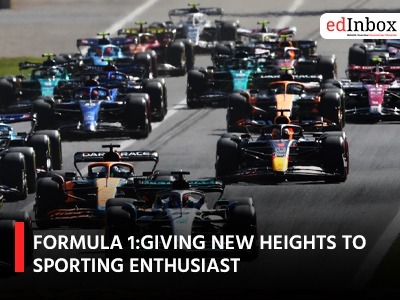
Sport is an age-old reflection of human excellence - our capacity to push limits, ignore boundaries and have fun while playing. Sport takes myriad shapes, but within the body of sport. From the odd and gnarled sounds of twin turbocharged engines running through the small, nimble and literal symphony of planning and ultimately executing a pit stop, Formula 1 is not just racing; it is a symphony, at full throttle, enjoyed by millions of people around the world. Formula 1 (F1) embodies the convergence of technology, human dexterity, energy, and spectacle. It includes the bellowing roar of turbocharged engines, the element of pit-stop strategy, and the essence of human nature in every riveting race.
Recently, Formula 1 has experienced a renaissance surge in fandom and interest. This surge is not limited to hardcore race fans, but includes Medium and Casual sports; sports fans and followers, engineering enthusiasts, pop culture followers, and some social justice or environmental crusaders. This influx of interest is not coincidence or coincidence - it's more intentional and a transformational evolution of the sport as a whole, driven by democratisation of the sport through innovation, inclusivity, storytelling, and globalisation. With a multifaceted, emotionally engaged, intellectually, and culturally embedded phenomenon, their own experience also allows Formula 1 to reach new heights that sport enthusiasts are strongly driven by.
Speeding Ahead: A Historical Perspective
With roots tracing back to the period right after the Second World War, Formula 1s early history dates to the first official World Championship in 1950 held at Silverstone, United Kingdom. In its early years, the races barely featured machines of absurd speeds and almost no safety, revealing the testing of human courage displayed by drivers like Juan Manuel Fangio and Alberto Ascari. Through the years, Formula 1 has matured from eras defined by legendary drivers Jim Clark, Niki Lauda, Ayrton Senna, and Michael Schumacher.
Since its inception, Formula 1 has transformed from a profile worthy of being a European sport to an international theatrical spectacle, and a truly global one at that. Races on five continents, with an annual schedule featuring glittering locations such as Monaco, Singapore, and Abu Dhabi, Formula 1 has taken its rightful place as the world's largest sport, and it has achieved this by creating a massive global audience. In short, it is the evolution of legacy and reinvention which has birthed one of the most exciting sporting products in the world today, and periodical cars changing in size and shape.
Formula 1 was formerly restricted to a narrow audience of wealthy society or auto-racing enthusiasts. Today's fans around the world are now safely informed, owing mostly to technologies like broadcast and communications, as well as media in the digital space and fan experiences sometimes bordering on the unreal. It is safe today to say that F1, and its five continents, gives back to a global audience - where viewership regularly numbers in the millions and a following which expands every season.
The Thrill Factor: Speed, Skill, and Strategy
Formula 1 uniquely offers a powerful combination of speed, skill, and strategic complexity. Racing at such astonishing speeds (more than 350 km/h), experiencing G-forces that stretch the limits of the human body, and resulting in very slim margins just adds to the volatility of the race.
Unlike other sports where the emphasis is solely on athleticism, Formula 1 is a complex mix of mechanical integrity as well as mental capability. The drivers must have split second reactions, all the while constantly adjudicating reasonably variant tracks, weather conditions, and level of mechanical reliability. Formula 1 is an intellectual sport where tactics - particularly, around pit stops, tire selections, and fuel supply - will generally determine the winner of the race more than pure speed.
The added variables in Formula 1 means that each race becomes not just a contest of mechanical machines, but also an environment of contesting minds, which mentally stimulates the sports fan to dissect and internalize the race to formulate their understanding of what just happened.
Beyond Speed: The Complexity of the Sport
The casual observer may view Formula 1 as a vehicle with 4 wheels going round and round on a circuit, but the true enthusiast understands that it is a nano-second sport with extreme capacity for complexity. It is more than just an assessment of the rate of how fast a car could go; Formula 1 is an assessment of the precision of how much a driver can brake to get into a corner, the efficiency at which a team can execute a pit stop in under three seconds, or how smart engineers can use the data to find performance.
The vehicles themselves are brilliant pieces of machinery. Thanks to hybrid power units, a sophisticated aerodynamic package, and materials technology (carbon fiber, etc.) each Formula car is a development from the forefront of technological and engineering thinking. Engineers are continually adapting for factors like fuel loads, weather, tire deterioration, track conditions, etc., to maximize performance of a Formula 1 car.
For the sporting enthusiast who enjoys mental challenges as well as physical challenges, Formula 1 offers a world of interest, and are aspects of the sport that create curiosity for eternal fascination. F1 is nothing else but strategy, timing, technology, and human execution working in harmony in a way that very few sports can create.
Worldwide Appeal: A Genuine Global Sport
Formula 1's rise as a global product has opened it up to a much larger fan base. The championship's calendar now features over 20 races in a number of nations from Australia to Japan, Saudi Arabia, Brazil, and the United States. Each race weekend is as much an event about speed, and also local culture and world unity.
This global exposure appeals to those who love sport and appreciate competition on an international stage. The variety of circuits from a flat out Monza in Italy to the street circuits of both Monaco and Singapore provides variation in thrill to their annual calendar. It also makes it easier for people to attend a Formula 1 season and experience it live and in person from different geographic locations around the world.
On top of that, F1’s local content productions, regional commentary, and focus on international drivers has helped create a fan base on all continents (just ask those fans and you will see they are passionate), especially in Asia, Latin America, and most recently the USA.
The Netflix Effect: Making F1 Pop Culture
The most significant moment for Formula 1 in recent years came from the hit Netflix documentary series *“Drive to Survive,”* that aired for the first time in 2019. The show gave the grand prix a human aspect, illustrating the rivalries, elite wants, and psychological strain on drivers and team principals.
For first-time audiences with no knowledge of specific car terminology, there was also a very good way in. Formula 1 was no longer a niche motor sport, it managed to transform a motorsport into a narrative driven drama and thus made it relatable to the masses.
The effect of *"Drive to Survive"* has not only pulled in brand new F1 fans into the sport and left a new generation of F1 enthusiasts, but it has enabled audiences to be highly engaged with little direct effort. F1 fans are now not simply watching races, they engage with F1 podcasts, engage with F1 merchandise, engage with F1 fantasy leagues, engage with F1 social media, etc. As they are now emotionally engaged, they have these channels and touchpoints that now make them a part of the F1 community beyond race weekends.
Inclusivity, Diversity, and an Evolving Culture*
Formula 1 is also actively working on becoming a more inclusive, diverse sport. Some examples of initiatives being developed are *F1 Academy, a program that fosters women in motorsport, and partnerships with various organizations/initiatives like *Mission 44*, founded by Lewis Hamilton.
Each of these initiatives opens the door for the sport to broaden its reach from its previous narrow demographic base.
The sport's active work to become more inclusive racially, geographically, and economically, is not only important from a moral standpoint, but is also critical from a business standpoint in order to attract the growing global audience who is looking for deeper engagement, beyond the television screen. As the sport continues to democratize its access to participation, and spectatorship, the opportunities for new fans and fresh talent will begin to happen exponentially.
Economic and Experiential Worth
Formula 1 is more than just a race day; it provides significant economic value to host cities, including in tourism, hospitality and global destination exposure. Grand Prix weekends are designed as true entertainment festivals nowadays, including concerts, fan zones, VIP experiences and cultural showcases.
This experience has made attending a Formula 1 event a bucket-list exercise for many sports fans, providing opportunities for travel, entertainment and sport all in one fabulous experience.
For instance, the night race at the Singapore Grand Prix has turned into a global event and globally recognized shake-up in sport, featuring a pace of lights, skyline, and sound. Also, the Las Vegas Grand Prix which started in 2023 brought Formula 1 racing to the literal heart of entertainment capital, wherein new levels of immersive sports-tourism were created for the die-hard 'F1 fan'.
Challenges and Future Outlook
While along the path of effects of risks and benefits to the sport of professional motorsport, Formula 1 is not without challenges. The sky high costs for entrants, access to sustainable resources, and/or excessive saturation and/or dominance for a few particular elite teams are threats to the integrity of the competition of the sport. In addition, the global reach for races in a multitude of counties, will need to focus on varying cultural sensitivities and unify rules and regulations across nations.
Thus far the FIA nor Liberty Media (the commercial rights holder of F1) have shown an ability and willingness to cope with these challenges. The extended race calendar with more races added to support multiple-day/multiple-race formats, sprint races, re-vamped Paddock Club; as inducting fan engagement models for the streams in formats with regular engagement around teams' driving talent are still all massive updates done with scope to measure and add into the evolving sport.
The future for Formula 1 looks bright. In addition to the promising 2026 new engine format presumably leading to even higher levels of technology innovation, and relentless investment opportunities externally with momentum in supporting younger drivers and supporting fan engagement and enthusiasms, with even more scope and aspiration for the wider audience with medium and next level platforms, the future breaks even closer towards more accessibility to frequent masses of and more fiercely competitive events than ever!
Conclusion: The Height of Passion and Precision*
Today’s Formula 1 stands for *speed, science, strategy, and spectacle* combined. A sport that requires technical execution and emotional intelligence, individual skills and team synergy, Formula 1 is, for the contemporary sport devotee, not "simply" a race; it is a continually unfolding narrative, an intellectual pursuit, a cultural event, and an emotional engagement.
By extending its international footprint as it has, enjoying increasing digital sophistication, committing to sustainability and human story-telling, Formula 1 is not only keeping pace with a crowded sporting landscape, it is *flying higher*.
More than ever, sports fans want more from an experience than the final score, and Formula 1 comes up with a sizing that is multi-dimensional, interactive, multi-disciplinary, and ultimately satisfying. Whether you're a passionate follower of Ferrari's great ascension, a gawking admirer of Mercedes' supremacy, an unapologetic supporter of Lando Norris or Oscar Piastri, or anyone who appreciates the hour of pit wall invention—Formula 1 represents something important for everyone.
In summary, Formula 1 is not changing motorsport—it is redefining what it means to be a sports fan in the 21st century.
BY- ANANYA AWASTHI