
India's higher education is undergoing a seismic transformation with the Viksit Bharat Shiksha Adhishthan (VBSA) Bill 2025 proposing to replace the University Grants Commission (UGC), AICTE and NCTE with a single regulator. Introduced in the Winter Session of Parliament, this NEP 2020 aligned reform is aimed at doing away with overlapping rules, expediting approvals, bringing IITs and IIMs under a single roof for the first time - triggering debates over quality, centralization, and student access.
What is VBSA?
Viksit Bharat Shiksha Adhishthan (VBSA) 2025 is a unified regulatory body the government of India is considering to implement in place UGC, AICTE and NCTE.
Established in 1956 under Maulana Abul Kalam Azad, the UGC coordinated the standards of universities for decades. Now, VBSA comes out as the highest umbrella commission with 12 members presiding over three specialised councils:
- Viksit Bharat Shiksha Viniyaman Parishad (Regulatory Council): Regulation and Enforcement.
- Viksit Bharat Shiksha Gunvatta Parishad (Accreditation Council): Quality ranking and recognition.
- Viksit Bharat Shiksha Manak Parishad (Standards Council): Curriculum and Academic Standard
Each council may have up to 14 members, including representatives of the states and experts on the subject matter. Funding shifts from UGC grants to direct Ministry channels, ending dual grant-regulation roles. First, IITs, IIMS and all higher education institutions (central, state, private, open universities) will work on the same standards.
Tough Penalties: ₹2 Crore Fines for Fake Colleges
VBSA introduces strict enforcement:
Violation
Penalty
Rule breaches
₹10-75 lakh
Unaccredited operations
Up to ₹2 crore
Repeated violations
Degree suspension/closure
Key note: President appoints chairpersons (3-5 year terms, extendable). The Centre can dissolve councils if needed, targeting substandard institutes issuing fake degrees that plague students annually.
Why Now?
Because NEP 2020 is fixing the flaws of UGC’s multiple regulator mess.
Education Minister Dharmendra Pradhan pointed out overlaps between UGC, AICTE and NCTE which were leading to delays and confusion.
- Single-window clearances for speedy decisions
- Global alignment with foreign university norms
- Focus on accreditation outcomes rather than inputs
Critics caution that over-centralization hurts state universities serving EWS/SC/ST students (60%+ reserved seats). Its proponents argue that the bill improves India's race towards Class Universities amid 1,600+ HEIs with 4 crore annual enrollments.
What does this mean for Indian Students?
In the case of VBSA, transparency in selecting colleges is ensured by obligatory accreditation, and thereby Class 12 passouts are saved from the scam of fake degrees as well as simplifying credit transfers. Colleges with single-window admission accelerate the admissions but may charge higher fees to colleges that are privately owned- watch out of scholarships and quotas. Rural/ EWS students gain in the evenness of online learning standards; state universities lose the flexibility.
Status of Bill & Next Steps
The bill was proposed on December 15, 2025 and awaits debate during the Winter Session. Track it through pib.gov.in/education.gov.in. In case it is approved, it will be rolled out in 2026-27 and will impact college admissions, fees, and rankings in general. Searches such as “VBSA Bill 2025 explained” are mushrooming proving that the talks are real and misunderstanding might surface which is why it is always better to trust the news shared on the official PIB portal. Lastly, students and parents, stay prepared to make new changed decisions in colleges in the future.
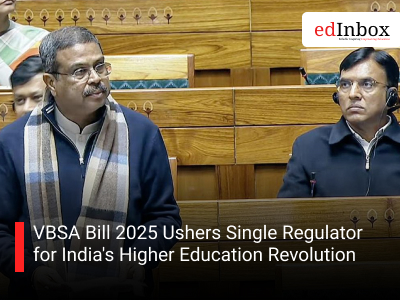
VBSA Bill 2025 Ushers Single Regulator for India's Higher Education Revolution
Typography
- Smaller Small Medium Big Bigger
- Default Helvetica Segoe Georgia Times
- Reading Mode