
With more than three lakh students appearing for the CAT examination every year in hopes of securing admission into India’s top business schools, concerns around employability, rising competition, and the future relevance of MBA degrees are intensifying. Against this backdrop, Amrish Patel, Chancellor of SVKM's NMIMS, has said that traditional degrees alone may no longer guarantee career security in an increasingly AI-driven economy.
Speaking in an interview with ET Education, Patel argued that management education must move beyond conventional classroom models and focus more on adaptability, leadership, critical thinking, and real-world problem-solving. He stressed that the rapid growth of artificial intelligence and digital technologies is fundamentally reshaping industries and redefining employer expectations.
“A degree alone won’t save careers anymore,” Patel said, highlighting how employers are increasingly valuing skills, practical exposure, and the ability to navigate uncertainty over academic credentials alone.
The conversation comes at a time when India’s MBA ecosystem is facing growing scrutiny over return on investment, placement pressures, and skill gaps. While lakhs of aspirants compete annually for seats in premier institutions, experts say only a small percentage ultimately secure admission into top-tier business schools, intensifying stress and psychological pressure among students.
Patel also reflected on the widening gap between aspiration and access in higher education, particularly as rising fees and competitive admission systems make elite management education inaccessible to many students. He argued that technology, if used responsibly, could help create more personalised and equitable learning experiences.
According to the discussion, the future of management education may increasingly depend on how institutions integrate AI, industry collaboration, experiential learning, and interdisciplinary thinking into their programmes. Experts believe business schools can no longer rely solely on legacy brand value or theoretical curricula in a rapidly changing labour market.
The debate around the future of MBA programmes has intensified globally as companies place greater emphasis on practical capabilities, digital literacy, and innovation skills. Many recruiters are now seeking professionals who can combine business knowledge with data interpretation, strategic thinking, and technological adaptability.
Patel’s remarks also align with broader global conversations around the transformation of universities in the AI era, where institutions are being urged to redesign learning systems around reasoning, leadership, and decision-making rather than rote information delivery.
As India prepares for another highly competitive MBA admission cycle, education experts say the larger question may no longer be simply where students study, but whether institutions are preparing them for careers that are constantly evolving under the influence of AI and automation.
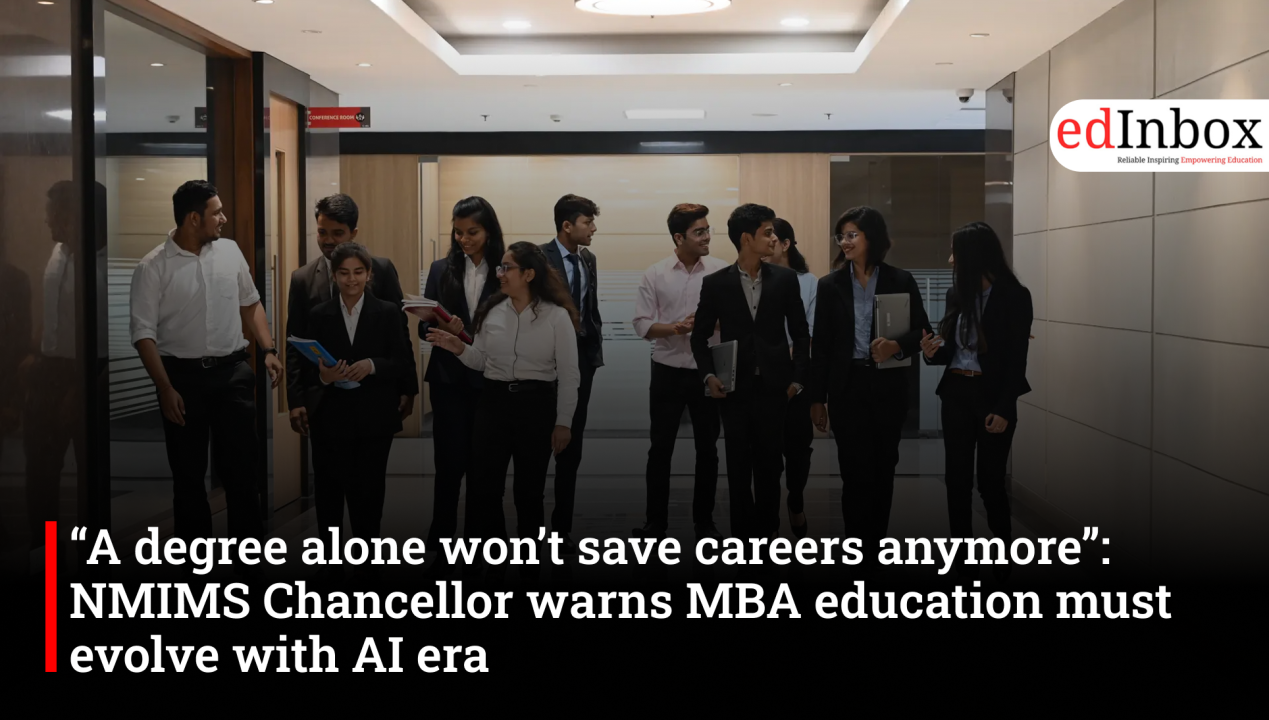
“A degree alone won’t save careers anymore”: NMIMS Chancellor warns MBA education must evolve with AI era
Typography
- Smaller Small Medium Big Bigger
- Default Helvetica Segoe Georgia Times
- Reading Mode