
Indian agriculture is increasingly operating under pressure from unpredictable weather, labour shortages, rising input costs, water stress, and volatile markets. In this environment, agricultural engineering is emerging as a critical force helping farmers improve efficiency, reduce losses, and adapt to changing conditions.
Experts say agricultural engineering is no longer limited to machinery alone. Instead, it is reshaping how different stages of farming connect with one another, creating more coordinated and reliable agricultural systems.
Traditionally, farming activities such as land preparation, sowing, irrigation, and harvesting were treated as separate operations. However, modern farming has become far more interdependent. A delay in planting can now affect irrigation schedules, pest management, and harvest timing, while uneven land preparation may lead to inefficient fertiliser use and inconsistent crop growth.
Agricultural engineering is helping address these gaps through technologies that improve operational consistency across the farming cycle. Laser land levelling, for instance, enables uniform water distribution, while precision seeders ensure even crop spacing and mechanised harvesting reduces delays that often lead to field losses.
Water management has become another major area of transformation. With climate variability increasing pressure on water resources, traditional irrigation practices based on observation and routine cycles are becoming less effective.
Technologies such as drip irrigation and sprinkler systems are gradually shifting farming toward demand-based water use. Rather than distributing water uniformly across fields, these systems deliver water according to crop needs and soil conditions. Experts say this encourages more disciplined irrigation decisions, improves water efficiency, and reduces crop stress during critical growth stages.
Agricultural engineering is also addressing one of India’s biggest but often overlooked agricultural challenges — post-harvest losses. A significant share of agricultural produce loses value after harvesting due to poor storage, inadequate grading, and weak transportation systems.
Engineering interventions such as scientific storage structures, grading systems, and improved handling technologies are helping reduce biological deterioration and mechanical damage during transport. Experts note that reducing post-harvest losses can sometimes improve farmer incomes more effectively than marginal increases in crop yields.
Climate adaptation has further expanded the role of agricultural engineering. As weather patterns become increasingly unstable, farmers are adopting systems such as polyhouses, shade nets, drainage infrastructure, and rainwater harvesting structures to reduce climate-related risks.
These technologies do not eliminate climate uncertainty, but they help stabilise farming operations by reducing exposure to heat stress, flooding, and water shortages.
Another key contribution of agricultural engineering lies in reducing operational volatility. Mechanisation reduces dependence on seasonal labour availability, irrigation systems lessen dependence on erratic rainfall, and storage infrastructure allows farmers to avoid distress sales immediately after harvest.
Experts say the broader goal is not to remove risk entirely, but to help farmers gain greater control over timing, execution, and resource management under uncertain conditions.
However, challenges remain. Many agricultural technologies continue to face low adoption because they are costly, difficult to maintain, or poorly suited for small landholdings. As a result, agricultural engineering is increasingly focusing on usability and accessibility rather than only technological advancement.
Shared machinery services, modular tools, local repair ecosystems, and simplified equipment models are becoming central to making agricultural technology practical for everyday farming.
Experts believe agricultural engineering is not transforming Indian agriculture through dramatic disruption, but through gradual correction of long-standing inefficiencies. By improving coordination, reducing operational variability, and strengthening resilience, it is helping Indian farming systems become more adaptable and reliable in an era of growing uncertainty.
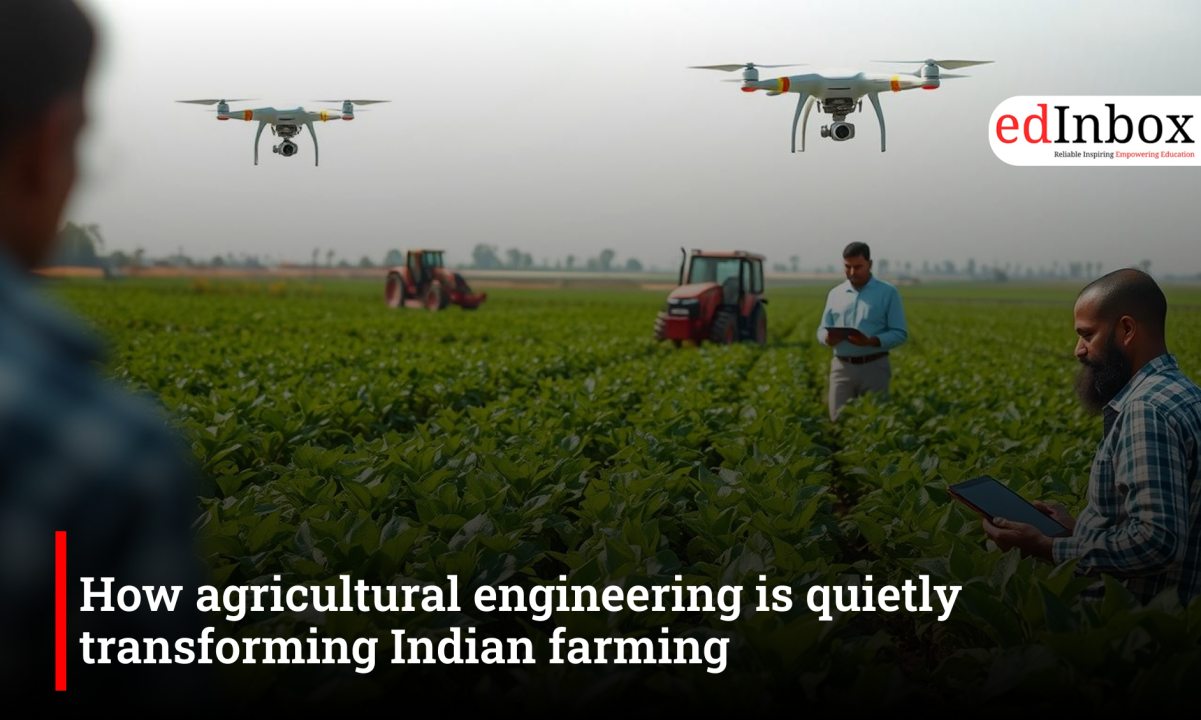
How agricultural engineering is quietly transforming Indian farming
Typography
- Smaller Small Medium Big Bigger
- Default Helvetica Segoe Georgia Times
- Reading Mode