
A growing confrontation between Union Education Minister Dharmendra Pradhan and the Cockroach Janata Party (CJP) escalated on Tuesday as protesters continued their demonstration for the fourth consecutive day at Jantar Mantar in Delhi.
The latest flashpoint emerged after Pradhan, during an interview with NDTV, called CJP 'B-team of disruptive elements.’. His remarks were met with a sharp response from CJP founder Abhijeet Dipke, who accused the minister of targeting young people and dismissing legitimate concerns raised by students.
The exchange has added a new political dimension to a movement that began online and has since evolved into a nationwide campaign attracting significant attention on social media.
What Did Dharmendra Pradhan Say?
Speaking about ongoing protests and criticism surrounding the education sector, Union Education Minister Dharmendra Pradhan said that some forces were deliberately trying to disrupt educational reforms and create instability.
Pradhan further stated that certain groups, including what he described as "education mafias" and vested interests, were attempting to derail educational progress.
"Some people are deliberately trying to derail education. Whether they are coaching centres or education mafias, they are being monitored. We will bring them to their knees; we cannot secure the future of the country's children."
The remarks came amid continuing protests and criticism directed at the government over education-related issues.
How Did CJP Respond?
Addressing protesters at Jantar Mantar, CJP founder Abhijeet Dipke strongly objected to the minister's remarks saying, "the Education Minister is calling the youth of the country terrorists. Sir, we are not terrorists. We do not need patriotism certificates from people like you."
Dipke later expanded on his criticism through a post on social media platform X: "Dharmendra Pradhan calls us terrorists. The irony is that his hands are stained with the blood of more than 17 students."
The statement quickly gained traction online, further intensifying the ongoing debate between government supporters and critics of the education system.
How Did the CJP Movement Begin?
The Cockroach Janata Party traces its origins to a controversial courtroom remark made by Chief Justice Suryakant during a hearing on May 15. During the proceedings, the Chief Justice reportedly remarked that some unemployed youth were "like cockroaches" who later become media personalities, social media activists, or RTI activists and attack the system. The comment sparked widespread discussion online.
The following day, on May 16, Abhijeet Dipke launched the Cockroach Janata Party and created social media accounts for the movement. Within days, the initiative began attracting significant public attention.
On May 22, Dipke launched an online petition seeking the resignation of Union Education Minister Dharmendra Pradhan. According to the campaign, the petition received support from more than eight lakh people.
Social Media Growth Fuels the Movement
One of the most striking aspects of the CJP phenomenon has been its rapid rise on social media. According to figures shared by the organization, the movement had accumulated approximately 2.27 crore followers on Instagram by June 10. Although the number has reportedly declined by around two lakh since then, it remains substantially higher than the follower counts of several major political parties on the platform.
Political observers say the movement's online growth highlights the increasing role of digital platforms in shaping public discourse, particularly among young voters and students.
Who Is Abhijeet Dipke?
Abhijeet Dipke, 30, is originally from Sambhaji Nagar, Maharashtra, and has a background in digital media and communications. He studied journalism in Pune and is currently pursuing a Master's degree in Public Relations at Boston University in the United States. Dipke was previously associated with the Aam Aadmi Party (AAP) before launching the Cockroach Janata Party initiative.
Why the Controversy Matters
The ongoing dispute goes beyond a war of words between a Union minister and a protest movement. At its core, the debate reflects larger questions about student activism, educational reforms, political participation, and the growing influence of social media-driven movements in India.
The rapid emergence of CJP demonstrates how online communities can quickly transform into organized campaigns capable of attracting national attention. At the same time, the government's response underscores concerns about misinformation, political mobilization, and attempts to influence public institutions.
As protests continue and both sides harden their positions, the confrontation is increasingly becoming a broader conversation about youth engagement, democratic dissent, and the future direction of India's education ecosystem.
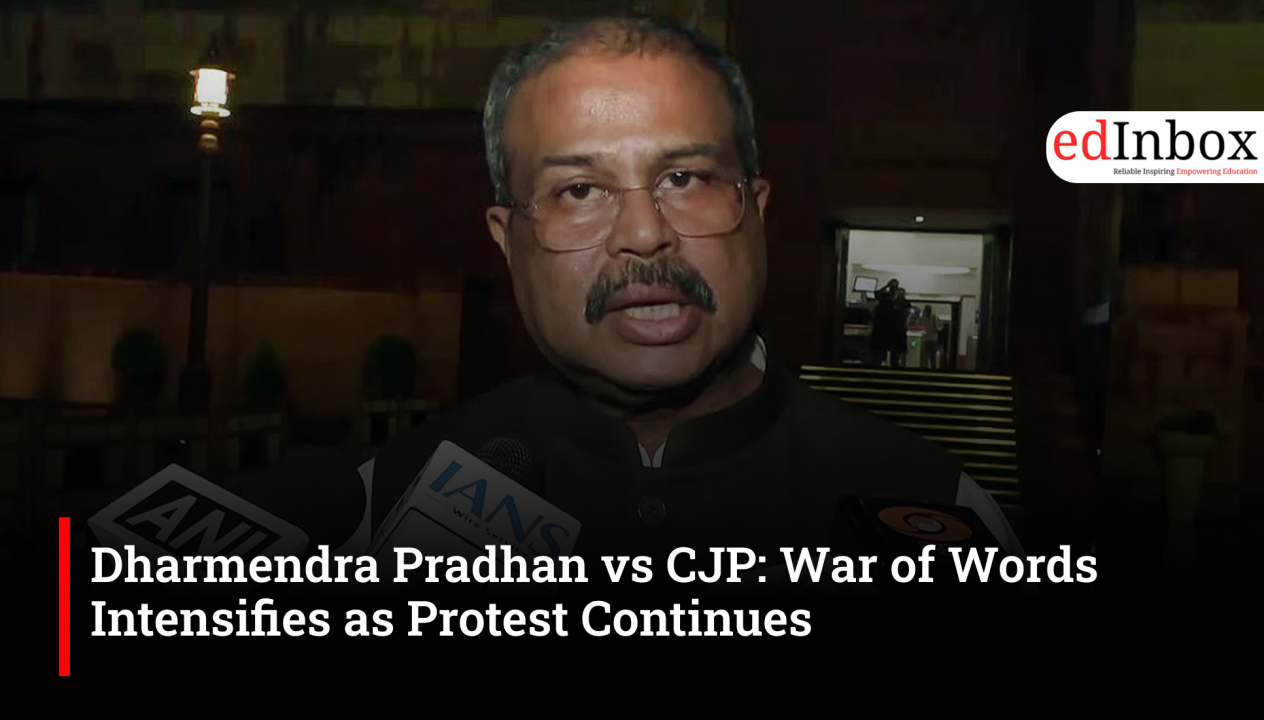
Dharmendra Pradhan vs CJP: War of Words Intensifies as Protest Continues
Typography
- Smaller Small Medium Big Bigger
- Default Helvetica Segoe Georgia Times
- Reading Mode