
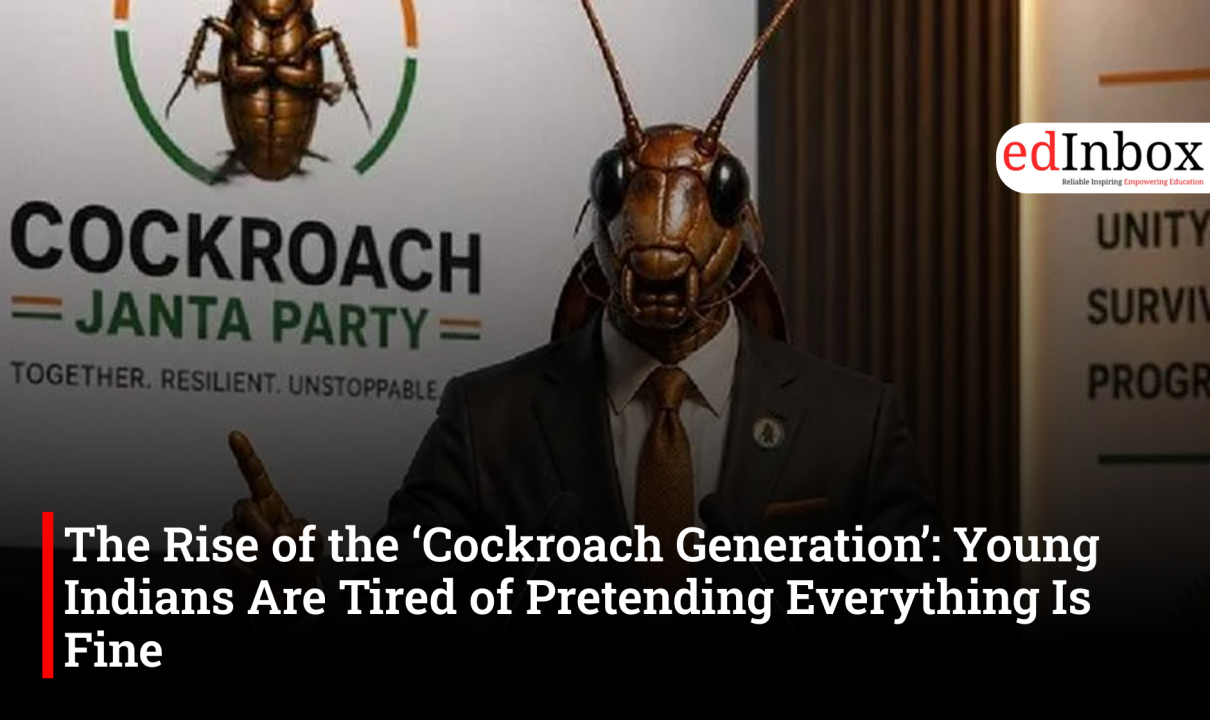
Indian youth are going viral on social media calling themselves "a cockroach" while supporting the Cockroach Janata Party. India never imagined that the word “cockroach” would become a youth movement.
But in a matter of days, after a widely circulated and much debated interpretation of remarks attributed to the Chief Justice of India, social media was abuzz with youngsters who were calling themselves just that. Initially, the internet had it as another silly meme. After that, the numbers were too big to ignore.
The digital community, dubbed the “Cockroach Janata Party,” reportedly reached over 40,000 active members and nearly 80,000 sign-ups in just three days. Instagram pages were suddenly created.Instagram pages were suddenly created. Telegram groups multiplied. Memes travel faster than explanations ever could.
However, there was a sad sincerity to the satire. Young Indians were not celebrating cockroaches. They were talking about the modern survival experience.
The Internet has finally given a name to Emotional Exhaustion
A cockroach is just a tiny creature trying to survive… Poison, heat, hunger, neglect, it still lives in a place no one should be forced to live. Hence the metaphor struck a chord and the literate youth of India came up bold revealing truth, showing reality, discussing necessary topics, and using humor to convey without offending.
For years, students and young professionals have been living under a pressure system that doesn't stop long enough to consider whether they are emotionally coping or not. Competitive exams start early. Expectations come even sooner. Many young people are exhausted by the time they reach the end of university, and they look older than they are.
This generation learns and lives in fear of joblessness. Works while being afraid of being replaced. Sleeps with a fear of time slipping away. Even when resting, they feel guilty that someone else is going faster online. And so the jokes began.
Gradually, it transformed, the internet is flooding with it. People are commenting, sharing their miseries and supporting the CJP. One of the relatable comments said: “Still alive after 5 entrance exams and 3 panic attacks. Certified cockroach.” The sentence is fun, but between the lines is the pain Genz is holding.
The ‘Cockroach Janata Party’ Is Not About Politics
The ‘Cockroach Janata Party’ is not a real political party, it was a satirical comment that became viral. At first, the name felt absurd and people started sharing it for fun. However, in a matter of days the “Cockroach Janata Party” became a sign of something more than just internet humour, psychologically. Youth are reclaiming an insult and making it into a collective identity. And that act has power!
Users started using the term “cockroaches” on social media, not in a sense of pride, but in the sense that they are stuck in survival mode. The symbol represents a generation that is constantly adapting, but is not emotionally rewarded for it.
Students took the opportunity to discuss the pressure of exams. Young workers associated it with unhealthy work environments and burnout. Others talked about job cuts, inconsistent pay, coaching culture, poor job interviews, increasing living expenses, and the fatigue of constant competition with no guarantee of security. It was spread because it brought together people who felt isolated in the same struggle.
Young India Is Tired in a Way Older Systems Do Not Fully Understand
Indian youth life is a lonely life in particular. It's hard to explain, because, on the surface, everything seems ambitious and productive.
Growth, startups, innovation and the quest to become a global powerhouse are the topics that are on everyone's lips in the country. Social media is a place where hustle is rewarded:
- LinkedIn rewards achievement
- Families reward stability
- Coaching industries pay for ranks
But WHO pays for emotional survival?
The young Indians of today are juggling several timelines in their minds. They need to get good grades fast, make money early, be tech-savvy, be mentally tough, support their families, keep their relationships, develop careers, constantly learn new things, and somehow be grateful all the way.
Fear has become a way of life:
- Concern about test failure.
- Parents' expectations.
- Worry about being financially irrelevant.
- The worry of not having a home.
- Fear of missing out
- Worry about falling behind friends who are “settled”.
Even happiness is now programmed against productivity! That's why so many young people saw themselves in the cockroach metaphor. It was a sign of strength, not weakness, but of constant adaptation in the face of pressure.
Gen Z Uses Humour the Way Previous Generations Used Protest
The older generation sometimes voiced their discontent in speeches, rallies or organised movements. Collective anxiety is handled differently by Gen Z. It translates pain into internet language first.
Emotional shorthand is the reason why memes have become so commonplace; it's easier to be vulnerable directly than it is online. Irony is a distancing from pain, but also a public exposure of pain. That's exactly what happened here.
The “Cockroach Generation” trend went viral because it managed to make emotional exhaustion visible in a non-dramatic way. Beneath the jocularity there were serious discussions about:
- student suicides
- exam pressure
- unemployment
- burnout
- unstable careers
- declining mental health
- social comparison
- economic insecurity
This was not only meme culture, nope, not at all. It was emotional information! For the first time in years, Indian youth discovered a language that was more truthful about survival than motivational culture.
Universities Cannot Ignore This Emotional Shift Anymore
There is one uncomfortable truth that lies under this moment: many students don't feel emotionally safe in the systems that are supposed to prepare them for life.
Universities talk a lot about placements, rankings and academic performance. Much less attention is given to emotional resilience, career confusion, identity anxiety, or psychological burnout. However, these issues are increasingly influencing student life on campuses.
There is no need for grand speeches about youth empowerment at this time of institutions. They require hands-on empathy. Edinbox has already started to ‘Be The Change’ in order to bring the change, but that’s not enough. All the universities, teachers, professors, policymakers as well as ministers must start the ground level changes.
Students require accessible counselling support, realistic career guidance, healthier academic pressure systems,,conversations around failure and uncertainty, industry exposure before graduation, and an environment where asking for help is not treated as weakness.
A generation raised inside constant competition cannot continue surviving only on motivational slogans. Indian Youth have had enough push but direction? support? That’s what they actually need. Young people are not machines that can be made to run forever. After a while, emotional fatigue turns into educational fatigue.
Policymakers Need to Understand That Anxiety Is Becoming Structural
The frustration of the youth is not just a product of one problem in India. It is emerging from the instability that has built up in the education, employment and social expectation systems.
The competitive exams become tougher every year. The delays in recruitment are still continuing for the aspirants. Starting wages frequently don't keep up with the cost of living in the city. In the meantime, digital culture is continually amplifying comparison and pressure. The result is mental fatigue on a massive scale.
The discussion of youth development policy often centers on skills, innovation and employability, which are all relevant fields. Emotional wellbeing is often not given the same priority. For too many students and young workers, mental health support is not available, particularly in non-metropolitan settings.
The “Cockroach Generation” trend isn't just a reaction to the internet. It is a warning message that is coming out through humour because traditional language is no longer adequate. And to be brutally honest, if a whole generation starts thinking about survival instead of aspirations, there is something going on in the social sphere.
The Most Disturbing Part Is How Normal This Exhaustion Has Become
The worst thing about this trend is not the rage, it is the normality. There are too many young Indians who have already come to believe that exhaustion is a part of adulthood; anxiety is treated as ambition, burnout is mistaken for discipline, emotional numbness is sold as maturity. But people keep moving because they think it's unsafe to stop.
That's why the cockroach became a strong symbol on the internet. It caught a generation that cannot be killed, but seldom gave them a chance to sleep. Young people are surviving all that is thrown at them, but survival is becoming an empty victory.
In between the memes, the sarcasm and the dark humour, Indian youth admitted something it has been hiding for years. It's fed up with pretending everything is okay. They aren’t supporting any party, to be specific, they are raising awareness.
As literate citizens, it is our duty to read between the lines and not let any propaganda or misinformation sway the way of change that this cockroach generation has started. And it is worth noting that perhaps the most unsettling part of this entire episode is that an entire generation had to compare itself to a creature known only for survival before society finally stopped and listened.
The Rise of the ‘Cockroach Generation’: Young Indians Are Tired of Pretending Everything Is Fine
Typography
- Smaller Small Medium Big Bigger
- Default Helvetica Segoe Georgia Times
- Reading Mode