
The growing preference for English-medium education is reshaping NEET preparation in Gujarat, with the number of students opting for the Gujarati medium in NEET 2026 steadily declining over the past decade. Education experts believe the trend reflects changing academic priorities, the dominance of English in medical education, and the limited availability of quality Gujarati-language study resources.
According to recent data, nearly 60,000 candidates chose Gujarati as their exam language in NEET 2016, but that number has fallen to less than 50,000 in NEET 2026. Despite the decline, Gujarati continues to remain the second most preferred regional language for the medical entrance examination after Hindi. This year, registrations in Gujarati exceeded those in Bengali, Tamil, and Assamese, while Hindi remained the most popular language with nearly 3.4 lakh registrations.
Educationists say the language shift is driven by practical considerations rather than cultural preferences. Since most medical textbooks, scientific terminology, and competitive exam resources are available in English, students increasingly believe that preparing in English offers a long-term advantage.
Govind Tiwari, a coaching institute owner, observed that admissions to Gujarati-medium schools have been declining while English-medium enrollments continue to rise. He explained that students planning careers in medicine find it easier to study in English because medical education, including textbooks and classroom instruction, primarily uses English terminology.
The shortage of high-quality Gujarati-medium NEET study material has further accelerated this trend. Many coaching institutes also report difficulties in finding experienced teachers capable of delivering Physics, Chemistry, and Biology lessons effectively in Gujarati.
NEET aspirant Prakash Patel said that although students may appear for the examination in Gujarati, most preparation materials—including reference books, question banks, mock tests, and online lectures—are predominantly available in English. As a result, Gujarati-medium students often have to rely on English resources throughout their preparation.
Om Prakash Maheshwari, a biology teacher with over 16 years of teaching experience, noted that even students enrolled in Gujarati-medium schools increasingly study from English textbooks and digital platforms to remain competitive.
The changing language preference comes at a time when Gujarat's NEET 2026 performance has also witnessed a sharp decline. Official figures show that 81,605 students appeared for NEET in 2025, with 50,040 candidates qualifying. In NEET 2026, the number of examinees dropped slightly to 79,190, while the number of successful candidates fell significantly to 38,146.
Although experts caution that there is no confirmed evidence directly linking the decline in Gujarati-medium participation to lower qualification rates, both trends have sparked debate among educators. Many believe improving the availability of Gujarati-language NEET preparation resources, strengthening regional-language coaching, and enhancing bilingual learning support could help students compete more effectively while preserving access to education in their mother tongue.
As NEET 2026 becomes increasingly competitive, the growing dominance of English highlights the need to balance accessibility, language inclusion, and quality educational resources for aspiring medical students across India.
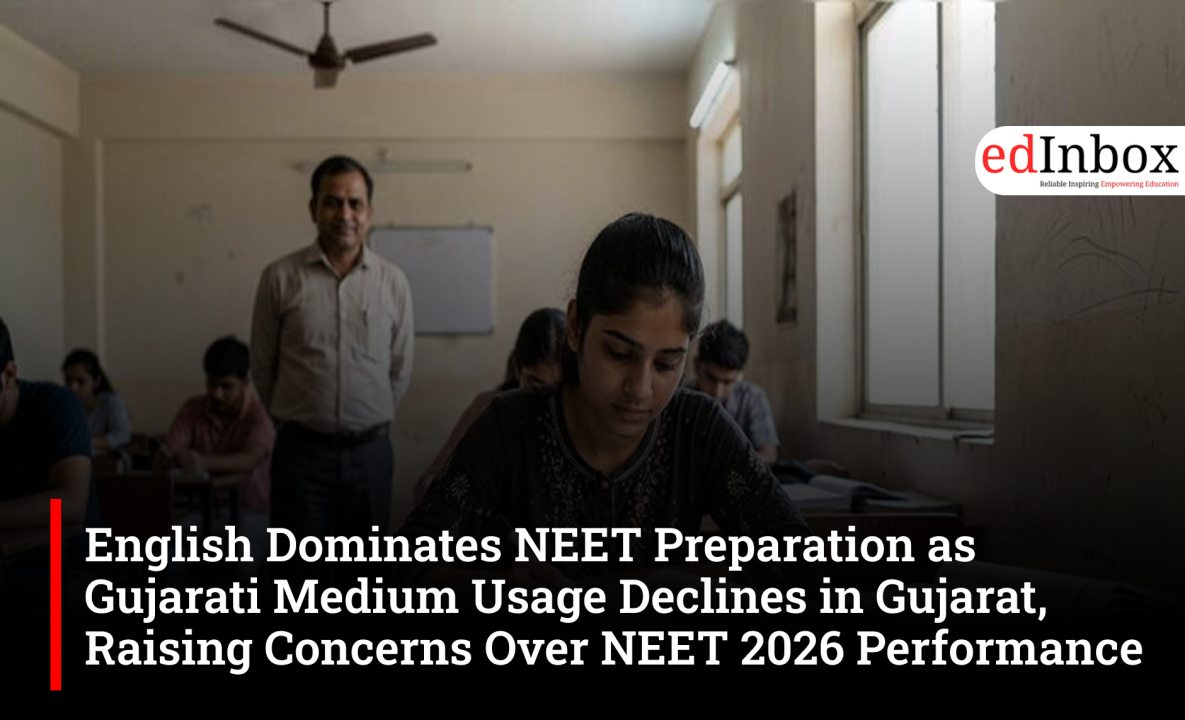
English Dominates NEET Preparation as Gujarati Medium Usage Declines in Gujarat, Raising Concerns Over NEET 2026 Performance
Typography
- Smaller Small Medium Big Bigger
- Default Helvetica Segoe Georgia Times
- Reading Mode