
Can scoring top ranks in India's toughest examinations prepare someone for life?
According to IAS officer Divya Mittal, the answer is not entirely.
The IIT Delhi graduate, IIM Bangalore alumna, and civil servant has sparked a nationwide conversation after sharing a heartfelt social media post reflecting on what India's education system failed to teach her despite years of academic success.
"IIT Delhi to IIM Bangalore to IAS. I got the best education my country had to offer. It taught me how to crack tough exams and manage big responsibilities. But it never taught me how to quiet my own mind or handle loneliness," she wrote.
Her post has resonated with thousands of students, educators and professionals, reigniting discussions on whether schools should focus more on life skills alongside academic achievement.
"We learn how to achieve, not how to be happy"
Mittal argued that while schools prepare students to excel in examinations, they rarely prepare them for the emotional and practical realities of adulthood.
"We spend many years learning how to achieve, but not a single day learning how to be happy," she wrote.
She listed nine life skills that she believes deserve a place in every classroom.
1. Emotional regulation
According to Mittal, students are often encouraged to suppress emotions rather than understand them.
While schools teach scientific concepts and formulas, they rarely explain how to process grief, disappointment, anxiety or heartbreak. Learning to recognise and regulate emotions, she argues, is just as important as academic success.
2. Honest communication
Students spend years writing essays and answering examination questions but receive little guidance on expressing vulnerability or setting healthy boundaries.
Mittal believes schools should teach young people how to communicate difficult emotions, say "no" respectfully, resolve conflicts and protect their personal and professional boundaries.
3. Critical thinking
Rather than memorising answers, students should be encouraged to ask meaningful questions.
She warns that education focused solely on correct answers may discourage curiosity, making it easier for people to accept information without questioning its source or validity.
4. Financial literacy
One of the strongest points in her post concerns money management.
Although students solve complex mathematical problems, many graduate without understanding budgeting, saving, debt management, investments or financial planning.
Mittal argues that financial literacy is essential for independent adulthood.
5. Self-discipline
Schools provide structured schedules, timetables and constant supervision.
Real life does not.
She believes students should learn how to motivate themselves, build routines and remain disciplined even when no one is monitoring their progress.
6. Handling loneliness
Academic life keeps students surrounded by classmates, teachers and friends.
Adulthood can be very different.
Mittal says schools rarely teach students how to enjoy solitude, build emotional resilience or cope with periods of loneliness in healthy ways.
7. Reading people
Success in life often depends on understanding people as much as understanding textbooks.
She believes students should develop emotional intelligence to recognise intentions, build healthy relationships and identify manipulation or unhealthy behaviour.
8. Mental health awareness
While physical education is part of most school curricula, mental well-being often receives far less attention.
Mittal stresses the importance of recognising stress, preventing burnout and knowing when to seek professional help without stigma.
9. Knowing yourself
Her final lesson focuses on self-discovery.
Students spend years striving to become toppers, she says, but rarely pause to understand their own values, interests and purpose.
According to Mittal, true education begins when individuals discover who they are beyond grades and medals.
Why her message resonates
The viral post has sparked widespread discussion because it echoes concerns increasingly raised by educators and psychologists. Across the world, schools are gradually incorporating social-emotional learning, financial literacy, mental health awareness and critical thinking into their curricula alongside traditional academics.
In India, the emphasis on holistic education under the National Education Policy (NEP) 2020 has also highlighted the importance of nurturing communication, creativity, well-being and life skills alongside academic excellence.
Mittal's reflections have therefore struck a chord with students preparing for competitive examinations as well as professionals navigating life beyond classrooms.
The bigger question
Her post raises an important question for educators and policymakers: Should schools only prepare students to pass examinations, or should they also prepare them for life?
As conversations around mental health, emotional intelligence and practical life skills continue to grow, many believe future classrooms may need to balance academic achievement with lessons that help students build resilience, confidence and self-awareness—qualities that matter long after report cards are forgotten.
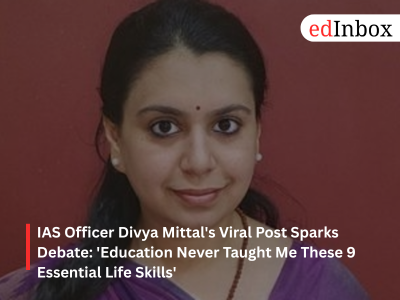
IAS Officer Divya Mittal's Viral Post Sparks Debate: 'Education Never Taught Me These 9 Essential Life Skills'
Typography
- Smaller Small Medium Big Bigger
- Default Helvetica Segoe Georgia Times
- Reading Mode