
The Economic Survey 202526 has brandished India to the world as a primary "education tourism" hub and hence, is a strategic push that opens the doors to higher education alongside the country's yoga, Ayurveda, heritage studies, and rural immersion, all of which are international student attractions.
The Survey accentuates India's disappointing participation in the international education market, revealing that India only attracts about 49, 000 foreign students, a mere 0.10 per cent of its total higher education enrolment which is quite insignificant over the globe. In fact, around 28 Indian students study abroad for every foreign student coming to India, which leads to an estimated foreign exchange outflow of USD 3.4 billion in FY24.
In order to solve this problem, the Survey suggests fast-tracking student visas, facilitating expansion of post, study internships, and encouraging joint degree programmes and academic exchanges mainly with BRICS and Global South countries.In addition, it refers to the entry of 15 foreign higher education institutions in the near future and the University Grants Commissions (UGC) 2022 regulations as major facilitators of internationalisation.
One of the main proposals is to create quick, duration academic delivery such as summer schools, semester, abroad modules, and certificate programmes allowing a blend of classroom learning and tourism experiences.
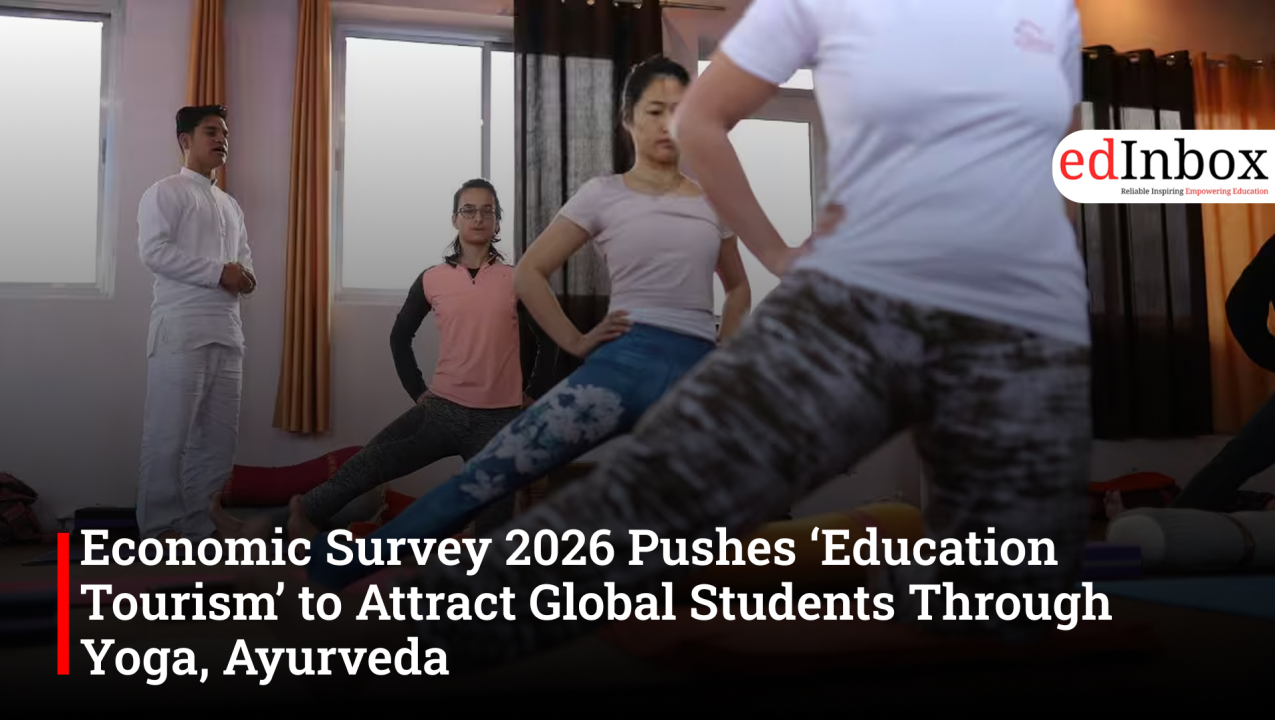
Such offerings may even include issuing certifications in yoga and wellness, healthcare studies based on Ayurveda, Indian philosophy, heritage conservation, and sustainability projects at the village level sectors where India naturally has a comparative advantage.
Moreover, the Survey points out that if western countries further restrict their visa policies, and considering that India's education ecosystem is relatively cheap, the country could become a preferred study destination for students mainly from South Asia, Africa and Southeast Asia.
However, the document flags significant challenges. It cautions against over, commercialisation of education and points to a drastic shortage of faculty where the vacancies are estimated to be at 56.2 per cent in higher education institutions. There have also been apprehensions about safeguarding the purity of indigenous knowledge systems such as yoga and Ayurveda from being diluted or misrepresented.
Besides, the Survey highlights that almost 75 per cent of Indian higher education institutions are not ready for industry at the moment, thus restricting the employability outcomes for international students.
The Economic Survey concludes that while education tourism presents a major opportunity to enhance India’s soft power and global academic footprint, its success will depend on regulatory clarity, investment in faculty and infrastructure, and careful balancing of tradition with academic rigour.
Economic Survey 2026 Pushes ‘Education Tourism’ to Attract Global Students Through Yoga, Ayurveda
Typography
- Smaller Small Medium Big Bigger
- Default Helvetica Segoe Georgia Times
- Reading Mode