No rule forces a girl to choose beauty.
No order stops her from choosing coding.
Yet by Class 9, many already know what they are “supposed” to pick.The education policy promises skills. The classroom reveals expectations. On paper, it is about employability. On the ground, it is becoming a social experiment.
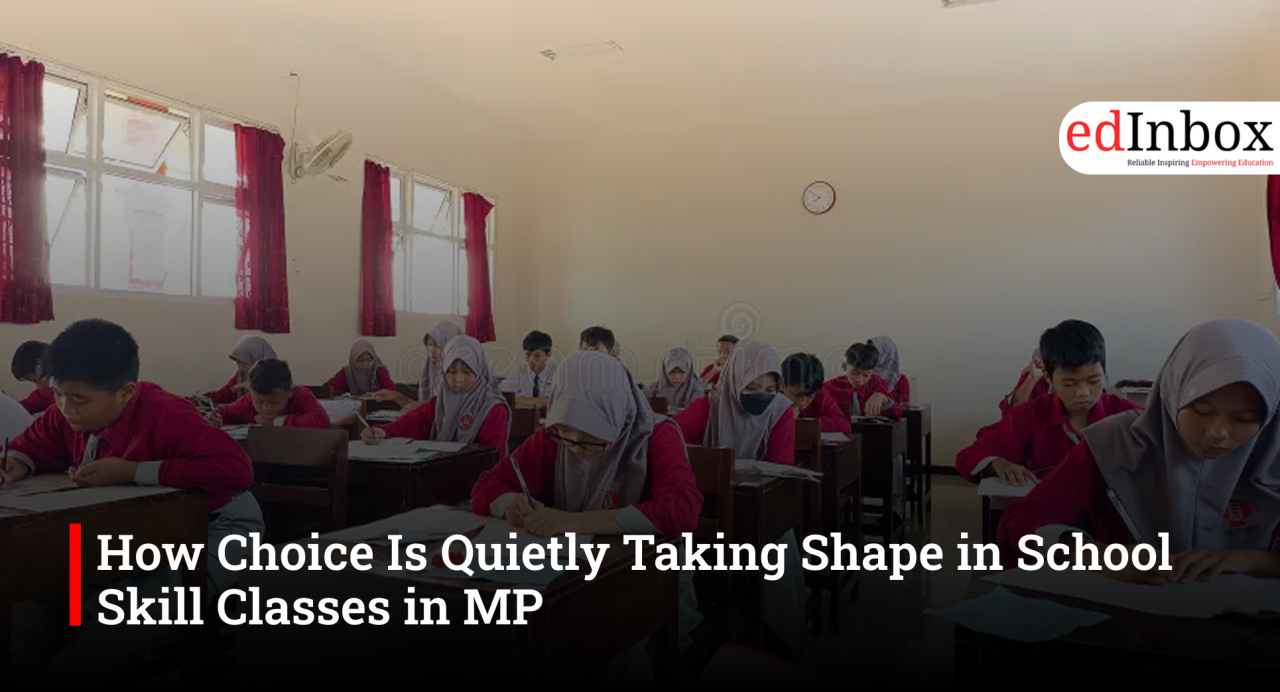
In classrooms across Madhya Pradesh, the vocational choice is not made in a single moment — it is shaped by marks, distance, confidence, money and family advice. When students explain their decisions in their own words, a pattern emerges: subjects are being selected less by interest and more by practicality.
For some girls, the decision begins with academics.
“We have many subjects to choose but our school is providing only IT and beauty. I will be able to score more marks in beauty compared to IT so I chose beauty and wellness”- Kritika Bansal
“My home is nearby so I do not get bus services. I need to cover the distance by walking. If I take tough subject, I will not be able to score good marks so I chose beauty,”- Jyoti Uikey
Others describe how confidence and familiarity influence their choice.
“My father told what will I do studying IT, like other girls if I take up beauty or stitching then I can get help if I do not understand the subject,” Simran Prajapati
For some students, the classroom is directly linked to income.
“I am already a mehendi artist and run a small venture besides studies. Here in MP we wear mehendi in every festival. People from every religion wear mehendi. So I keep getting calls and support my family this way. Our school will give me a certificate and I don’t need to do an additional beauty course to open a salon, which is my dream”-Saadia Akhtar
"We are receiving hands-on training about products and how to handle customers. Besides, we are also learning how to grow a skill into a business at a very young age." - Monika Chacko, class 12
Meanwhile, students who opt for IT often see it as long-term mobility.
“In the IT course we are learning basic computer skills and handling applications. We will graduate to using AI once we complete these. It's interesting to come to school and have our sir who explains us whenever there is any doubt.” - Pallav Mahovia, Class 12
“I have not chosen beauty courses. I am more interested in computers. I like using different applications and learning AI. In future I will make software that helps a larger section of farmers in Madhya Pradesh.” -Pooja Soni
“Plumbing and masonry are skills that will not fetch me good money if I ever take it forward. My father works on a farm and while helping my father I can learn the craft as a plumber. But learning IT in school as a subject will help me to take it forward later on in life and get me good money for the future. So my parents wanted me to take up an IT course. ”- Mahadeo Masure
Economic reality shapes choices as well.
“I need to help my family and most of the time I miss school. So I wanted to take up an easy subject that I already know. Hence I took plumbing and not IT. In this subject I can get help from my cousins as they are plumbers”- Gaurav Ahirwar
Together, these voices suggest vocational education is not merely offering options. Students are weighing effort, accessibility and earning potential. The subjects differ, but the reasoning is similar: choose what feels manageable today and useful tomorrow.
The Policy Behind the Classrooms
A quiet shift is underway in 324 Sandipani Vidyalayas across the state. From the new academic session, government schools have introduced Beauty and Wellness courses alongside Information Technology under an expanded vocational education drive beginning in Class 9.
The syllabus has been developed by Pandit Sundarlal Sharma Vocational Institute and offered from Classes 9 to 12 as part of 56 vocational programmes intended to integrate job-oriented skills with regular academics.
At Sandipani Vidyalaya, Bilkisganj, early enrolment data offers a snapshot: 40 students in Beauty and Wellness and 49 in IT. Officials say students are free to choose, and vocational subjects carry examination marks reflected in report cards.
"There are about 40 students enrolled in Beauty courses and 49 in IT. We have beauty and wellness courses for girls from class 9-12 who get trained by industry professionals. In 2026 we had our first batch of students enrolled from class 12 who are currently undertaking the IT and beauty training courses. The syllabus is decided by the government," said the principal.
He added, “There is a free choice given to all the boys and girls for picking their vocational subject. IT courses are getting filled easily by both boys and girls. There are very few girls taking interest in IT while a major chunk is opting for beauty and wellness.”
A Question Beyond Numbers
The programme includes courses in agriculture, plumbing, retail, electronics and more, and certifications are awarded after examinations. The state describes it as skill integration.
Yet experts warn about unintended messaging.
Former NCPCR chairperson Shanta Sinha said, “The proposal to introduce courses such as beautician training in Classes 9 to 12 is deeply troubling. It evokes an earlier era when “Home Science”, with its modules on cooking, laundry, stitching, and domestic accounting was offered to girls in high school, ostensibly to “prepare” them to become good wives. That model of education was withdrawn as being discriminatory and was confining girls. “
She added, “The introduction of gender-coded vocational options today is no different in its underlying logic. It reinforces the stereotype that girls are naturally suited for appearance-based, care-oriented, or domestic roles, while boys are expected to pursue technology, engineering, and higher-paying professional pathways.”
The classrooms show no formal barriers.
Yet choices are clustering.Not because students lack freedom —
but because freedom operates within familiarity, family advice and survival logic.In these schools, vocational education is doing more than teaching skills.
It is revealing how aspirations are formed long before careers begin.
How Choice Is Quietly Taking Shape in School Skill Classes in MP
Typography
- Smaller Small Medium Big Bigger
- Default Helvetica Segoe Georgia Times
- Reading Mode