
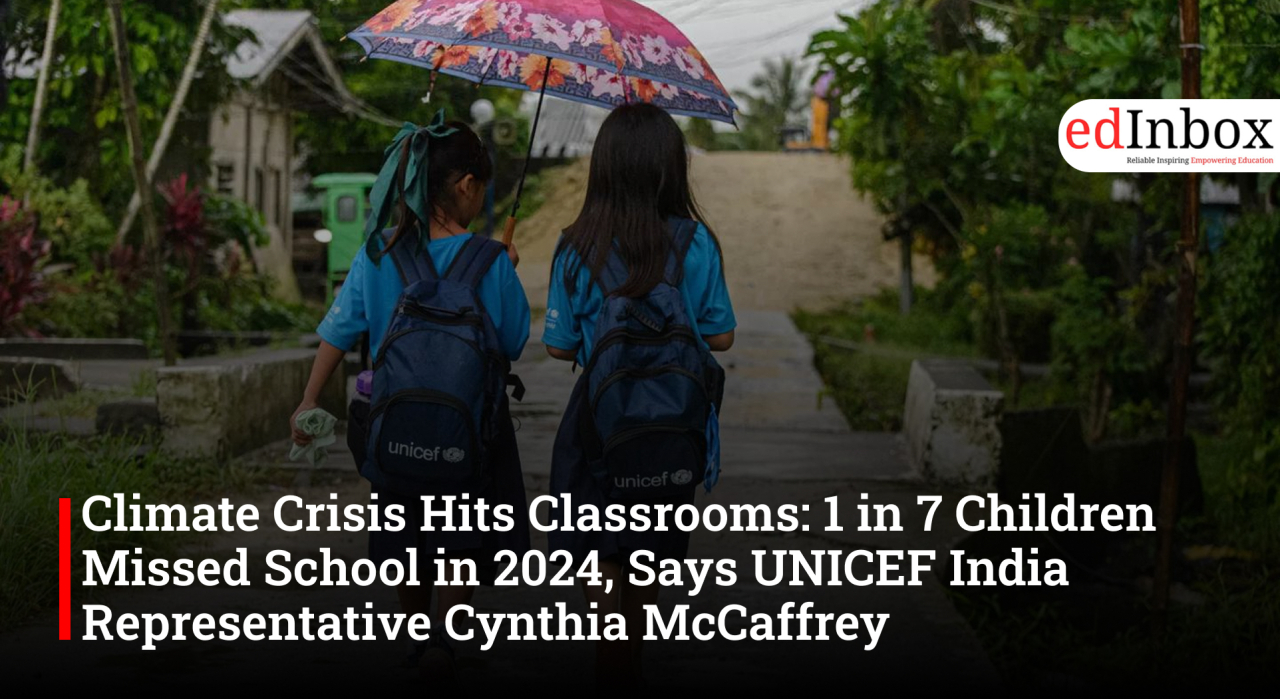
According to UNICEF India representative Cynthia McCaffrey, climate change has forced one out of seven children to stay out of school in 2024. During the Mumbai Climate Week, Jennifer healthy, Climate and Environment in our Global Context, Program Officer of the UN Children's Fund India Country Office, held a conversation with The Indian Express about the adverse effects of climate change on children's health, the Government's mitigating actions, and climate finance.
India is 26th on the Children's Climate Risk Index. Besides working with the Government of India, how are you cooperating with the state governments to make schools and educational institutions more climateresilient, especially given air pollution and heatwaves?
Our report shows that globally there are one billion children living in areas that are climate extremely high, risk areas, and India is no exception here as we are talking about children from India too. As a result, climate change is impacting education, it's interrupting learning, and one in seven children in 2024 were out of school because of a climate incident. In addition to this, climate change is also impacting nutrition and health, so we're working with the government as they're looking to cut across all sectors, and one of the things we want to be careful about is that it's not just addressing climate on education, but it's about looking at the child at the centre of everything, and making sure that we think through nutrition. If a child is poorly nourished, that will affect their learning as well, so we want to solve the problem of nutrition as well as keep schools open. If we keep schools open and we stop the floods, but we haven't been able to stop the droughts and the floods that impact the food system, then a child will be poorly nourished and still won't be able to learn. As a result, we are working with several ministries, including health, education, women and child development, and not just the environment.
How is climate change uniquely affecting children in India compared to other regions around the globe?
I think part of the issue here is that the climate doesn't have any borders. So the climate change that's happening around the world is having a similar impact on children in India. So one is that it's important that the Governments that are accountable anywhere in the world are continuing to build those protective systems, as well as those systems that promote the future and well-being of children, including in India. But I think the challenge of climate mitigation requires the world to continue to come together, because climate adversaries don't stop at a border. Food systems are being shifted or interrupted. And so the ability to have reliable, healthy food is therefore impacting a child's diet. And we're seeing that in India. So India is, like many countries around the world, dealing with the triple burden of nutrition. Malnutrition, so you're looking at the malnutrition. You're looking at increased micronutrient deficiencies because the diet is being impacted by climate.
What are the most critical, immediate gaps in child protection that you see in rural, vulnerable communities owing to climate change?
When children are out of school for extended periods, that leads to child labour. Maybe they have to go to work. It exacerbates and may lead to child marriage. So those are issues that can be definitely contributed to by adverse climate conditions when creating long-term interruptions forcing people out of school. And those would be the issues to look at: child protection, keeping children in school, and all of the issues that might kick a child out of school, including climate. Therefore, a primary way to counter this challenge is to maintain a strong nutrition system to ensure that the child is healthy to learn in school, and at the same time making sure that there is no interruption in their livelihood forcing them out of school.
In recent years, we have been witnessing record-breaking heat levels coupled with heatwaves. So what impact do these have on a child's mental and physical health in the longer term?
So if, and again, you go back to the beginning of a child's life, extreme heat is impacting mothers' health while they're pregnant. Therefore, there is a need to make sure that we also identify how to protect the mother so that the child is born healthy. Low birth weight or early birth of children are some of the impacts that we are seeing globally. When a child is born, the first thousand days remain important. So it does have an impact if they're in extreme heat, or in a place where there's extreme heat, where the diet may be impacted. Therefore, stimulation during those first thousand days, which include the child being able to go out and play, is a major contributor to a child's brain development. And as you know, the first thousand days, a child's brain develops, it's 80 per cent of their brain. So being able to have that holistic approach to a safe place, which means safe from floods, safe from heat, is extremely important for a child's formative years.
Is climate financing adequately prioritising children's needs?
Unicef is not a financial expert, but we're trying to be at the table with those financing experts that come up with those instruments to say, think about the child. It will make your investment have a higher return, because if you invest in children, it's much more economical. It will have a much more lasting impact. We've looked at different financing instruments. We could help you figure out the ways that you could do that.
In India, standing where we are now, what do you think is required in education policies to raise climate awareness?
The Government of India is doing things in the right way by looking at both how you reach children. India has adopted an inclusive system through teachers and teen clubs. So I think one thing that becomes important is giving children access to both the facts and the learning about it, but also a very tangible approach in understanding the environment through green clubs. This would not just enable learning but also lead to brainstorming solutions together. Another aspect is to continue to share knowledge so that you've not only got literacy, but also climate literacy. That would result in a community level of understanding of climate adversities.
Climate Crisis Hits Classrooms: 1 in 7 Children Missed School in 2024, Says UNICEF India Representative Cynthia McCaffrey
Typography
- Smaller Small Medium Big Bigger
- Default Helvetica Segoe Georgia Times
- Reading Mode