
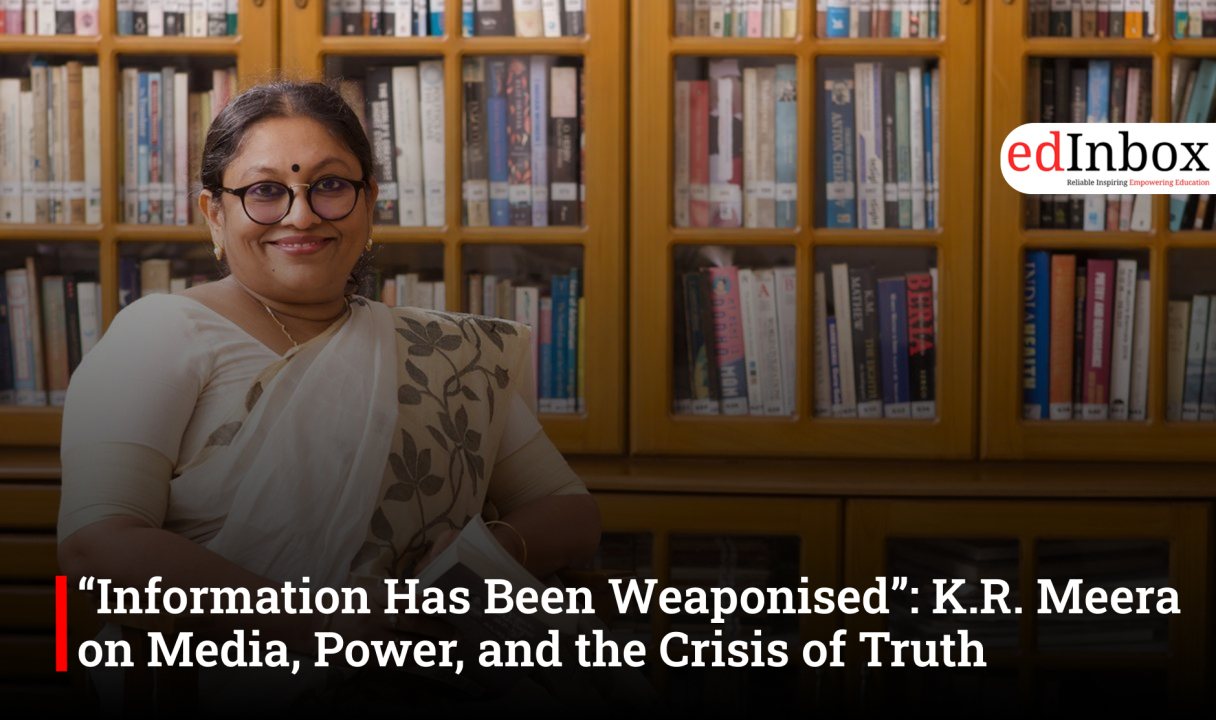
At a time when truth is increasingly contested and journalism finds itself entangled with power, writer and former journalist K.R. Meera issues a stark warning: information has been weaponised. Speaking at the 20th annual national meeting of the Network of Women in Media, India (NWMI), Meera reflected on the erosion of public trust, the moral collapse of media institutions, and the growing influence of PR-driven narratives. In this conversation, she speaks candidly about democracy under strain, the courage of women journalists, and why journalism today must reclaim its ethical spine
Q: You described today’s media environment as precarious. What worries you the most about journalism right now?
What worries me deeply is that information has been weaponised. We live in a time when truth is increasingly difficult to discern, not because facts don’t exist, but because narratives are manufactured to serve power. Journalism was meant to illuminate, but it is now often used to confuse, polarise, and manipulate.
Q: You said democracy is failing in many parts of the world. How is that linked to the media?
Democracy depends on trust—trust in institutions, trust in facts, trust in each other. Extreme polarisation has shattered that trust. When the media becomes partisan, PR-driven, or fear-based, it accelerates democratic decay. Journalism should challenge power, not amplify it unquestioningly.
Q: You made a striking statement that “journalism is meant for women.” What did you mean by that?
I meant that journalism requires courage, empathy, and moral clarity—qualities women reporters have consistently demonstrated. Women journalists often question authority without compromise and bring ethical depth to storytelling. That courage is essential today.
Q: You urged journalists to evaluate their work through a moral lens. What should that lens be?
Every journalist should ask: Does my work serve the poor or their predators? If reporting strengthens the powerful at the cost of the vulnerable, it has failed its purpose. Journalism cannot be value-neutral in an unjust society.
Q: You also spoke about social media’s role. How has it changed journalism?
Social media has created what I call a “cancer culture”—where speed overrides verification and PR narratives masquerade as news. It rewards outrage over insight and visibility over truth. This environment is deeply damaging to public discourse.
Q: During the panel discussion, filmmakers spoke about the cost women pay for speaking up. Does this mirror what happens in the media?
Absolutely. Whether in media or cinema, power structures remain punitive. Women who question them often lose work, credibility, or mental peace. Internal committees exist, but systems rarely care about justice—only damage control.
Q: Actor Rima Kallingal mentioned that systems don’t really care if women get justice. Do you agree?
Sadly, yes. Many systems are performative. They exist to signal reform, not to deliver it. That is why sustained pressure—from the media, from collectives, from public discourse—is crucial.
Q: Has anything changed at all?
Yes, the way these issues are reported has changed. Women journalists have played a huge role in that shift. Stories are no longer buried or sensationalised in the same way. That is progress, even if slow.
Q: What gives you hope in this difficult moment for the media?
Women in the media give me hope. So do young journalists who are still asking uncomfortable questions. As long as there are people willing to risk comfort for truth, journalism is not lost.
Q: What would you tell journalists at the start of their careers today?
Do not measure success by access or applause. Measure it by integrity. Journalism is not a profession to gain power—it is a responsibility to question it.
“Information Has Been Weaponised”: K.R. Meera on Media, Power, and the Crisis of Truth
Typography
- Smaller Small Medium Big Bigger
- Default Helvetica Segoe Georgia Times
- Reading Mode