
As Madhya Pradesh accelerates its push towards skill-based education and employability, government schools across the state are introducing vocational courses in Beauty and Wellness for girls and Information Technology (IT) for boys from the new academic session. Rolled out from Class 9 onwards, the initiative aims to bridge the gap between school education and job-ready skills, allowing students to earn academic credits while receiving industry-aligned vocational training.
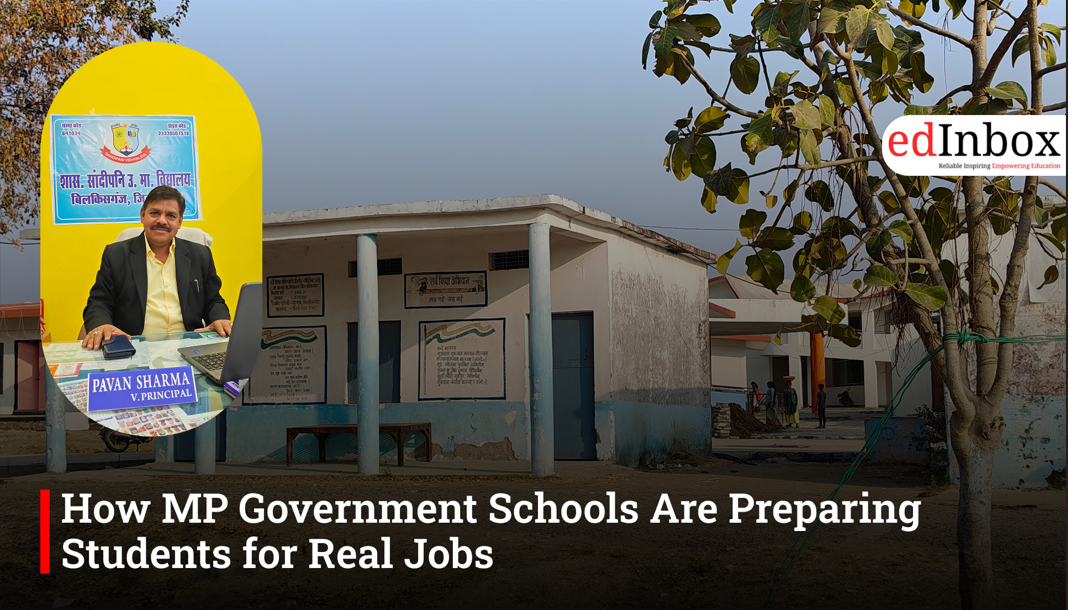
Emerging as a regional hub for vocational education, Sandipani Vidyalaya, Bilkisganj, is setting a benchmark by successfully implementing the programme and attracting students from government schools within a five-kilometre radius. The school’s early adoption and structured delivery of skill-based courses have positioned it as a model government school under Madhya Pradesh’s education reforms, particularly in rural and semi-urban areas.
The initiative reflects the state government’s broader focus on integrating skill development into secondary education, reducing dropout rates, and improving employability outcomes for students from government schools. Courses in Beauty and Wellness and IT are designed to provide hands-on training, practical assessments, and certification, ensuring students graduate with both board-recognised marks and market-relevant skills.
In an interview with Pawan Sharma, the Principal of Sandipani Vidyalaya, Bilkisganj, explains how the vocational courses are being implemented at the school level, the growing demand among students, and how Sandipani Vidyalaya is outperforming neighbouring government schools by offering structured vocational pathways without compromising academic learning.
Q: What is the idea behind introducing Beauty and Wellness and IT courses in government schools?
Principal, Sandipani Vidyalaya, Bilkisganj: The main objective is to ensure that students do not see education as limited to textbooks alone. Through Beauty and Wellness courses for girls and IT courses for boys, the government wants students to start building practical, job-oriented skills from Class 9. This helps them become confident, self-reliant, and better prepared for future careers.
Q: How are these vocational courses structured within the school system?
Principal: These courses run alongside regular academic subjects. The curriculum has been developed by the Pandit Sundarlal Sharma Vocational Institute and is implemented by the School Education Department. Students can continue these vocational subjects from Classes 9 to 12 without compromising their core studies.
Q: Can you explain the duration and certification process of the Beauty and Wellness course?
Principal: The Beauty and Wellness programme is designed as a two-year vocational course, beginning in Class 9 and concluding in Class 10. At the end of the course, students appear for examinations, and successful candidates receive a government-recognised certificate. Currently, the programme is being introduced as a pilot project and will be expanded further based on student response.
Q: What kind of training do students receive under this initiative?
Principal: Students are trained by industry professionals, which makes the learning process very practical and relevant. In 2026, we enrolled our first batch of Class 12 students who are now undergoing IT and Beauty training. The syllabus and assessment pattern are decided by the government to maintain uniform standards.
Q: Are there other vocational options available for students?
Principal: Yes, government schools already offer courses in Banking and Financial Services, Healthcare, Physical Education and Sports, Travel and Tourism, Telecommunications, Food Preservation, and Agriculture. From the new session, Class 9 students can choose from Agriculture, Plumbing, Sewing Machine Operator, and Automotive trades. For Class 10, five trades—IT, Beauty and Wellness, Electronics and Hardware, Retail, and Security—are available.
Q: How are these courses evaluated academically?
Principal: Vocational subjects in Classes 9 and 10 carry 100 marks, including practical assessments. These marks are added to students’ report cards, ensuring that skill-based education receives the same academic importance as other subjects.
How MP Government Schools Are Preparing Students for Real Jobs
Typography
- Smaller Small Medium Big Bigger
- Default Helvetica Segoe Georgia Times
- Reading Mode