The world, from the very beginning, is trying to find water on the moon, mars and other planets. But not every space mission has been fruitful. In the new space race, water and fuel are more valuable than gold, and India today may have found the moon’s most valuable resource– water.
Based on observations made by the Chandrayaan-2 Orbiter's Dual Frequency Synthetic Aperture Radar (DFSAR), scientists have detected radar signatures that are highly indicative of the presence of subsurface water-ice within permanently shadowed craters in the vicinity of the Moon's south pole.
The discovery is significant because the south pole of the moon is becoming the focus of the international space race. With this finding, India has come under the spotlight and might soon rewrite deep space exploration.
Chandrayaan-2 Discovered Ice Under The Lunar Surface
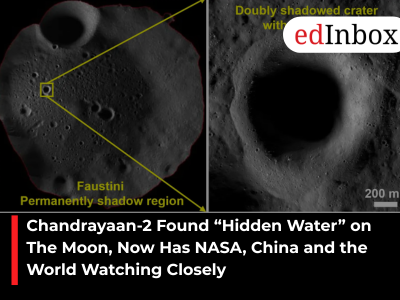
PRL scientists, Ahmedabad, have studied what are called “doubly shadowed craters” which are the areas within the permanently shadowed craters where sunlight never reaches.
The interior temperatures of these craters can reach almost minus 248 degrees Celsius, which means that water-ice can persist for billions of years without evaporating.
The scientists identified signatures of subsurface ice deposits in four craters on the moon using advanced radar polarimetry data from Chandrayaan-2's DFSAR instrument. One crater within the Faustini basin exhibited particularly strong evidence such as radar reflections and surface features that could suggest the presence of ice-rich material beneath the surface.
As per official ISRO mission updates, Chandrayaan-2 orbiter is still functioning and has been performing high-resolution scientific observations of the Moon for years since its launch.
The Importance Of Water On The Moon Is Growing
Water on the Moon was considered primarily a scientific curiosity for decades. It is now considered to be one of the most valuable resources for future space missions. Water can potentially be converted into astronauts' drinking water, breathable oxygen, and rocket fuel of hydrogen.
This is referred to as In-Situ Resource Utilisation (ISRU) and could enable future lunar missions to rely less on supplies sent from Earth, significantly decreasing the cost of long-term space exploration. That is one reason why major space agencies are now focusing heavily on the Moon’s south pole.
Moon’s South Pole is the Starting Point of New Space Race
NASA's Artemis programme will see astronauts return to the Moon and a long-term human presence near the Moon's south pole. The area is thought to be ideal because the permanently shadowed craters could contain water-ice that is accessible, and the surrounding elevated areas are exposed to near-constant sunlight for generating power from the sun.
In the 2030s, China is also stepping up its plans for future lunar explorations and a proposed International Lunar Research Station with Russia.
With countries getting ready for the next phase of lunar exploration, control of resource-rich areas of the Moon is gaining importance. In that context, the findings of Chandrayaan-2 are not only of scientific importance but also of importance to the country.
India's Growing Ambitions in the Moon
India’s lunar programme has rapidly evolved over the past decade. Following the successful soft landing of Chandrayaan-3 in 2023, ISRO has announced its plans for future missions such as Chandrayaan-4, which will be dedicated to the lunar sample return objectives and advanced exploration capabilities.
India also has long-term plans related to human spaceflight and deep space exploration. The Chandrayaan-2 discovery thus not only puts India in the lunar exploration game, but also as a nation contributing to the scientific data that can drive future lunar missions around the world.
A Quiet Scientific Success With Worldwide Impact
Scientific findings from orbiters are not as dramatic as a rocket launch or landing, but they can take years to develop. However, they can have a profound impact on how humans understand space.
The new Chandrayaan-2 results are being interpreted as a significant clue to the possibility of the presence of a substantial amount of water-ice that can be used on the Moon. And if future missions validate these results, India's involvement may be a key factor in humanity's next chapter beyond Earth.
As the world rushes to the Moon again, Chandrayaan-2 is quietly reminding the world that India's space programme is not only reaching the Moon, it is helping to shape the future of deep-space exploration itself and making its place in history.
Chandrayaan-2 Found “Hidden Water” on The Moon, Now Has NASA, China and the World Watching Closely
Typography
- Smaller Small Medium Big Bigger
- Default Helvetica Segoe Georgia Times
- Reading Mode