For decades, drought defined the hardships of farming in Madhya Pradesh's Bundelkhand. Today, however, many farmers say a different crisis is pushing agriculture to the brink—repeated crop destruction by nilgai, wild boar and stray cattle.
Across villages in Chhatarpur, cultivators are spending sleepless nights guarding their fields, abandoning profitable crops and, increasingly, leaving agriculture altogether in search of wage labour in cities.
'I'd Rather Work as a Labourer'
For Chandan Singh Rajput, farming has become financially unsustainable.
Rajput leases around 20 bighas of farmland in neighbouring Jhinna village, paying an annual lease of ₹85,000 to cultivate wheat, peas and sesame. Instead of sleeping at home, he now lives in a makeshift hut in his fields, keeping watch through the night.
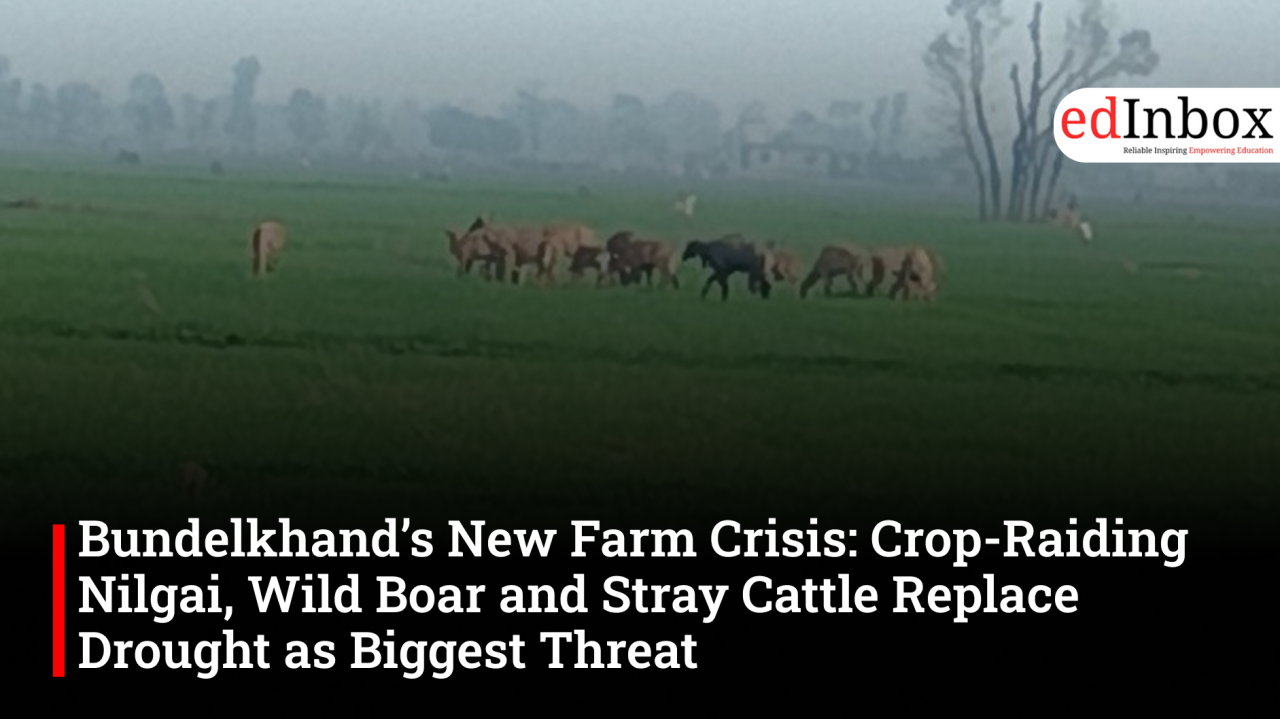
According to Rajput, herds of nilgai frequently enter farmland after dark, and even a brief lapse in vigilance can wipe out an entire crop.
During the last kharif season, he harvested only 400 kilograms of sesame despite cultivating all 20 bighas. His subsequent pea crop yielded around 1,000–1,200 kilograms, though he estimates production could have been nearly five times higher without animal damage.
He estimates his total losses at around ₹1.5 lakh, including ₹55,000 from peas alone.
"If I worked as a daily wage labourer, at least I could sleep at night," he says.
Wildlife Has Overtaken Drought as the Biggest Challenge
Farmers across Bundelkhand say that while drought once posed the greatest threat to agriculture, wildlife has now become a more immediate concern.
Another tenant farmer from Patha village, Makhanlal, says he has suffered continuous financial losses over the past four years.
"The last profitable year was 2021," he says, estimating cumulative losses of ₹1.5 lakh to ₹2 lakh since then.
Farmers Guard Fields Around the Clock
In Pehra, farmer Omnarayan Tiwari has begun installing fencing around his land.
Despite these efforts, he says farmers struggle to save even half their harvest.
Attempting to drive animals away is not without risk.
According to Tiwari, wild animals occasionally become aggressive, injuring those trying to protect their crops.
Entire Fields Destroyed Within Hours
The problem begins almost immediately after sowing.
In nearby Parai, farmer Arimardan Singh Yadav says wild boars dig up freshly sown fields, while nilgai and stray cattle invade once crops begin to grow.
Large herds—sometimes numbering 400 to 500 animals—can devastate standing crops within a matter of hours.
Solar Fencing Offers Limited Relief
Civil society organisations are attempting to help farmers protect their fields.
According to Ravikant Pathak, the organisation is assisting around 500 farmers across 12 villages in installing solar-powered electric fencing.
Each installation costs approximately ₹20,000 for a four-hectare farm, with the organisation covering half the expense.
However, Pathak notes that nilgai are capable of jumping over many such barriers, limiting their effectiveness.
Farmers Abandoning Cultivation
The continuing crop losses are forcing many cultivators to reduce or completely abandon farming.
Farmer Babulal Pal estimates that nilgai, wild boar and stray cattle destroy up to 75% of crops in the area.
Last year, he cultivated chickpea on four bighas but harvested less than half a quintal.
Although his family owns nearly 50 bighas of land, multiple family members now spend their days and nights guarding fields instead of pursuing other work.
"We have enough land, but we cannot harvest our crops," he says.
Migration Rising Across Villages
The agricultural crisis is also reshaping rural livelihoods.
According to local farmers, many have stopped cultivating crops such as pigeon pea and sorghum because repeated wildlife attacks make cultivation financially risky.
Sharecropping has also become less attractive, as uncertain harvests discourage both landowners and tenant farmers.
Babulal Pal estimates that members of nearly 80% of households in his village have migrated to towns and cities in search of employment, leaving behind primarily elderly family members to manage the remaining farmland.
His 80-year-old father, Bhavanidin, who still spends nights guarding crops, says he no longer wants the next generation to depend on farming for a living.
A Growing Rural Challenge
The situation unfolding in Bundelkhand reflects a broader challenge confronting many agricultural regions in India, where increasing human-wildlife interactions are threatening rural livelihoods.
While farmers continue to battle unpredictable weather, they say the relentless crop raids by nilgai, wild boar and stray cattle have made agriculture increasingly unviable. Without stronger mitigation measures, effective crop protection and long-term wildlife management strategies, many fear that more cultivators will abandon farming altogether, accelerating migration and deepening the region's agrarian distress.
Bundelkhand’s New Farm Crisis: Crop-Raiding Nilgai, Wild Boar and Stray Cattle Replace Drought as Biggest Threat
Typography
- Smaller Small Medium Big Bigger
- Default Helvetica Segoe Georgia Times
- Reading Mode