India's rich scientific heritage has the potential to redefine modern education by blending traditional wisdom with contemporary science, according to educationist Prof. Saroj Sharma. She argues that integrating ancient Indian knowledge systems into STEM (Science, Technology, Engineering and Mathematics) education under the National Education Policy (NEP) 2020 can create a more holistic, ethical and innovation-driven learning ecosystem.
Rather than treating ancient knowledge as history alone, Prof. Sharma advocates using it to inspire scientific inquiry, sustainability, critical thinking and multidisciplinary learning—key objectives envisioned under NEP 2020.
Ancient India laid the foundations of scientific thought
Prof. Sharma highlights that India's scientific tradition stretches from the Indus Valley Civilization to scholars such as Aryabhata, Charaka, Sushruta, Brahmagupta, Bhaskaracharya, Varahamihira and Nagarjuna.
She points to achievements including advanced urban planning, metallurgy, astronomy, mathematics and medicine that continue to influence modern scientific disciplines.
Historic centres of learning such as Nalanda, Takshashila and Vikramshila promoted interdisciplinary education centuries before the concept became globally recognised.
According to her, exposing students to these contributions can instil confidence in India's scientific legacy while encouraging innovation rooted in evidence and inquiry.
Ayurveda offers lessons in preventive healthcare
Prof. Sharma believes Ayurveda remains highly relevant in addressing today's lifestyle-related health challenges.
She explains that Ayurvedic principles such as Dinacharya (daily routine), Rtucharya (seasonal lifestyle) and maintaining dosha balance encourage preventive healthcare rather than treating illness after it develops.
With rising cases of diabetes, hypertension, obesity and cardiovascular diseases, integrating Ayurvedic concepts into health education can promote healthier lifestyles among students.
She also notes that Ayurveda's emphasis on balanced nutrition, physical activity and mental well-being aligns with modern preventive medicine and public health objectives.
Yoga supports mental health and holistic development
Mental health is another area where ancient Indian knowledge can enrich modern education.
Prof. Sharma notes that increasing academic pressure, digital distractions and social media have contributed to stress and anxiety among children and adolescents.
Drawing from Patanjali's Yoga Sutras, she explains that yoga and meditation help improve concentration, emotional stability, memory, self-awareness and overall well-being.
She observes that this holistic approach complements NEP 2020, which encourages education systems to support students' emotional, physical and psychological development alongside academic achievement.
The worldwide recognition of International Day of Yoga further reflects the growing acceptance of these practices across cultures.
Sustainability rooted in traditional wisdom
Prof. Sharma also emphasises the environmental lessons embedded in India's traditional knowledge systems.
Ancient Indian texts viewed nature as a living entity deserving protection, encouraging practices such as rainwater harvesting, biodiversity conservation, organic farming and sustainable resource management.
She argues that introducing these principles into school curricula can help students understand environmental stewardship from both scientific and cultural perspectives.
Such an approach, she says, aligns closely with global sustainability goals and climate-resilient development.
Linking traditional science with modern STEM
According to Prof. Sharma, ancient mathematical and astronomical knowledge can complement contemporary STEM education.
She cites contributions by Aryabhata, Bhaskaracharya and Varahamihira, whose work in astronomy, trigonometry and mathematics laid important conceptual foundations for scientific advancement.
Studying these alongside modern scientific theories can encourage students to appreciate the evolution of scientific ideas while strengthening analytical and problem-solving skills.
She also points to India's achievements in space exploration—including ISRO's Chandrayaan and Mangalyaan missions—as examples of how strong mathematical traditions continue to support scientific excellence.
Scientific heritage and sustainable architecture
Prof. Sharma highlights Vastu Shastra as another area worthy of academic exploration, particularly in architecture and environmental design.
She explains that traditional principles focusing on natural lighting, ventilation, energy efficiency and environmental harmony can complement modern concepts such as green buildings, passive cooling, solar energy and sustainable urban planning.
Studying these ideas through a scientific lens, she suggests, can help students understand climate-responsive architecture without compromising evidence-based engineering practices.
NEP 2020 encourages multidisciplinary learning
Prof. Sharma concludes that NEP 2020 provides an opportunity to integrate India's scientific heritage into mainstream education through interdisciplinary teaching, research and innovation.
She stresses that this integration should not promote unverified claims or romanticise the past. Instead, it should encourage students to critically examine historical contributions, understand their relevance in contemporary science and develop solutions for future challenges.
By combining ancient Indian knowledge with modern STEM education, she believes India can nurture scientifically informed, ethically grounded and globally competitive learners capable of contributing to sustainable development and technological innovation.
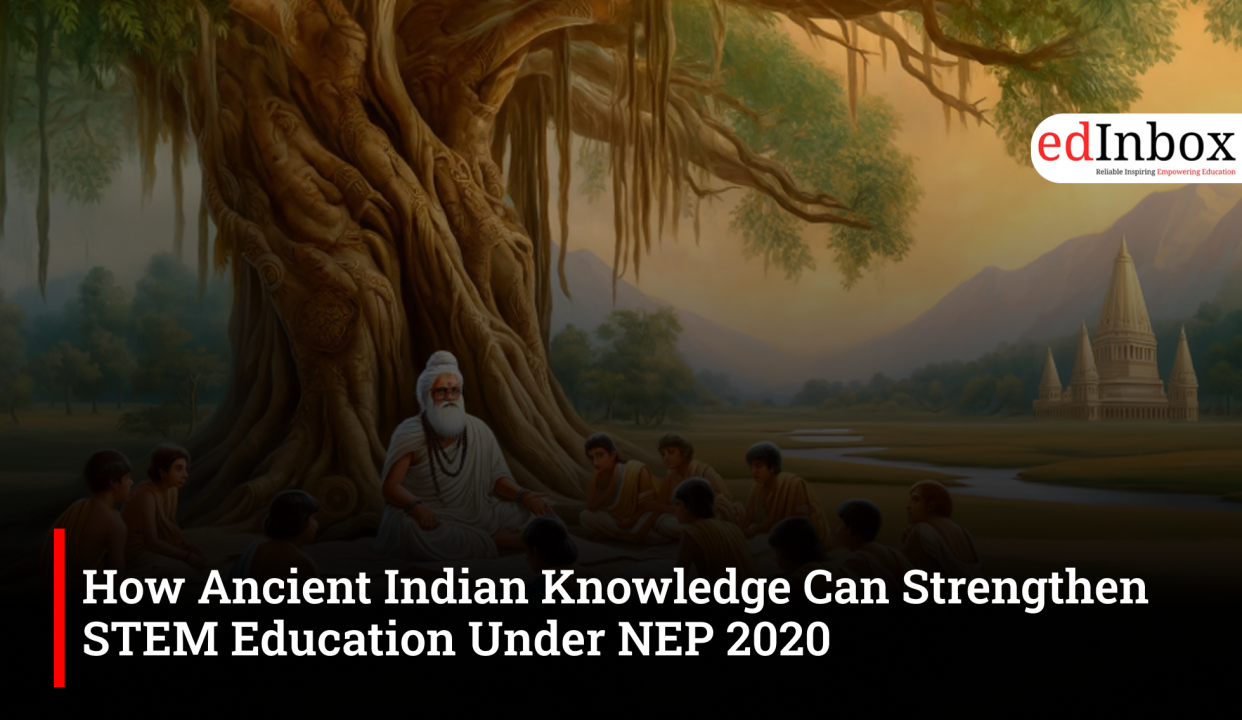
How Ancient Indian Knowledge Can Strengthen STEM Education Under NEP 2020
Typography
- Smaller Small Medium Big Bigger
- Default Helvetica Segoe Georgia Times
- Reading Mode