
Union Finance Minister Nirmala Sitharaman on Sunday placed design education and creative skills at the centre of the government’s education and employment strategy while presenting her ninth consecutive Union Budget for 2026–27, outlining measures aimed at aligning learning with jobs, enterprise and services-led growth.
“The Indian design industry is expanding rapidly and yet there is a shortage of Indian designers. I propose to establish, through a challenge route, a new National Institute of Design to boost design education and development in the eastern region of India,” the Finance Minister said.
A key education proposal in the Budget is the establishment of a new National Institute of Design through the challenge route to strengthen design education and development in the eastern region of India.
The design push is coupled with a wider emphasis on the creative economy. To augment India's animation, visual effects, gaming and comics (AVGC) sector, Content Creator Labs are to be established in 15, 000 secondary schools and 500 colleges, with the sector forecast to need two million professionals by 2030.
Stakeholder Reactions
Sanjay Gupta, Vice Chancellor, World University of Design, said, The Budgets strong push towards the creative and design economy is a welcome step for Indias youth. I have been advocating for this. By expanding AVGC and content creation labs across schools and colleges, the government is opening doors to future, ready careers within the growing creative economy. The proposal to strengthen design education addresses a long, standing talent gap. Together, these measures will nurture creativity, generate meaningful employment, and position India as a global hub for design, content, and innovation."
Adding to the reaction over the design education push in Budget 2026, Yajulu Medury, Vice Chancellor, Mahindra University, said, The Union Budget 2026, 27 is a remarkable move to position India as a global knowledge hub. Through the Yuva Shakti initiative, emphasis has been put on the governments efforts to ma k e education more relevant by connecting it with real, world careers, thus facilitating the transition to a knowledge, driven economy.
Higher Education Infrastructure
In higher education, the Budget proposed multiple investments, including new institutes, university townships, girls’ hostels and telescope infrastructure facilities. The Centre will support States through the challenge route to create five university townships near major industrial and logistics corridors. These academic zones will host universities, colleges, research institutions, skill centres and residential complexes.
Vinayak V. Bhosale, Trustee, Sanjay Ghodawat University, added, “For this vision to truly deliver, industry must be brought into curriculum design and incentivised to offer apprenticeships, joint research, and pathways for collaborative patents and spin-offs. With this kind of structured partnership, these townships can become powerful engines of both innovation and employability, redefining the educational landscape instead of just adding more buildings”
To improve access for women students, particularly in Stem institutions, the government announced that one girls’ hostel will be established in every district through viability gap funding or capital support.
To promote astrophysics and astronomy education, four telescope infrastructure facilities, the National Large Solar Telescope, the National Large Optical-infrared Telescope, the Himalayan Chandra Telescope and the COSMOS-2 Planetarium, will be set up or upgraded. The Budget also reduced tax collected at source under the Liberalised Remittance Scheme (LRS) for education and medical remittances from 5 per cent to 2 per cent.
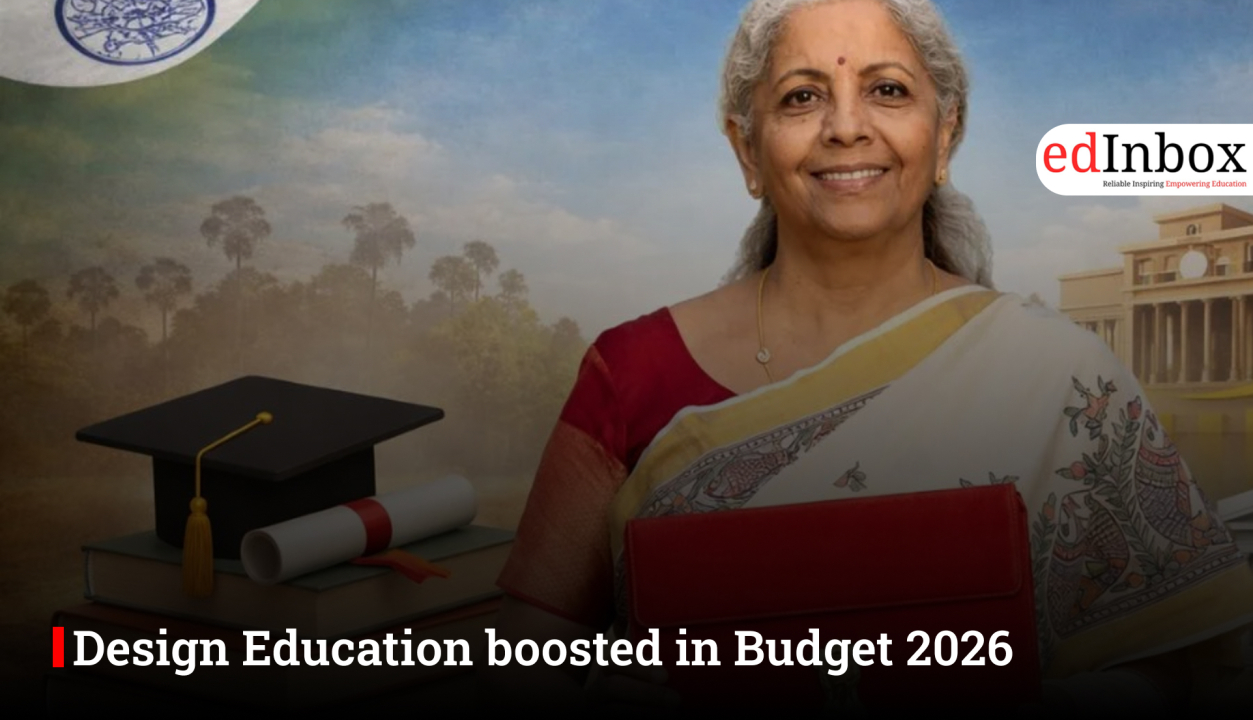
Design Education boosted in Budget 2026
Typography
- Smaller Small Medium Big Bigger
- Default Helvetica Segoe Georgia Times
- Reading Mode