
A brown bear that has spent decades standing silently behind glass in an English museum is now helping scientists tackle a very modern problem — wildlife crime.
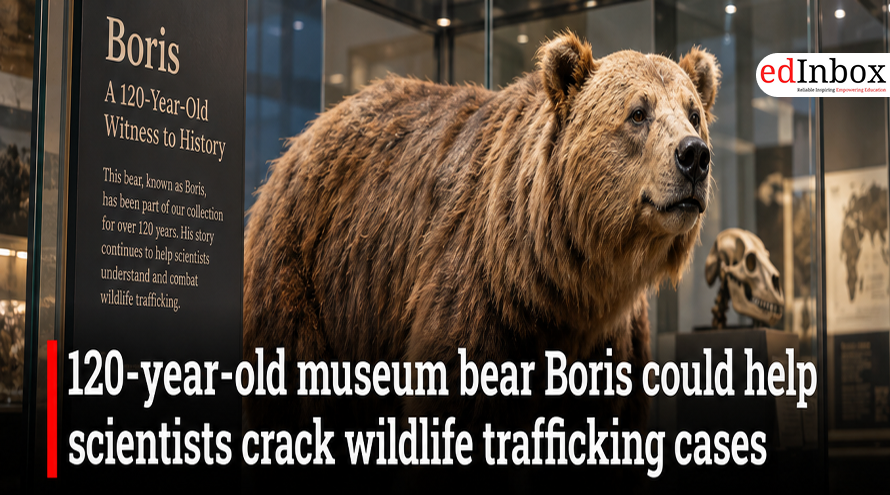
Known as Boris, the taxidermy bear at the Museum of Chelmsford has become an unlikely resource for forensic research more than a century after the animal was preserved. Researchers are studying samples of Boris’s fur to understand whether tiny features in animal hair can help investigators identify species involved in poaching and illegal wildlife trafficking.
The research is being led by Hayden Leigh, a forensic science graduate at the University of Staffordshire. As part of his PhD, Leigh is examining Boris’s hair under the microscope and studying its genetic characteristics. He is comparing the preserved material with characteristics that investigators might find in hair recovered from contemporary wildlife crime scenes.
The aim is to determine whether animal hair can provide useful forensic clues even when investigators do not immediately have access to sophisticated or expensive DNA testing.
Wildlife trafficking investigations can involve animal remains, fur, feathers, bones and other biological material. Establishing which species a sample came from can be critical to an investigation, particularly when traffickers attempt to conceal the origin of illegally obtained wildlife products.
DNA analysis can provide highly precise identification, but it can also be expensive and require specialist facilities. If microscopic examination of hair can reliably narrow down or establish the species involved, it could potentially give investigators another, more accessible tool.
Boris is particularly valuable because museum specimens preserve biological material from animals that lived decades ago. Such collections can offer scientists reference samples that would otherwise be difficult to obtain.
The bear has been part of the Museum of Chelmsford’s story since 1932. According to the BBC, Boris arrived as part of a large collection of taxidermy donated to the museum by a local game hunter. Over the decades, he became one of the institution’s best-known exhibits and something of an unofficial mascot.
Now, his preserved fur is being given a new purpose.
The research also highlights the unexpected scientific value of museum collections. Specimens originally preserved for education or display can decades later become valuable resources for modern forensic science.
For Boris, that means a new chapter long after his death — this time not simply as a museum attraction, but as a potential contributor to the fight against poaching and illegal wildlife trade.
120-year-old museum bear Boris could help scientists crack wildlife trafficking cases
Typography
- Smaller Small Medium Big Bigger
- Default Helvetica Segoe Georgia Times
- Reading Mode