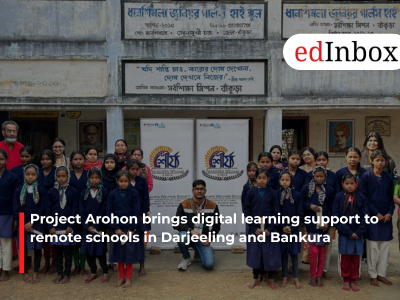
Driven by the belief that education remains the foundation of social progress, Shaurya Welfare Society has expanded its grassroots educational initiative, Project Arohon, across remote regions of Darjeeling and Bankura to strengthen digital learning access in underserved schools.
The initiative, conducted between July 2025 and January 2026, focused on schools struggling with declining enrolment, poor infrastructure, teacher shortages and limited digital access. The word “Arohon,” meaning ascent or rising upward in Bengali, reflects the project’s larger aim of empowering children and communities through education.
Before launching the intervention, a four-member survey team from the organisation visited seven institutions in the Rongmukh-Sonada belt of Darjeeling and parts of Bankura. The survey documented infrastructural limitations, digital exclusion, low student-teacher engagement and the socio-economic hardships faced by tea estate workers and Lohar tribal communities.
Among the schools surveyed were Jai Bharat Primary School, Vidyaratna Primary School, Proletarians Academy, Chandraman Dura Nursery School and Ramkrishna English School.
The findings revealed a severe shortage of resources. Some schools operated without electricity, while others functioned from fragile hillside structures divided by cardboard partitions and furnished with broken benches and worn-out blackboards. Several institutions relied almost entirely on community-appointed teachers and nominal student fees to survive.
In Bankura, Dhansimla Junior Girls High School, once home to more than 400 students, now has only 34 girls enrolled despite having government-appointed teachers and infrastructure. Teachers cited social pressures, economic hardship and gender-based responsibilities as major reasons for declining attendance among girls.
The outreach also extended to Ma Brahmamoyee Seva Ashram, a community-run educational shelter supporting children from the Lohar tribal community through academic tutoring and co-curricular learning activities.
As part of the Rongmukh intervention conducted in October 2025, Project Arohon installed electrical infrastructure, introduced computers and digital learning tools, organised teacher and guardian workshops and enabled remote desktop support systems for continued technical assistance. The initiative also distributed books donated by Julien Day School.
In Bankura, volunteers conducted extempore sessions, quiz competitions and puzzle-based learning activities while distributing winter clothing, books and educational kits to students.
The project highlighted how digital learning infrastructure could help bridge educational inequality in geographically isolated and economically distressed communities. Organisers believe computer-aided teaching can improve student engagement, reduce dropout rates and encourage fresh enrolment by connecting learners to broader educational resources beyond their immediate surroundings.
At the same time, the survey underscored deeper structural challenges facing rural education, including poor sanitation, lack of trained teachers, unsafe school environments and limited parental awareness regarding long-term educational outcomes.
Project Arohon’s interventions reflect a growing effort among grassroots organisations to combine digital inclusion with community-based educational support in regions where conventional schooling systems continue to struggle.