
Every Indian admission season comes with a familiar soundtrack: hoardings promising “world-class” degrees, social media reels of shiny campuses, and counsellor calls urging families to “book a seat” before deadlines close. But behind the noise sits a tougher reality: privately managed universities are operating in a red-ocean market—too many providers, too little differentiation—and today’s students and parents research harder than institutions assume.
Branding, in this environment, is not decoration. It is a survival system—one that must translate real academic substance into credible narratives, build trust fast in a high-stakes purchase, and run an efficient admissions funnel without creating ethical or reputational blowback.
“Branding is no longer ‘logo + tagline’—it is the aggregate stakeholder experience, a function of substance, not cosmetics.”
1) India’s admissions market is crowded—
but the real battle is for belief Higher education is an “experience/credence” service: families pay first and discover outcomes later. That makes trust the core currency. In a cluttered marketplace, branding helps reduce perceived risk, improves discoverability and shortlisting, and can strengthen fee resilience—but only if outcomes and student experience sustain the promise over time.This is why some of the most respected private institutions in India have leaned into credibility architecture—the public signals that help families verify seriousness before they verify outcomes. Consider how Ashoka University has repeatedly positioned itself through faculty profiles, research visibility, and student outcomes rather than high-decibel mass persuasion; or how O.P. Jindal Global University (Sonipat) has built a case for outcome trust by foregrounding data-led narratives and external validation; or how Shiv Nadar University has held attention through interdisciplinary outcomes and research-led positioning, rather than “poster-first” marketing.
The catch is non-negotiable: branding cannot substitute for academic quality, governance, outcomes, transparency, and student experience. Any institution that tries to use marketing to “cover” weak substance may win a cycle, but will struggle to sustain reputation, referrals, and yield.
2) Stop reversing the order: substance → narrative → amplification
Many institutions amplify first (ads), invent narratives next (brochure language), and try to build substance last (labs, MoUs, hurried “initiatives”). The sustainable institutions invert the sequence: substance → narrative → amplification. This is the central discipline: build real institutional capability, convert it into auditable stories, and only then scale distribution. It is slower at the start—but it compounds, because every admission cycle becomes easier when stakeholders already believe your promises.
Here, India already has instructive cases. KREA University (Andhra Pradesh) has anchored communications around a distinctive learning model (“Interwoven Learning”) after building the pedagogy as the primary product. FLAME University (Pune) has strengthened its liberal education narrative through long-run curricular design and learner experience—then amplified it via alumni voices and substantive content. Ahmedabad University has often let faculty-led work and academic seriousness do the early heavy lifting, before pushing for mainstream attention.
“Most private universities amplify first… The institutions that fill seats sustainably do the opposite.”
3) Find your “mountain peaks”—
and make your promise falsifiable. In India, “excellence” has become a meaningless word because everyone uses it. A credible brand promise must be specific, falsifiable, and evidence-supported—built around a few genuine “mountain peaks” where the institution truly stands above peers.A useful way to sharpen the promise is to answer three questions with discipline: Who is this for (and not for)? What outcomes will a learner realistically achieve? What institutional system produces those outcomes?
When these answers are clear, marketing stops sounding like everyone else—and admissions teams stop “selling everything to everyone,” which is often the fastest route to weak-fit enrolments and high regret.
Examples help clarify what “mountain peaks” look like on the ground. MIT World Peace University (MIT-WPU), Pune has leaned into a peace-and-ethics-inflected identity (including peace-oriented engineering narratives) to separate itself from generic “tech + placements” talk. Amity University has often argued scale and global visibility using external credentials and accreditations rather than only adjectives. Symbiosis International (Pune) has long owned a recognisable “internationalism + student services” story, supported by tie-ups and systems for inbound/outbound mobility.
4) Build the proof engine:
turn institutional enablers into admissions assets Universities often complain that “marketing is hard because education is complex.” The counter is operational: the institution already has its most persuasive content—if it documents its enablers and outcomes properly.A practical approach is to treat internal enablers as a content-and-proof engine rather than fabricate promotional claims. Done well, this produces a steady stream of evidence: pedagogy in action, projects, lab outputs, fieldwork, internships, student portfolios, faculty explainers, and student support systems—each mapped to the decision anxieties of students and parents.
This is where several private universities have built visible “proof loops.” NMIMS (Mumbai) frequently showcases industry-linked learning assets—projects, market tools, and faculty-industry interface—because these compress the distance between “degree” and “job role.” Chitkara University (Punjab) has invested in public-facing showcases of student work and innovation outputs that function like an always-on admissions showroom. Manipal Academy of Higher Education (MAHE) has made clinical, simulation, and partnership ecosystems part of its public narrative, so parents see systems—not slogans.
5) Sell evidence of transformation—not “a campus”
Some enablers convert exceptionally well because they directly answer the fears families carry into the admissions decision: affordability, employability, and credibility.
Consider how a proof-based story system can be built around the “admissions gold” areas: scholarships (“Investing in Talent”), organic learning (“Learning by Doing”), skills training (“Career-ready from Day One”), and multi-assessment (“Show What You Know”). This is the pivot that changes everything: you stop selling “a campus,” and start selling evidence of transformation.
What does that look like in Indian practice?
Scholarships as transformation proof: Institutions such as Ashoka and Shiv Nadar University have repeatedly used student journeys—who got funded, what they built, where they went next—to make financial aid feel like a merit-and-outcome system, not a discount.
“Learning by Doing” as visible pedagogy: UPES Dehradun has often highlighted capstones, industry-linked projects, and applied learning narratives to reduce the “will this be employable?” anxiety.
Career readiness as a public dashboard: Large-volume private universities such as LPU often publicise competition wins, innovation outputs, incubations and role outcomes to show movement, not just infrastructure.
Portfolio as currency: In design and creative education, institutions like Pearl Academy and World University of Design have relied heavily on portfolio showcases to make competence visible—because in creative careers, work speaks louder than brochures.
“You stop selling a campus, and start selling evidence of transformation.”
6) Your website is the “ultimate brand statement”—
and your trust infrastructure. The institutional website is not a brochure. It is the definitive brand artifact—and, increasingly, your credibility backbone.A high-performing admissions website typically does five jobs: proof hub; outcome clarity; program-market fit; conversion layer; and reputation defence.
In a market where parents assume “marketing exaggeration,” the website becomes your quiet differentiator—because it is where claims either stand up or collapse. This is why institutions that treat the website as a verifiability machine tend to earn disproportionate trust. Ashoka’s public-facing architecture—faculty, research, policies—signals “auditability.” NMIMS and O.P. Jindal have leaned into website-as-proof-centre logic: disclosures, processes, and clarity presented in one place. And universities like FLAME have experimented with richer “life on campus” visibility so that the lived experience doesn’t feel hidden behind poster language.
7) Gen Z won’t “believe” your ads. They will audit your footprint. Gen Z learners research institutions through social media to gauge authenticity; a strong footprint should reflect substantive capacity, not poster-making. Translated into practice: stop treating social as announcements. Treat it as public documentation of learning—student portfolio walk-throughs, faculty explainers, project micro-documentaries, transparent webinars, and parent-facing trust content.
This is also where “earned trust” is built: thought leadership and credible events that signal seriousness beyond paid media.
India’s private universities are already moving—unevenly, but clearly—in this direction. Amity’s social channels often foreground student work and wins to feel “real,” not manufactured. Shiv Nadar University has used explainers and long-form conversations to build faculty credibility in public view. UPES has leaned into student diaries and applied learning storytelling. And institutions such as MIT-WPU and FLAME have used conversation formats—talk series, faculty conversations, theme-led programming—to create a footprint that reads like a knowledge institution rather than an ad campaign.“Stop treating social media as posters… Treat it as public documentation
of learning.”
8) Treat admissions as a measurable funnel—
not an annual Panic If you want optimum admissions, you need a measurable funnel with disciplined stage tracking: lead → qualified lead → application started → submitted → offer → enrolment (yield) → 30/60-day attendance (retention proxy).Then map content to stage: top-of-funnel reputation; mid-funnel proof and fit; bottom-funnel transparency on fees, scholarships, safety, escalation, deadlines.
The uncomfortable truth: many private universities don’t lose admissions because they lack leads. They lose them because trust breaks right when parents ask, “Show me what you deliver—and what you do if something goes wrong.”
This is why operationally mature institutions behave like high-integrity consumer brands: they instrument the funnel, reduce friction, and remove ambiguity. Large funnel operators such as NMIMS and LPU have increasingly treated admissions as a stage-wise pipeline with measurable conversion points. Ecosystems such as Manipal and Chitkara have leaned into dashboards and systems thinking—connecting lead sources, counselling, and deposits into a single operating rhythm. Meanwhile, higher-selectivity institutions such as KREA and Ashoka have often focused on a different funnel discipline: applicant experience and credibility at each touchpoint, deliberately avoiding coercive “sales culture” even when volumes are pressured.
9) The caution zones:
what quietly destroys brands (and seat yield). In a tightening reputational environment, the fastest way to damage admissions is to trigger distrust through overclaims, rankings misuse, coercive sales culture, privacy negligence, or discount-led positioning.
The recurring minefield is outcome claims—placements, ranks, “#1”—because they invite scrutiny and backlash when they are not defensible with proof. The safer discipline is simple: publish auditable methodologies and avoid absolute claims unless they can be supported by verified data.
The other slow poison is a “spammy” funnel: if the admissions experience feels manipulative, the brand damage is immediate—even before any formal complaint. The positive contrast is instructive. Institutions that consistently prefer verifiable, third-party-supported narratives—and maintain “single source of truth” discipline on websites and disclosures—tend to be more resilient when public scrutiny rises. The core advantage is not that they are perfect; it is that their claims are easier to audit, clarify, and defend.
The institutions that win won’t be the loudest. They’ll be the most provable. Strip away the hype and a privately managed university sustains admissions by doing three things well: deliver a distinctive learning model, publish auditable proof (not adjectives), and run an ethical, measurable funnel that respects families as high-stakes decision-makers.
Across India, the institutions that keep showing up as “proof-over-promise” examples—Shiv Nadar, Ashoka, FLAME, Ahmedabad University—demonstrate a simple strategic truth: reputation compounds when the public can verify the systems behind the story. And operationally scaled institutions such as NMIMS, UPES, Chitkara show another truth: disciplined documentation of learning, outcomes, and student support can sustain admissions even in fiercely competitive metros.
In India’s private higher education market, the winning “thought” will not be “they advertise everywhere.” It will be: they are credible, transparent, future-ready—and they can prove it. And credible universities will gradually find honourable mentions in NAAC Accreditation, NIRF Ranking, QS and Times Higher Education ranking.
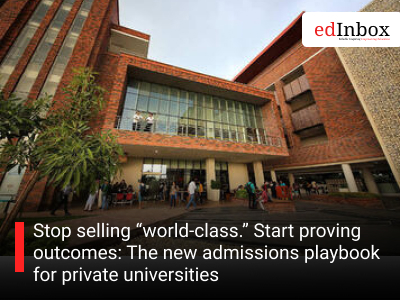
Stop selling “world-class.” Start proving outcomes: The new admissions playbook for private universities
Typography
- Smaller Small Medium Big Bigger
- Default Helvetica Segoe Georgia Times
- Reading Mode