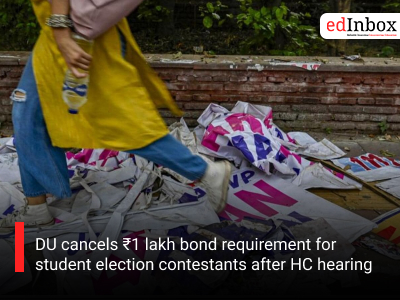
Delhi University (DU) told the Delhi High Court on Friday that student contestants for the Delhi University Students' Union (DUSU) elections do not have to deposit ₹1 lakh, as required under its August 8 notice.

On behalf of the university, advocate Rupal Mohinder moved in front of justice Mini Pushkarna that nominees would now have to pay only an affidavit and a security bond while submitting nominations.

The move was proposed by way of a petition challenging the varsity's August 8 notice calling for election candidates to produce a ₹1 lakh bond. The notice had been issued by the varsity to prevent vandalism around and inside the university, for the September 18 polls and to prevent the situation last year when university and public property were vandalized during the DUSU polls.

Observing DU's submission, the top court rejected a plea by two candidates, one of them Anjali, and Abhishek Kumar, both belonging to rural backgrounds, who argued that the provision was against their constitutional rights.

Their petition, filed by lawyer Raja Choudhary, argued that the condition was arbitrary and discriminatory under Article 14 because it effectively excluded rural and middle-class students from contesting. It also argued that the rule violated the recommendations of the Lyngdoh Committee recommendations, which place joint liability for defacement, and exceeded the registrar's jurisdiction. "The impugned clause defeats the democratic essence of student unions, turning elections into an elitist forum, against judicial instructions for democratization," the petition further stated.

The elections had been conducted a year ago on September 27, 2024, but the vandalism on a large scale caused a lag of nearly two months in counting and declaration of the results following an order by the Delhi High Court to take down all graffiti and posters.

The August 8 notification had caused outrage as well, with the Akhil Bharatiya Vidyarthi Parishad (ABVP) submitting an earlier this month memorandum against the need for a ₹1 lakh bond. The organization demanded its withdrawal immediately and warned of a massive campus movement in case the provision was not withdrawn.

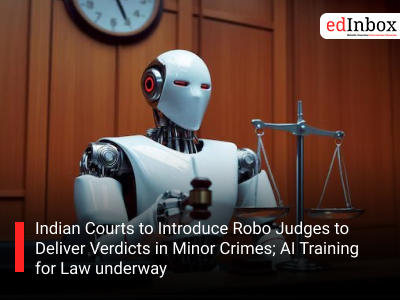
The Indian government is implementing AI (artificial intelligence) in the courts to support judges and speed up routine cases like minor crimes, traffic offences, and land disputes, without replacing human decision-making.

AI in Indian Courts: What’s Changing

The biggest hurdle to Indian courts is that, as of July 2025, the number of pending cases is 5.29 crore, and just under 4.65 crore in district courts alone. To address this, AI-driven robo-judges are being used to perform data-intensive jobs. These software applications can quickly crunch case information, compare previous verdicts, summarise documents, make predictions, and aid in sorting out information, allowing judges to concentrate on the essential areas of law.

Human Judges are in Control.

AI will not replace judges. Instead, it is an intelligent assistant that simplifies paperwork and legal research. However, all final decisions remain in the hands of human judges. The unofficial norms, such as the new rules established by the Kerala High Court, clarify that AI is a helpful tool that cannot independently make or comprehend legal decisions.

How is Training Being Done?

Specialised training is also underway to help district and sessions court judges use AI tools effectively; more than 3,000 courtrooms in 8 states already participate in training. Some judges have travelled to Singapore to attend advanced courses, having studied in other countries such as Estonia and China, where AI in the courts has already been successfully introduced. Programmes are run with help from the Indian Institute of Public Administration (IIPA), which focuses on teaching ethical AI use and international best practices..  

Effects and Value

Already, AI applications are proving to reduce pending cases by 15-20% and accelerate case processing by approximately 30% in cities such as Bengaluru, Delhi, and Mumbai.

Tools such as SUPACE (Supreme Court Portal Assistance in Court Efficiency) and e-Courts Project Phase III allow legal research to be conducted more quickly, translated into regional languages and facilitate case management. 

Ethical and Legal Protection.

Strict laws make sure AI is utilised closely with transparency, fairness, confidentiality and human supervision as the core focus, and build upon that, the court must document every application of AI, and judges must never accept AI suggestions without verifying them first, minimising the possibilities of bias or error.

Indian and Global

The first AI-guided robo judges were introduced by Estonia in 2019, in minor claims, and China subsequently scaled the technology to millions of cases. India is proceeding slowly, observing how global experiments are progressing and customising the best practices to meet local requirements.

The future of the Indian legal system under AI looks brighter, particularly considering the number of cases that need to be resolved. Nonetheless, its purpose will stay purely supportive, and the justice will be not only quick but also person-oriented, providing hope to students, professionals, and netizens who want to receive just and prompt legal results. 

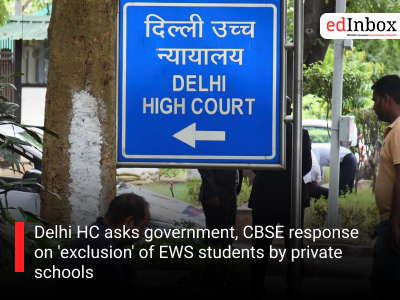
Delhi High Court on Wednesday asked the Delhi government and CBSE to respond to a plea claiming "commercialisation" and "systemic exclusion" of EWS students from private schools by coercive buying of costly books of private publishers and hefty academia material.

A bench consisting of Chief Justice D K Upadhyaya and Justice Tushar Rao Gedela issued notice during hearing a PIL and asked the Delhi government, the Central Board of Secondary Education (CBSE) and the National Council of Educational Research and Training (NCERT) to file the replies within a period of four weeks and posted the plea for Nov 12.

The petitioner Jasmit Singh Sahni is said to be an education policy researcher and social activist engaged in the sphere of educational equity and rights-based access to quality schooling in India.

According to Sahni, EWS or disadvantaged group students chosen under the RTE Act were either denied the advantage of admission or compelled to drop out because of the unaffordable private publisher books and school kits.

The petitioner, represented by lawyers Amit Prasad and Satyam Singh, averred that despite persistent policy interventions on the part of the Ministry of Education and CBSE, private schools are still ordering unregulated private publisher books worth up to Rs 12,000 a year, even where NCERT books are priced below Rs 700.

"This ubiquitous practice not just disobeys CBSE affiliation bye-laws and RTE Rules but is also denying admission to children who are admitted under Section 12(1)(c) of the RTE Act and cannot afford these text books, thus negating the very purpose of inclusive education," the plea added.

The Delhi government offers only Rs 5,000 yearly reimbursement, the plea averred, creating a chasm that compels EWS families to withdraw admissions that defies the 25 percent reservation requirement for disadvantaged children.

The plea averred despite the circulars issued by CBSE during 2016-2017 requiring the compulsory use of NCERT books, private schools were prescribing costly private publisher books.

BCI has taken a decisive step by introducing a three-year moratorium on the establishment of new law colleges across India, effective from August 2025. The ruling has far reaching consequences to law school hopefuls, law teachers and schools in the country. Here are the 5 reasons why the Bar Council Of India has taken this step:

Improving the Quality of Legal Education

India now has more than 1700 law colleges, many of which are operating with poor infrastructure, inadequate faculty , and a shortage of resources. Numerous studies by the BCI and other organizations have indicated that a large percentage of these colleges are working on volume rather than quality graduates that are not significantly trained on matters concerning practicalities of being in law. The moratorium is supposed to curb the uncontrolled rise in the number of low-quality institutions and channel efforts on improving educational standards before authorizing new colleges.

Addressing Commercialization and Degree Shops

The unregulated proliferation of law schools has given way to commercialization of legal education where some schools tend to be degree mills where entry is a business rather than educational choice. This has led to slackened academic integrity and student outcomes. The moratorium implemented by BCI is aimed to bring down this practice and reinstate the confidence in law degrees in India.

Faculty Shortage and Lack of Facilities

One of the main issues in most law colleges is: lack of qualified full-time faculty and lack of proper infrastructure e.g., well-stocked library, moot court and practical training facilities. The moratorium will allow current colleges the time they need to refine their faculty hiring and facility upgrades to meet the BCI high standard before bringing more colleges into the system.

The Necessity of Curriculum and Practical Training Reforms

With new fields such as cyber law, arbitration and artificial intelligence in law, the course curriculum of most law colleges is obsolete and not in tune with the requirements of contemporary legal practice. The time in moratorium will be utilized to redesign curricula, expand on the practical training rounds through internships and moot courts, and includes new fields of the law to land graduates ready to work.

Finding a Balance between Supply and Demand during a Judicial Backlog

There are massive backlogs of cases in the judicial system in India and there is demand for quality lawyers and not necessarily the sheer number of students passing out of mediocre schools. The oversupply of law graduates with insufficient skills saturates the job market/law system. The moratorium focuses on quality rather than quantity to create competent lawyers who would contribute to the legal profession and judicial reforms.

What Does This Implies to Students?

Although the moratorium implies the decrease in the size of the seats and growth, there is a strong chance of legal education becoming of better quality and the outcome of better employability of students taking law courses during and after this phase. Only a few colleges in underserved or marginalized areas will be considered, and these have to meet stringent criteria.

This three-year restriction on new law colleges is a decisive action by the BCI in shoring up India's law education system. This should be seen by aspiring law students and educators as the time to prioritize quality and practical education and make legal education resonate with the demands of the 21st century profession.

Great lawyers are not made by the knowledge they possess, but by the key qualities that define their work, approach, and commitment to serving justice. Legal knowledge is just a small part of becoming a great lawyer. In today’s world, where everything, every information, is just a click away, top lawyers have certain traits that set them apart from normal lawyers or people practising law. Whether you are a law aspirant, budding attorney or someone seeking to become a great lawyer like Late Ram Jethmalani, there are 5 traits that are must-haves.

Boldness in the Advocacy

Ram Jethmalani was renowned for never giving up, even in the toughest cases. He also picked up contentious clients and political cases because he was confident that everyone is entitled to a robust defence.

A great lawyer is one who is courageous and fearless. Never compromising in hard cases of defending the correct thing, even in a case that is not popular, is critical to justice.

Holistic Knowledge of the Law

Late Ram Jethmalani achieved success because of his enormous and meticulous understanding of various laws such as criminal law, constitutional law, financial law and many more.

A lawyer needs to be highly knowledgeable in the area of law and always on the learning curve. Laws evolve, and keeping up with the change ensures the best advice and representation for the clients.

Effective and Clear Communication

Ram Jethmalani was an expert speaker. His court appearances or his speeches at any forums were always followed by triumphs as he could simplify deep, strong legal arguments and use easily understandable words.

A good attorney should be able to present concepts well, when talking and in writing. Effective communication enables the clients to comprehend their case and persuade judges and juries well.

Dedication to Fairness and Equity

Jethmalani was a believer in justice and never compromised with his values, upholding human rights and humane treatment of every person. 

Integrity matters; a good attorney will focus on ethical and fair practice as the top-most priority and will not discriminate between two cases.

Hard work and tenacity

As a lawyer, Ram Jethmalani spent more than 80 years toiling in preparation, sweat-breaking in the fight put up by him on behalf of his clients. Law requires tenacity and effort. A good lawyer does not give up but always pushes to deliver the best representation ever.

The career of the late Ram Jethmalani has taught us that great lawyers are those who are courageous in their actions, knowledgeable in the field, communicative, ethical and hardworking. These are not just qualities to make a successful legal career; the practices safeguard justice and are useful to society.

In conclusion, all the law aspirants seeking to be great lawyers must have these 5 traits. Because these traits serve as a roadmap for excellence and trustworthiness, the lawyers possessing these qualities grow drastically in their careers, contributing rightly to the Indian legal system.

The Rajasthan government Wednesday told the high court that student union polls will not be conducted this year, citing the planned implementation of the National Education Policy (NEP) and suggestions from university heads all over the state. In a formal response to the court, the government stated that the prevailing academic situation makes it impossible to hold the polls.

Authorities invoked the Lyngdoh Committee recommendations, according to which student union elections must be held within eight weeks of the beginning of the academic session. They pointed out that the continuous academic calendar, reconfigured in the wake of NEP implementation, doesn't allow following this schedule.

The govt further informed the court that nine universities' vice-chancellors have recommended that the polls not be held this year. The officials, as per the submission, have cited disruption in class timetables and an uncertain academic structure as the reasons behind holding up the polls.

The issue was raised in the high court by Jai Rao, a first-year student of the MA course of Rajasthan University, who approached the court through a petition on July 24. Rao, in his appeal, claimed that the right to elect student representatives is inherent and asserted that elections never took place in Rajasthan for three consecutive academic sessions.

The court had heard the case for the last time on July 29 and asked the state to submit a detailed reply. In the meantime, student leaders from all over the state have organized several demonstrations in recent weeks demanding that the elections be conducted at the earliest.

There will be no additional new law colleges or law schools in the nation for three years, as the regulatory Bar Council of India (BCI) has declared a three-year moratorium on new centres of legal education.

"During the period of the moratorium, no new centre of legal education shall be opened or granted permission anywhere in India.". Additionally, no current centre of legal study can add any new section, course, or batch without prior written and express approval from the BCI. Outstanding applications that have not been given final approval as on the date of commencement will not be touched and will be dealt with according to law," Srimanto Sen, principal secretary of the BCI, said on Wednesday.

Justifying the decision, the council described it as compelled "to stop the deterioration in quality across legal education segments, demonstrated by the uncontrolled mushrooming of sub-standard institutions, frequent issuance of NOCs by state govt and affiliations by universities without checks, and to avoid commercialisation of legal education, indiscriminate academic malpractice, and continuing shortages of quality faculty."

With a proposed number of some 2,000 such centres of legal education already functioning in the country, the BCI feels that institutional capacity of the country is sufficient, the release stated, and the focus has to now turn towards consolidation, quality improvement, and systemic strengthening in public interest and in furtherance of constitutional obligations.

The rule, to be issued shortly for an uninterrupted period of three years, derives its power from the Advocates Act, 1961, and depicts the council's responsibility to uphold and maintain standards of legal education, preserve the integrity of the profession, and protect public interest in the administration of justice, it said.

Referring to a resolution passed in 2019 establishing a temporary moratorium of new law schools, and the later order of the Punjab and Haryana high court dated Dec 4, 2020, the BCI averred it also brought out a comprehensive press release of June 16, 2021 calling for strict diligence by state govts and universities.

"The current rule fulfills the direction of the court by implementing the steps through regulation rules and complements the Council's historic strength in quality," Sen added in the statement.

But there are a few exceptions. 

The rules exempt proposals exclusive to socially and educationally backward classes, SC/STs and economically weaker sections, proposals in remote, tribal or aspirational districts notified by concerned authorities and courses exclusive to individuals with disabilities.

"Such proposals have to meet tight requirements, such as valid NOCs, previous university associations, evidence of infrastructure and faculty capabilities, and meet need-based establishment under the Rules of Legal Education," the statement added.

More Articles ...