Chatgpt has become the go-to platform for everyone. No matter the issue one is facing, he/she will run to Chatgpt with their concerns. The world has changed and courtrooms are mimicking the same by allowing the use of Chatgpt history as evidence. Several recent reports, statement by Open AI CEO Sam Altman, and real-time court cases confirmed this significant change to all users of chatbot technology, especially in India.

What Did Sam Altman say?

As Sam Altman revealed in a public podcast, numerous users, and in particular younger users, refer to ChatGPT as their friend, therapist, or advisor. He emphasized a decisive distinction between discussing with doctors, lawyers, or psychiatrists, as conversations are covered by confidentiality. However, your conversation with an AI model does not have such privilege. Assuming you got into a discussion with ChatGPT and someone attempts to bring this case to court and request that your conversations be shown, OpenAI might be court-ordered to provide those, even in the case of you deleting the chats.

Sam Altman statement: “Right now, if you talk to a therapist or a lawyer or a doctor about those problems, there’s legal privilege for it. But we haven’t figured that out yet for when you talk to ChatGPT”  

The Reason Why ChatGPT is Not a Private Chat

 As per law experts and even  OpenAI CEO Sam Altman, the chats one has with ChatGPT are not confidential. If any court issues an order or a subpoena to get the chat history then OpenAI can be forced to share it despite the fact that the conversation was deleted.

Most courts around the world are recognizing digital records in the form of texts, emails, and chatbot logs, provided they are relevant to a case. The case can be either civil, criminal, or business-related, but the chats with chatgpt will be subject to the same legal findings or evidence as the other digital communications.

Some Indian-courts have resorted to AI and ChatGPT research purposes; however, the high courts have been conservative and have primarily used ChatGPT as a source of info-gathering purposes, non-decisive major decisions. Still, as Indian law adapts, ChatGPT data is likely to be treated like any other e-evidence if required for a case. 

Examples: Evidence and reference of chatGPT in Courts

In the U.S., some instances are already encountered where the ChatGPT was used by lawyers in legal research. There are some courts that also have requested OpenAI to retain all the chat logs of users, in case they are used as evidence.

ChatGPT-generated material has been permitted as an element of a legal case in the UK and Europe; however, the courts typically exercise caution regarding it, with concerns over its accuracy and a desire to know how the information was generated or obtained.

Courts such as those of Punjab and Haryana and Manipur have used ChatGPT conversations.  As per a research paper, the Punjab and Haryana High Court have used ChatGPT for input on a bail petition that  included the allegations of a brutal fatal assault. This ChatGPT reference was taken merely to  emphasize its sole purpose of providing a comprehensive understanding of bail considerations in the cases that involved cruelty.

What to do to stay safe?

  • Think Before You Type: Avoids sharing sensitive or confidential information using ChatGPT or other AI chatbots, especially the stuff you will not wish to see in public or legal.
  • Find Certified Help: In any case of legal, health, financial, or emotional issues, you should speak to the appropriate professionals and not only AI, which can never provide confidentiality and professional responsibility.
  • Be Aware of Your Rights and Dangers:  What you place on the internet, be mindful of it. Your chats with your AI can also be used as evidence just as today we have social media posts and emails used as evidence.

Why are Indians especially at risk? 

ChatGPT has become widely used by the youth in India in cases of seeking advice, relationships, legal confusion or career questions among others since India is one of the largest markets. However, the law of India fails to safeguard such dialogues. Indeed, OpenAI has stated in court itself that it does not maintain an office or servers within India and thus the local laws such as the Indian confidentiality or copyright laws do not directly apply to it.

In the meantime, Indian courts are experiencing their first big lawsuits against OpenAI from many companies and media houses that are concerned about the breach of their privacy and copyright protection. However, until India has its own AI specific rules and regulation, the chatgpt data can be used as evidence in the court. 

What Not to Talk About to the AI Chatbots?

To enhance a safe usage, the following details should not be observed in ChatGPT or other AI chatbots:

  • Family secrets or problems in your life
  • Interpersonal or matrimonial conflicts
  • Doubt of the legality or suspicion of law-breaking. 
  • Secrets to the banks or business secrets. 
  • The health issues should be discussed with a physician or counsellor. 

How to Use AI Safely?

  1. Chatbot conversations should be considered as public. 
  2. Do not give out your Aadhaar, OTP number, or OTPs on your mobile phone, or any personal secrets. 
  3. Do not take personal advice for  issues such as divorce, mental health, or the vice of legal problems.
  4. In case you need artificial intelligence to brainstorm, you should make things generic.

In simple words, by using ChatGPT, your information does not enjoy any protection of the law and can be considered as court evidence in case of such necessity. Be smart and safe on the internet; never assume that the chatbot conversations are confidential. When it comes to something important, do not rely on AI, rely on professionals.

As Sam Altman and privacy advocates worldwide believe that as AI becomes more common, laws must evolve to protect user privacy. But this will take time. Until the privacy and data protection rules are clearly stated by the court, users in India must remain alert and responsible while using AI tools.

The Delhi government has petitioned the Supreme Court seeking a review of its order mandating a blanket ban on the plying of petrol vehicles over 15 years old and diesel vehicles over 10 years old of all categories in the National Capital Region (NCR).

In its July 25 plea, the Rekha Gupta government has contended that "the road-worthiness of a vehicle is a technical and scientific matter that has to be associated with actual emissions as tested and indicated by mechanisms stipulated under the Motor Vehicles Act, the Central Motor Vehicles Rules, etc., in contradistinction to across-the-board ban on the basis of age which has no nexus with actual emissions".

The state has stated that the prohibition on the plying of the aforementioned vehicles during the past seven years, "although certainly salutary in intent was found to have entailed many practical difficulties to the citizens of Delhi, which today, considering the developments in technology and enforcement now prima facie seem to outweigh the prudence and feasibility of the continuation of the aforesaid ban".

The plea also requested the court to order the Centre or the Commission on Air Quality Management (CAQM) "to conduct a proper broad based, scientific study on the necessity for continuation of" the total ban ordered by the Supreme Court's October 29, 2018, order.

The Delhi government stated that in its considered opinion, "the considerable development in Pollution Under Control (PUC) technology, expanded coverage of PUC testing, tighter monitoring of emission norms, shift to Bharat Stage VI engines and several other measures" that have been taken since the Supreme Court judgment "adequately meet the issues that compelled" the Supreme Court to pass such a judgment.

"It is the belief of the State Government that there is very urgent requirement for a graded, balanced and technology based regime to manage vehicular pollution and that rather than an age-based across-the-board ban, a scientific data-based regime be designed taking into account all relevant parameters to determine individual vehicular pollution, for instance but not exhaustively: (i) Actual emission, (ii) Actual mileage, (iii) periodical and routine vehicle fitness tests and (iv) best available retrofitting strategies (CNG/electric conversion)," the application reads.

The plea further mentioned that "a balanced policy would not only protect the environment by phasing out polluting vehicles, but also safeguard the rights of the responsible vehicle owners".

The government explained that the full ban order "was originally enacted as an emergency provision at a time when Bharat Stage IV (BS-IV) emission norms were in place and the transition to Bharat Stage VI (BS-VI), with much stricter and newer norms, had not yet begun.

It further added, "However, it is submitted that in order to address the problem of pollution in the NCR region, a holistic policy is needed which provides vehicle fitness based on the actual emission level of a specific vehicle in accordance with scientific parameters and not impose a blanket ban on the basis of simply the age of the vehicle."

The government added that much has happened in terms of technological, legal, and environmental advancements since 2018, which makes a "re-consideration of this decision" by a technical body necessary to set a graded and structured plan to address pollution.

The application also stated that there are different sources of air pollution in Delhi other than vehicle pollution and that emissions from vehicles only form part of multiple sources of air pollution in Delhi NCR. “Other significant contributors include: stubble burning, biomass burning, road and construction dust, industrial emissions, weather and meteorological factors. As per the Commission for Air Quality Management, the percentage contribution of the said sources to the air quality of Delhi varies significantly depending on the season,” the plea stated.

The Delhi government has asserted that CAQM in its 'Policy to Check Air Pollution in the National Capital Region' adopted in July 2022 has laid down, "These studies demonstrate that there is significant seasonal variation in the relative contribution of pollution sources between winter and simmer", and argued that "thus…a scientific appraisal, and cost benefit appraisal of phasing out vehicles on the basis of age would be an appropriate approach".

The state said that since the issue of Delhi’s air quality is not confined solely to the National Capital Territory but rather to the broader National Capital Region, it is respectfully submitted that “it would be appropriate if suitable scientific studies on the feasibility, desirability and efficacy of continuing the said ban are carried out at the level of the Union of India or the Commission for Air Quality Management”.

The Education Ministry is finalizing a bill for establishment of the Higher Education Commission of India (HECI) — a much-debated proposed single regulator of higher education, Minister of State for Education Sukanta Majumdar informed the Lok Sabha on Monday.

In a response letter, Majumdar has stated that the decision conforms to the National Education Policy (NEP) 2020 that enunciates a "light but tight" governance model. The model aims to promote transparency, efficiency, and accountability and institutional autonomy, innovation, and good governance.

As was contemplated under the NEP 2020, the HECI would be a horizontal umbrella body with distinct verticals for regulation, accreditation, finance, and research quality. The above commission is to supersede existing regulators like the University Grants Commission (UGC), All India Council for Technical Education (AICTE), and National Council for Teacher Education (NCTE).

UGC. oversees non-technical education, whereas AICTE oversees academic institutions and NCTE oversees school teacher training. For the first time in a 2018 draft bill to substitute the UGC Act, it was recommended to have all these functions vested under one regulator. The said bill was later released for public hearing by way of release.

Efforts to introduce the HECI intensified once more under Union Education Minister Dharmendra Pradhan, who was sworn in back in July 2021.

NEP 2020 has yet again asserted that the current regulatory framework must be remade from scratch so that India's higher education system can be revitalized and endowed with the ability to meet the challenges of times and global standards.

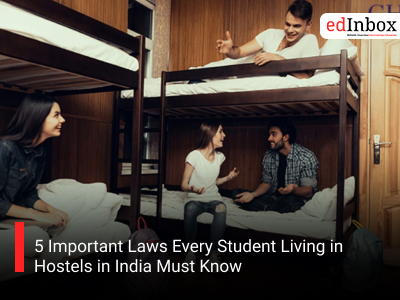
Staying in a hostel is an enjoyable and significant part of a students’ life. It’s an important lesson of independence, responsibility, and provides an opportunity to socialize with individuals of a different background. However, together with the freedom, living away from home, students also need to know some of the laws that guarantee their rights and ensure they stay safe. These laws let you feel safe in the hands of the Indian legal system and knowing them can keep you away from any trouble and defend their rights without being scared.

5 major laws that every student staying in hostels in India should know

The Right to Safety & Protection from Harassment: The Protection of Children from Sexual Offences (POCSO) Act, 2012 & Indian Penal Code (IPC) Sections on Sexual Harassment

The basic right of students who live in hostels is to be free of harassment and abuse. The POCSO Act has been very powerful in giving a legal shield to minors (under 18 years of age) against sexual acts such as harassment or any assault. Students who are older than 18 have rights against any type of molestation, stalking, or sexual harassment as enforced by the IPC.

In case a student encounters unacceptable physical touch by another student or employee or vexing comments, he/she can submit a police complaint and the offender may be penalized under such acts. Hostels will be expected to sustain a safe environment and prevent such behaviour.

Right to Privacy: Indian Constitution, Article 21 (Right to Privacy)

Every human being is entitled to privacy and this is also the case with schooling students living in hostels. In various words, neither the government nor your fellow students or hostel authorities should intrude in your personal space or even touch your personal property without your consent.

For example, If hostel staff enter your room or check your personal items without informing you or valid reason, it can be challenged legally as an invasion of privacy. But there are exceptions when the safety checks are actually legitimate or there is an emergency situation on board.

Right to Freedom and Expression of Religious Rights: Indian Constitution Article 19(1)(a) and 25

As the students come from diverse backgrounds, this law protects their beliefs and practices ensuring there is no discrimination or interference as long as it doesn’t affect others. 

For example, if a student is celebrating janamastami, diwali, eid, etc. they are allowed to do so until they are not forcing others to celebrate with them or doing something that is harming the rights of others.

Right Against Discrimination: Indian Constitution, Article 15

On the basis of caste, religion, gender, or place of origin, it is unlawful to discriminate against anybody in any public place which even hostels are. Hostels are not allowed to reject your entry or discriminate against you based on your person.

For example, when a hostel denies one a room or limits its facilities due to gender or religion, then Article 15 is violated. To seek help, you may contact legal authorities or even write to higher persons in authority and get it sorted.

Cyber Safety and Online Conduct: Information Technology Act, 2000 & IPC Sections on Cyber Crimes

In this digital era, the students tend to post pictures, videos, or messages on the internet. The IT Act guards against cyberbullying, harassment and distribution of obscene or offensive content. Using videos or pictures without the consent of the other party is also illegal.

For example, when someone who is your classmate and equals you in age posts indecent pictures of you online or popularizes rumours on social networks, you can make a complaint within the framework of cyber laws. The hostel must also ensure its strategies are geared towards prevention and solution of cyber harassment among its students. 

The Importance of Knowing these Laws

Laws knowledge can be of benefit to students of hostels: 

  1. Protect against abuse, discrimination, or right violation.
  2. Stand up and say something when injustice is practiced. 
  3. Maintain a respectful living environment that is safe.
  4. Engage disputes legally instead of allowing matters to come fully blown.

In conclusion, Always read and understand the hostel's rules, they should align with the law.

In case you or someone is being harassed or discriminated against, it is important to report it to authorities or adults you trust as soon as possible. It is necessary to remember that the law is in your favor and will help you to guarantee your safe, impartial, and joyous stay. 

Simply put, a hostel is the new home and one has the right to stay peacefully in a hostel. Being familiar with these laws will give you the confidence that you can hold onto your rights and concentrate on your studies and personal development in a positive environment.

The Supreme Court on Monday was agitated over the wave of suicides among students in leading educational institutions and took suo motu cognizance of the two recent cases involving IIT-Kharagpur and Sharda University. The Court stated that "something is seriously wrong with the educational system" and ordered both the universities to submit in-depth reports.

A bench headed by Chief Justice warned institutions that they could be held in contempt if they failed to file FIRs within time. "It is not an isolated case. We need to know why the students are being pushed to take extreme steps," the bench observed.

The accident is the sequel to the sudden death of Ritam Mondal, who was a fourth-year student of IIT-Kharagpur studying mechanical engineering, and was spotted hanging from the ceiling of his hostel room on July 18. He is the fourth student to have committed suicide this year on the campus. IIT officials also stated that Mondal's recent behavior showed no indication of mental turmoil. A fact-finding committee has been formed, and the institution assured full cooperation with the ongoing investigation.

Another student suicide at Sharda University has joined the chorus of criticism against the campus mental health care and pressure-cooker academic environment in Indian higher education.

The Court has directed the two universities to submit detailed reports on student welfare mechanisms, grievance redressal mechanism, and past history of any such incidents. The case has been adjourned for further hearing next Monday.

The Supreme Court action is a testament to growing judicial alarm about student mental health, forcing colleges to reconsider the emotional and psychological price of college life—and move quickly before lives are lost once more.

The country has experienced a type of political occasion that has rarely been seen, the resignation of the Vice-President Jagdeep Dhankhar way before his tenure ended. The step has raised a lot of concerns concerning the constitutional process of the country and the way forward. 

Who Takes over the Vice-President Now?

The Indian Constitution has not envisaged an acting Vice-President. Nevertheless, given that the Vice-President happens to be the ex-officio Chairman of the Rajya Sabha (Upper House of Parliament), the onus to preside over the House, albeit temporarily passes to the Deputy Chairman. At this point, the Deputy Chairman, Harivansh Narayan Singh will assume the mantle and make sure that work of the Rajya Sabha would proceed.

When Will the Election Take Place?

The Constitution sets no timeline of a maximum in which the Vice-President position should be filled unlike the case with the President job which requires a vacancy to be filled within six months. All that the constitution demands is that the election should be held as soon as possible. This very vital poll will be announced by the Election Commission of India. The poll is conducted in compliance with the Presidential and Vice-Presidential Acts of 1952, as per the set standards of parliamentary procedures.

How Many Years will the New Vice- President Serve?

The individual that is appointed to be a new Vice-President does not merely finish the term of Dhankhar. New candidates on the other hand will have completed a full term of five years on the date of assuming office. The habit assures stability and keeps the sanctity of the constitutional posture.

What is the Election of the Vice-President?

And here is what happens in the time of a Vice-Presidential election:

  1. Electoral College: It is made up of the members of both Houses, Lok Sabha and Rajya Sabha as well as the nominated members. This is devoid of state legislatures. 
  2. Voting Process: The process of voting takes place on a secret ballot at the Parliament House, where a proportional representation based on a single transferable vote is adopted. The voters are ranked through the preference of MPs by rank and each vote is equally valued.

Winning Quota: A candidate has to win a mathematical quota to win: Quota=(Total Valid Votes/2)+1 

Fractions (where you have them) are disregarded. Otherwise, in the case where nobody gets to this threshold in the initial count, the candidate who has the least number of first-preference votes is excluded, and their votes are handed to other contestants depending on the second choice vote; the same procedure is repeated until one of them surpasses the quota. 

Eligibility criteria for Vice president 

  • Must be 35 or above
  • Must be a citizen of India.
  • Must qualify as a member of Rajya Sabha.
  • Must not hold any office of profit under the state or central government.
  • Must be registered as an elector in any parliamentary constituency.

The resignation of the vice president after the middle of his term is a big thing but there is no risk of the discontinuity of the administration because of the Constitution and the Indian parliamentary practices. The processes demonstrate the flexibility of Indian democracy, as it offers a smooth transition, even in an exceptional case. The next election is not only going to fill a gap but it will also commence a new term of the second highest constitutional office that the post of Vice president holds in India.

The National Commission for Scheduled Tribes has ordered the Indian Institute of Technology, Bombay (IIT-B) not to displace tribals of Bhangshila Pada without due process of law.

In its order on May 26, 2025, it also ordered action to be taken under different sections of the Scheduled Castes and Scheduled Tribes (Prevention of Atrocities) Act against people who were obstructing the supply of water and electricity and the tribals' access road.

The battle for land ownership between the institution and the tribals commenced in 2007. In Jan this year, IIT-B, citing a Bombay High Court judgment of Jan 2, 2025, declared the tribals were in illegal and unauthorised occupation of land (Survey No. 22 and CTS No. 67) and claimed IIT-B to be the owner of the land. The notice threatened the tribals withforcible eviction in accordance with law for not vacating.

The tribals, therefore, issued a legal notice to the institution stating that they have been in unbroken possession of the land ever since the British period. Two years back, the Sarpanch of the village, Meena Raote, complained to the Commission that in 2007, after a Memorandum of Understanding (MoU) between IIT-B and the Mumbai Metropolitan Region Development Authority (MMRDA), the tribals were held as encroachers and were being forcibly removed. Raote asserted that the property card is in her grandfather's name but there is no basic infrastructure. She added that according to a 2013 biometric survey, the tribal families are being termed encroachers.

The Commission, in 2023, instructed the suburban collector of Mumbai to file a report. In its report, the collector noted that 10,000 square meters of land belonging to IIT-B was purchased for the Jogeshwari-Vikhroli Link Road widening project. 137 slum residents were found in a survey conducted by NGO SPARC in 2010, and 97 accepted rehabilitation while others, including some tribal families, declined.

The Commission had conducted a hearing in May this year and directed a stay against the eviction of the tribals. In another turn of events, the Kurla Tehsildar instructed the BMC not to seal off the entry road to Bhangshila Pada."The Bhangshila Tribal Pada habitations are old and for their minimum necessities, an ambulance entry, domestic use of gas cylinder, and movement of other daily necessities is required. Therefore, to seal their entry is not appropriate. Thus, they shall be allowed to go in and out by your security," states the letter. IIT-B has been requested by the panel to provide documents proving its land ownership.

More Articles ...